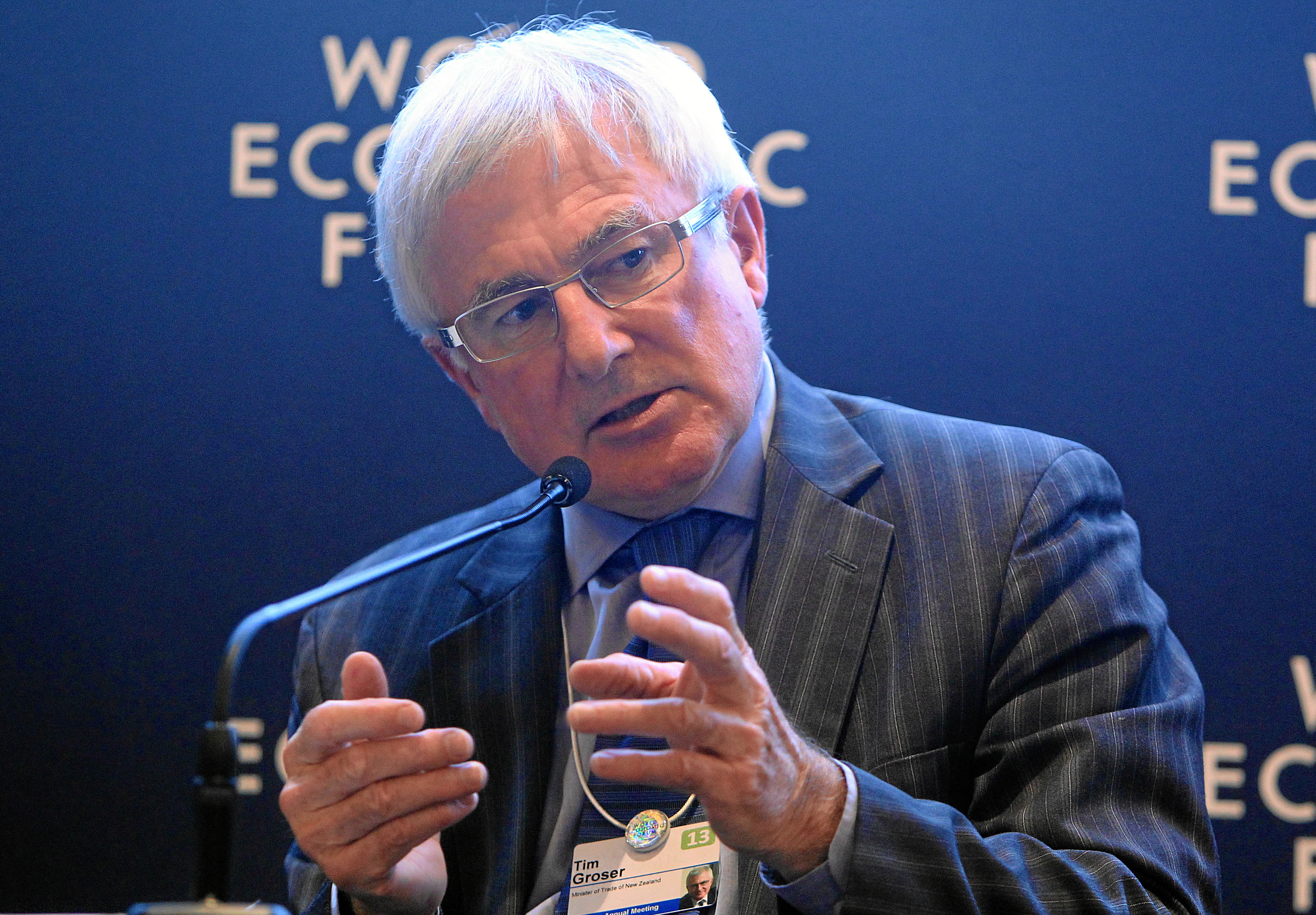
Tim Groser
Former Minister for Climate Change of New Zealand
11
APPEARANCES
8
PODCASTS
Aug 17, 2026


Tim GroserGUEST
I'm a huge fan of wind and solar, but they themselves cannot do this transition because of the issue of what's called the base load.
Tim GroserGUEST
If you have a hundred megawatt solar power plant, on a bright sunny days, it'll produce more or less 100 megawatts per hour.
19 MINS LATER


Corin DannHOST
So we're probably stuck with this till at least the end of this, um, term in the US.
Tim GroserGUEST
Well, I think that's probably right, but let's step back and look at what is the actual impact of this on our economy, and I mean, there are two separate issues.
Tim GroserGUEST
I don't want to get into long-term systemic issue, which is the more serious problem for us around what does it mean to have the world's largest economy walk away basically entirely from a rules-based system and the norms under it.
Tim GroserGUEST
In terms of the impact this latest twist has, I'd use the word negligible on our economy.
Tim GroserGUEST
Uh, the reason being this: first of all, and this is to be welcomed, the, about 30% of our exports, including our most important exports like beef and kiwi fruit and some other products, are exempted from these, uh, new tariffs.
Tim GroserGUEST
That has always been the case since this president decided to raise tariffs and move down this protectionist path.
Corin DannHOST
We, we keep working on, on new agreements, multilateral agreements, whatever, outside of the US.
Tim GroserGUEST
In terms of the impact this latest twist has, I'd use the word negligible on our economy.
Tim GroserGUEST
Uh, the reason being this: first of all, and this is to be welcomed, the, about thirty percent of our exports, including our most important exports like beef and kiwi fruit and some other products, are exempted from these, uh, new tariffs.
Tim GroserGUEST
That has always been the case since this president decided to raise tariffs and move down this protectionist path.
Tim GroserGUEST
The second thing is that they replaced tariffs of ten percent, so ten to twelve point five, look, it's, it's negligible.
Tim GroserGUEST
Now, individual exporters who might be listening to you and me, Corin, might be angry because it'd have more impact on their particular company, and so on and so forth, so I recognize that.
Corin DannHOST
We, we keep working on, on new agreements, multilateral agreements, whatever, outside of the US.


Nicholas KralevHOST
Generally, when you look at the state of American power, both hard and soft power, do you believe this conflict with Iran has strengthened it, diminished it? Where are we on that front?
Tim GroserGUEST
Well, I think a lot about this issue at both a high level and then particularly with respect to my two areas of expertise, which is international trade strategy and climate change.
Tim GroserGUEST
My view, and I think it's a very orthodox one, is that the United States has used over the last 75 years its immense power in an incredibly constructive way.
Tim GroserGUEST
I mean, of course, one could pick out all the exceptions to that if that's the way your mind works.
Tim GroserGUEST
But I would describe, I mean, when the United States in 1945 looked at the world, It was amongst the countries with real power, the last man standing.
Tim GroserGUEST
Even the other so-called victors, Russia, France, and the United Kingdom, were left shattered economically and with many, many political problems, quite apart from the two Axis powers, Japan and Germany, that were essentially completely destroyed and had to reinvent themselves.
Nicholas KralevHOST
How do you look at the current situation when it comes to the ability of the United States to project this power and also its ability to influence

speaker_1HOST
Can this be done?
Tim GroserGUEST
We'll find out, you know, how many of these higher fruit, we picked the lower fruit first, of course, can be harvested in the next five or six years.
speaker_1HOST
Why these countries?

Tim GroserGUEST
Um, we'll find out, you know, how many of these, um, higher fruit, we've picked the lower fruit first, of course, can be harvested in the next five or six years.

Tim GroserGUEST
We'll find out, you know, how many of these higher fruit, we pick the lower fruit first, of course, can be harvested in the next five or six years.

Tim GroserGUEST
Um, we'll find out, you know, how many of these, um, higher fruit, we've picked the lower fruit first, of course, can be harvested in the next five or six years.
Tim GroserGUEST
Well, I think it goes down to my metaphor, the conventional metaphor of picking the, the, the easier hanging fruit at the bottom of the tree.

Tim GroserGUEST
First of all, these countries are the countries which are either currently reasonably important or potentially very important in the long run, but we haven't got specialised trade agreements.
Tim GroserGUEST
With respect to the European, the small lifter countries, this is plugging the gaps in what is now a very good result for our country.
Tim GroserGUEST
We've got a very comprehensive high quality deal with the UK after they withdrew.

Jesse MulliganHOST
Do you think that that was kind of a sliding doors moment, that the rest of the world had this sort of startling realisation that actually you can't take anything for granted now and you've got to take care of number one and maybe the world of global trade will never be the same?

Andy ThompsonHOST
So for people who don't know what that is, why was that so important to New Zealand agriculture? What did that mean?
Tim GroserGUEST
We've got to go through a little bit of economic history lesson here, Andy, so the younger folk that might be listening can understand just what a dramatic situation our country faced when Britain went into the then EEC, as we used to call the EU in 1973, and we were up the creek without an economic pattern.
Tim GroserGUEST
So the thing that our farming community probably does understand is that economically we were developed after the colonial period as an offshore farm for Britain.
Tim GroserGUEST
And in an imperial system like this, We were actually part of the British food supply system.
Tim GroserGUEST
And so instead of the Brits, who were then the leading industrial power in the early 20th century, having all their farms in Sussex and southern England, they had a disproportionate number of them in New Zealand.
Tim GroserGUEST
which had very similar growing conditions and, of course, a culture that they inhabited by English-speaking people for the most part.
Tim GroserGUEST
So we didn't give a damn about the international trading system from 1945 through to 1975, because in 1950, would you believe 90% of our total exports went to Britain? 90%.
15 MINS LATER
Andy ThompsonHOST
It wouldn't take long or it wouldn't take much for it to go back the other way, would it? And then we could be quite exposed.

Andy ThompsonHOST
So for people who don't know what that is, why was that so important to New Zealand agriculture? What did that mean?
Tim GroserGUEST
We've got to go through a little bit of economic history lesson here, Andy, so the younger folk that might be listening can understand just what a dramatic situation our country faced when Britain went into the then EEC, as we used to call the EU in 1973, and we were up the creek without an economic pattern.
Tim GroserGUEST
So the thing that our farming community probably does understand is that economically we were developed after the colonial period as an offshore farm for Britain.
Tim GroserGUEST
And in an imperial system like this, We were actually part of the British food supply system.
Tim GroserGUEST
And so instead of the Brits, who were then the leading industrial power in the early 20th century, having all their farms in Sussex and southern England, they had a disproportionate number of them in New Zealand.
Tim GroserGUEST
which had very similar growing conditions and of course, a culture that they inhabited by English speaking people for the most part.
Tim GroserGUEST
So we didn't give a damn about the international trading system from 1945 through to 1975, because in 1950, would you believe 90% of our total exports went to Britain, 90%.
15 MINS LATER
Andy ThompsonHOST
It wouldn't take long or it wouldn't take much for it to go back the other way, would it? And then we could be quite exposed.