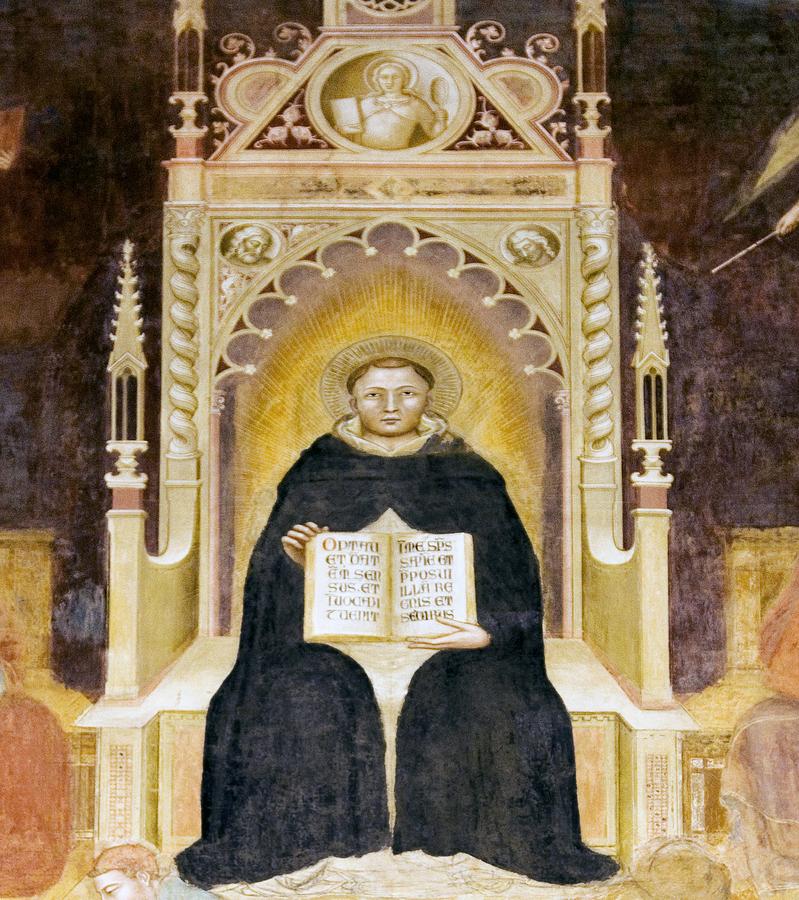
Thomas Aquinas
Italian friar and priestWikipedia
1.8k
MENTIONS
704
EPISODES
465
PODCASTS
Search complete. 1841 mentions across 704 episodes found for "Thomas Aquinas".
Sep 22, 2026

Joel WebbonHOST
... a noticer.
Joel WebbonHOST
Uh, this is the view of Aquinas.
Joel WebbonHOST
Um, this is the view of pretty much everyone, and I'm pretty sure, I could be wrong, but I'm pretty sure it is the view of Eastern Ors- Orthodox, uh, divines, theologians, and philosophers.
Joel WebbonHOST
Um, if it's not, because when I say Aquinas and Augustine, that, that means it's Protestant and Catholic.
Wesley ToddHOST
Right.
Joel WebbonHOST
Does not necessarily mean that it's Eastern Orthodox, because just for our listeners to keep in mind, if you're not aware of this, a good thing to keep in mind, uh, this is where we share much...
Joel WebbonHOST
But neither of us is saying, "Well, you can have Augustine, 'cause ew." No, we're both saying, "Augustine, awesome.
Joel WebbonHOST
I want him." "No, I want him." Protestants and Catholics.

Thomas DavenportGUEST
I had not originally intended to give two talks this week, but it's my own fault.
Thomas DavenportGUEST
But I'm very happy to be speaking to you today on experiments in Aquinas.
Thomas DavenportGUEST
Now, I'm being cheeky here.
Thomas DavenportGUEST
There is a word, experimentum, that Aquinas uses.
Thomas DavenportGUEST
If you read Aquinas in English, you will never see the word experiment, because experimentum is almost always in English translated as experience, and in one sense that is a better translation, because Aquinas is not thinking about experiments in the contemporary context of making a fancy device to test things.
Thomas DavenportGUEST
And yet, again, in my perhaps rose-colored glasses, there's a sense in which his notion of experiment, which is much deeper than the general sense of experience that we would take for granted, actually comes close to, or at least is important for, I think, getting a sense of how experiments help us to understand the natural world.
Thomas DavenportGUEST
And so that's what I'm hoping to do today.
Thomas DavenportGUEST
So I won't actually be talking about making physical devices, but I'm going to be talking about an important aspect of how Aquinas understands how we learn about the world around us and the natural world.

Conor DonnellyHOST
So notice how Prudence discerns the true good, not the false goods, the authentic, deep, profound, true good in every situation, in every decision, in every circumstance.
Conor DonnellyHOST
prudence also chooses the right means to achieve it not just any means the best means most fruitful means most efficient most economical the book of proverbs says the prudent person looks where they're going saint thomas aquinas says and the prudence is recta ratio agibilium it's the right reason in action right reason applied to practice right reason in doing, ordering things according to their end or their purpose.
Conor DonnellyHOST
Doing things or using things for the purpose for which they have been created.
Conor DonnellyHOST
And so it's the virtue that has as its object to tell us what to do in each particular case.

Paul VanderKlayHOST
Because actually, your saints and heretics are closer together than what anyone might think.
Paul VanderKlayHOST
Because don't forget, Thomas Aquinas was studying Aristotle when Aristotle was banned by the Roman Catholic Church.
Paul VanderKlayHOST
And Thomas Aquinas wasn't always Thomas Aquinas.
Paul VanderKlayHOST
the way he's considered now.
Paul VanderKlayHOST
And saints and heretics always have that edge to them.

BrianHOST
You realize they are not just words we made up, they're real and solid, existing beyond our labels and names.
BrianHOST
The great medieval philosopher and theologian Thomas Aquinas believed in a heartfelt realism over and against nominalism.
BrianHOST
He suggested that universal truths are eternally present in the divine mind before they find expression in the physical world.
BrianHOST
When we talk about justice or love, we're not just creating practical social rules.

Bill WieseGUEST
And our sin actually deserves eternity in hell.
Bill WieseGUEST
And Thomas Aquinas said this.
Bill WieseGUEST
He was considered the greatest theologian of the medieval church.
Bill WieseGUEST
He said the higher the position the one sinned against, the graver the sin.

Dark ChildAUDIENCE
Let me just...
Dark ChildAUDIENCE
Okay, so when St. Thomas Aquinas says, the Jews, by reason of their faults, are sentenced to perpetual servitude, am I, like...
Dark ChildAUDIENCE
What is that? Doesn't he say that?
E. Michael JonesHOST
Rejection of logos.

Jim PapandreaHOST
He actually says this several times throughout his writings, including also in The Practice of the Love of Jesus Christ.
Jim PapandreaHOST
And in case you don't believe him, he quotes St. Teresa of Avila to back him up, as well as St. Thomas Aquinas.
Jim PapandreaHOST
Commenting on scripture passages about prayer and perseverance, St. Alphonsus says, Those who do not ask with perseverance will not persevere.
Jim PapandreaHOST
He wrote guidelines for priests when hearing confessions and manuals to help priests with their own spiritual growth and to catechize the laity and teach them how to pray.
Jim PapandreaHOST
And this requires a priest hearing confessions to know the teachings of the church, but it also requires them to know people and what their people are really capable of, so as not to burden them with penances they will never carry out.
Jim PapandreaHOST
And St. Alphonsus found this balance by the combination of his rigorous training on the one hand, and his experience as a missionary with real people on the other.
Jim PapandreaHOST
And his moral theology would become the Catholic standard, making him a kind of counterpart to Aquinas, And this is actually the biggest part of his legacy as a doctor of the church.
Jim PapandreaHOST
What Thomas Aquinas was to philosophical theology, Alphonsus Liguori was to moral theology.

Alan NobleGUEST
That's just, that's just, it's circular logic.
Alan NobleGUEST
But, But then I read a Thomas Aquinas scholar who taught me that we love ourselves because God first loved us.
Alan NobleGUEST
And we don't know better than God.
Alan NobleGUEST
If God loves us and he sees all our flaws, then we should love ourselves.

Terry BarberHOST
One, he wants to thank the Blessed Virgin Mary big time.
Terry BarberHOST
Two, he wants to have some questions for Thomas Aquinas and also some of the Greek fathers questions about philosophy and then he said after my third one I want is after I take a little rest in heaven because I didn't rest much on earth I'm going to ask the good Lord to send me back down to bring souls back to the church
Jesse RomeroHOST
And that's exactly what he's doing now.
Terry BarberHOST
All right, Bella Dodd, folks, New York attorney, member of the Communist Party, USA, was another Sheen pupil.
694 more episodes mention Thomas Aquinas.
Create an account to see the whole feed, search across every transcript, and follow the entities you care about.