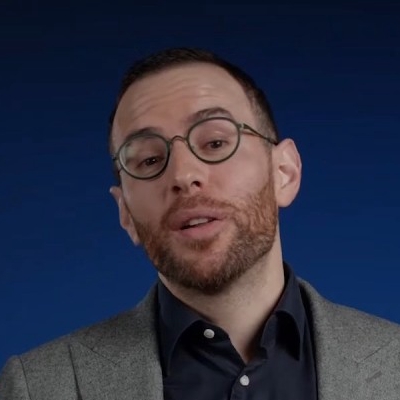
Thales Teixeira
Former Harvard Business School professor of marketing (10 years), now Professor of Practice at UC San Diego's Rady School, co-founder of Decoupling.co/Decomposer.ai, and author of "Unlocking the Customer Value Chain."
7
APPEARANCES
1
PODCASTS
Oct 15, 2026

Yunjoo ShinHOST
I would like you to explain the three types of decoupling that you mentioned in the book.

Thales TeixeiraGUEST
Any industry that there's decoupling, it can be classified into value creation decoupling, value capturing decoupling, or value eroding decoupling.
Thales TeixeiraGUEST
Twitch, it doesn't allow you to play ga- the game, it allows you to watch somebody else playing the game.
speaker_1ADVERTISER
See visible.com for details.
Thales TeixeiraGUEST
This is what I teach Harvard students and University of California students in the first day of an MBA course.
Thales TeixeiraGUEST
The customer value chain are the series of activities that we as customers are required to do in order to acquire, use, and dispose of goods and services.
Thales TeixeiraGUEST
So for instance, if you want to get a checking account, you need to look at all of the available options of banks that can offer you a checking account.
Thales TeixeiraGUEST
Then you go to a bank branch, and then you apply for a checking account, you provide documents, and then they'll give you a checkbook and other materials so you can open an account, have a checking number.
Thales TeixeiraGUEST
After an early stage founder maps out the customer value chain, the next step is identifying the weak link in the customer value chain.
speaker_1ADVERTISER
Visit thehartford.com/riskmitigation to learn more.
Thales TeixeiraGUEST
And what PillPack realized is that if you have to buy and consume many pills per day, it's a very complicated process.
Thales TeixeiraGUEST
And they mapped out the customer value chain as going to the doctor, getting tested, receiving a prescription, then going to the pharmacy, paying for the medication.
Thales TeixeiraGUEST
And then once you figure out all of this, you have to create a plan to remember what time of day to take the medication.
speaker_2ADVERTISER
See visible.com for details.
Thales TeixeiraGUEST
He was saying one of his board members told him the people he should be looking to hire are unemployed.
Thales TeixeiraGUEST
He said, "Why hire unemployed people?" One, because they're the only people who have bandwidth to actually be experimenting and trying and learning new skills.
Thales TeixeiraGUEST
And two, they have categorically learned that their existing skill set is insufficient for the future.
Thales TeixeiraGUEST
And I think right now, as regards to building AI muscles, what most people think is they're going to wait till their boss tells them to do something.
speaker_2ADVERTISER
Consult a healthcare professional if symptoms persist.
Thales TeixeiraGUEST
I always begin the classes by asking questions, not writing down math equations, right? Not going into the details, but just intuitively based on everything that you've seen, you've done, what do you think? I ask them simple cases.
Thales TeixeiraGUEST
For instance, if you were to design for a fire alarm, when should it say that there is fire or not? That's something you can change, right? You can put a threshold in what level of smoke or when does it think it's smoky, and that's a very practical question.
Thales TeixeiraGUEST
And sometimes I see with students who may not have the mathematical training, but they're very intuitive and practical.
Thales TeixeiraGUEST
They may be like, "Oh, I would go and measure how noisy it is," or, "I would show different levels of smoke, have like candles of different sizes and go and test it." Many times people already may be somewhat aware of this, so they have some intuitive ideas, so that already is a good starting point.
Thales TeixeiraGUEST
They have an intuition, but that's a wrong intuition, which is still okay because intuitions are not always the only answer.
Yunjoo ShinHOST
I would like you to explain the three types of decoupling that you mentioned in the book.
Thales TeixeiraGUEST
Any industry that there's decoupling, it can be classified into value creation decoupling, value- ... capturing decoupling or value eroding decoupling.
Thales TeixeiraGUEST
Twitch, it doesn't allow you to play ga- the game, it allows you to watch somebody else playing the game.
Thales TeixeiraGUEST
So playing a game is a value creating activity, we all know that, but watching the game being played is a value creating activity.
speaker_4ADVERTISER
Consult a healthcare professional if symptoms persist.
Thales TeixeiraGUEST
value-capturing activities is this idea that has become the standard of mobile games, which is the freemium model.
Thales TeixeiraGUEST
You can decouple those activities and just play the game until you realize that you like it.
Thales TeixeiraGUEST
Fortnite is one of the biggest examples of decoupling value-capturing activity from a value-creating activity of playing the game.
7 MINS LATER
speaker_4ADVERTISER
Consult a healthcare professional if symptoms persist.