Telecommunications Act of 1996
33
MENTIONS
28
EPISODES
27
PODCASTS
Search complete. 33 mentions across 28 episodes found for "Telecommunications Act of 1996".
Nov 4, 2026

Harold Ford Jr.PANELIST
What did he do after that? He passed welfare reform.
Harold Ford Jr.PANELIST
He passed the Telecommunications Act, and he passed the Balanced Budget Act.
Dana PerinoHOST
The cops program.
Harold Ford Jr.PANELIST
He did.

Glenn DiesenGUEST
So I think there's already building some opposition, but still below the political level so far.
Jimmy DoreHOST
Is there any independent media of any, you know, like in the United States in 1996, Bill Clinton passed the Telecommunications Act.
Jimmy DoreHOST
So we used to have 50 giant media companies.
Jimmy DoreHOST
They were already giant and consolidated.

Erin RileyGUEST
Corporate greed and people who are not music people and deregulation and laws and things that are not favorable to the old style of radio is so competitive and just people, the bottom line, the financial bottom line is all that really matters.
Erin RileyGUEST
And the odd thing that I did feature in the book and I learned from doing my research is that radio stations that were all purchased in 1996 and all of the big turnover with the Deregulation Act, the Telecommunications Act of 96, is that they put the debt, like all of the purchases, they put the debt on the radio station.
Erin RileyGUEST
You know, give you a comparison.
Erin RileyGUEST
What if you bought a house and the debt was on the house? Not you.

Jill LeporeGUEST
But by the time you get to the 1990s and the Declaration of Independence of Cyberspace, that John Perry Barlow manifesto from 1996, libertarians have really won the day.
Jill LeporeGUEST
The Telecommunications Act of 1996 is written by them, and it says this will be a lawless space, which is exactly what the libertarians wanted.
Jill LeporeGUEST
And that model is really well set up for social media.
Jill LeporeGUEST
So when social media is rolled out, people are like, this clearly is also going to be a lawless space.

Tyson SlocumGUEST
It's a drought in the Pacific Northwest.
Tyson SlocumGUEST
It's after effects of the Telecommunications Act.
Tyson SlocumGUEST
And we all have computers that are using electricity.
Tyson SlocumGUEST
Once the Enron tapes got into the public domain, it changed that debate overnight that we saw that a company intentionally created power shortages for the sole purpose of making electricity scarce to drive prices up so that they could make bigger profits.

speaker_3NARRATOR
Yet the parallels between Netscape and OpenAI extend into politics, Just like how the Trump administration has anchored its strategy to AI, the Clinton administration architected the information superhighway.
speaker_3NARRATOR
Through the 1991 High Performance Computing and 1996 Telecommunications Act, the federal government provided legal protection, waived regulation for dot-com companies, and mandated Netscape as the browser of choice for millions of students and government employees.
speaker_3NARRATOR
At the same time, the Clinton administration advocated for Netscape browsers, Cisco switches, and Sun servers abroad so that the U.S. could dominate this emerging web.
speaker_3NARRATOR
And when Microsoft began bundling Internet Explorer for free into Windows, the DOJ launched an antitrust lawsuit as a taxpayer-funded attempt to protect Netscape.

Miriam EckenfelsGUEST
And so, 704 No More is an initiative that tries to sort of like slow down the uncontrolled rollout of cell tower infrastructure and 5G poles across the US.
Miriam EckenfelsGUEST
And the reason it's called 704 No More is because Section 704 of the Telecommunications Act of 1996 prohibits, expressly prohibits local authorities that have to deal with where to place these cell towers from considering the health and environmental impact of the radiation.
Miriam EckenfelsGUEST
So when you, as a local zoning authority, are receiving an application from a telecom carrier, like, hey, I want to build a cell tower next to this school, or I want to build a cell tower in the right-of-way, in the public right-of-way in front of this home, and make no mistake, like, we are talking sometimes, we have clients where the cell tower is two feet away from their property line.
Miriam EckenfelsGUEST
Oh, my God.

Robyn Roxanne KincaidHOST
It's the rise of Fox News, TV, Radio Rwanda.
Robyn Roxanne KincaidHOST
It's the Telecommunications Act of 1996.
Robyn Roxanne KincaidHOST
I mean, everything is part of it.
Robyn Roxanne KincaidHOST
But it's all part of why we got this stupid this fast.

Julian DoreyHOST
right, we got it.
Julian DoreyHOST
So the Telecommunications Act of 1995 was a sweeping legislative effort that set the stage for modern telecommunications.
Julian DoreyHOST
While introduced and heavily debated throughout 1995, it ultimately passed and was signed into law in 1996.
Julian DoreyHOST
So, the core goals of the bill, the primary objective of the legislation was to foster competition, reduce government regulation, key elements included, let's go down, market integration, allowing long-distance carriers like AT&T, local phone companies, and cable operators to compete in each other's markets, deregulation, removing federal controls on cable TV pricing.

Jill LeporeGUEST
And then with the internet, that kind of vibe really finds a purchase in an alliance with the resurging conservative movement.
Jill LeporeGUEST
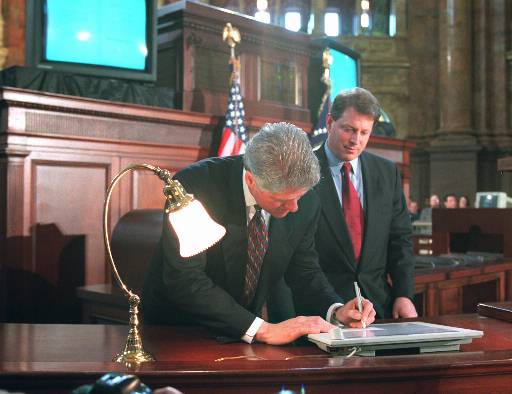
So Newt Gingrich, with his contract with America, is really behind the 1996 Telecommunications Act that Bill Clinton signs, but that says the Internet is basically beyond the realm of law.
Jill LeporeGUEST
This guy, John Perry Barlow, who is a very important counterculture figure, writes this Declaration of the Independence of Cyberspace.
Jill LeporeGUEST
He's like, you guys don't understand what we're building here, this cyberspace.
18 more episodes mention Telecommunications Act of 1996.
Create an account to see the whole feed, search across every transcript, and follow the entities you care about.