Tarawa
Capital of KiribatiWikipedia
105
MENTIONS
40
EPISODES
35
PODCASTS
Search complete. 105 mentions across 40 episodes found for "Tarawa".
Sep 19, 2026

Aaron BennettNARRATOR
A fifth generation samurai, handpicked and personally extolled by the emperor, Kuribayashi combined combat experience with an innovative mind and an iron will.
Aaron BennettNARRATOR
although this would be his only combat against american forces he had learned much about his prospective opponents from earlier service in the united states more significantly he could appraise with an unblinking eye the results of previous japanese attempts to repel american invasions of japanese-held garrisons Heroic rhetoric aside, Kuribayashi saw little to commend the defend-at-the-water's-edge tactics and all-or-nothing bonsai attacks which had characterized Japan's failures from Tarawa to Tinian.
Aaron BennettNARRATOR
Kuribayashi, a realist, also knew not to expect much help from Japan's depleted fleet and air forces.
Aaron BennettNARRATOR
His best chances, he concluded, would be to maximize Iwo's forbidding terrain with a defense in depth along the pattern of the recent Bayak and Peleliu defensive efforts.
Aaron BennettNARRATOR
But Kuribayashi's force was twice that size.
Aaron BennettNARRATOR
The men existed on half rations of water for months before the battle began.
Aaron BennettNARRATOR
Unlike earlier amphibious assaults at Guadalcanal and Tarawa, the Americans would not enjoy either strategic or tactical surprise at Iwo Jima.
Aaron BennettNARRATOR
Japanese strategists concluded Iwo Jima would be invaded soon after the loss of the Marianas.

Aaron BennettNARRATOR
By the beginning of 1944, United States Marine Forces had already made a dramatic start on the conquest of areas overrun by the Japanese early in World War II.
Aaron BennettNARRATOR
Successful American assaults in the southwest Pacific, beginning with Guadalcanal and the Solomon Islands in August 1942, and the Central Pacific at Tarwa and the Gilbert Islands in November 1943, were crucial campaigns to mark the turn of the Japanese flood tide of conquest.
Aaron BennettNARRATOR
the time had now come to take one more decisive step assault of the islands held by japan before nineteen forty one these strategic islands mandated to the japanese by the league of nations after world war i were a source of mystery and speculation outsiders were barred illegal fortifications were presumed yet any central pacific drive toward japan's inner defense ring had to confront these unknowns The obvious target to begin with was the Marshall Islands.
Aaron BennettNARRATOR
As early as 1921, a Marine planning officer had pinpointed their geographic significance.
37 MINS LATER
Aaron BennettNARRATOR
Early on the afternoon of the next day, 2 February, D plus 2, the 24th Marines finished its conquest of Namur and the island was declared secured.
Aaron BennettNARRATOR
in the final moments of combat however lieutenant-colonel aquila j dais commander of the first battalion was standing to direct the last attack of his men a burst of machine-gun fire riddled his body and he became the most senior officer to die in the battle for his superb leadership under fire he was awarded a posthumous medal of honor across the sand spit on roye it had been a different story this island was nearly bare for it was mostly covered by airfield runways when the twenty third marines hit the beaches on d plus one the fierceness of the pre landing bombardment prevented the japanese defenders from mounting a coordinated defense small groups of marine riflemen joined their regiments attached tanks in a race across to the far side of the island this charging style caused considerable confusion as to who was where reorganized into more coherent units the men made a final orderly drive to finish the job in spite of the rapid progress on roy there were still some major enemy strong points which had to be dealt with an after-action report of the second battalion described one example of this perilous work in matter-of-fact terms there was a blockhouse constructed of reinforced concrete approximately three feet thick it had three gun ports one each facing north east and west another indication of the enemy's mistaken assumption that the americans would attack from the sea rather than the lagoon shore two heavy hits had been made on the blockhouse one apparently by fourteen inch or sixteen inch shells and the other by an aerial bomb nevertheless the position had not been demolished the battalion commander lieutenant colonel edward j dillon then ordered company g to take the blockhouse the company commander first sent forward a seventy five millimeter half track which fired five rounds against the steel door at this point a demolition squad came up and its commander volunteered to knock out the position with explosives while the half track continued to fire infantry platoons moved up on each flank of the installation the demolition squad placed charges at the ports and pushed bangalore torpedoes through a shell hole in the roof cease fire was then ordered and after hand grenades were thrown inside the door half a squad of infantry went in to investigate unfortunately the engineers of the demolition squad had not got the word to cease fire and had placed a shape charge at one of the ports while the infantry was still inside luckily no one was hurt but as the company commander reported a very undignified and hurried exit was made by all concerned inside were three heavy machine guns a quantity of ammunition and the bodies of three japanese many japanese had to be flushed out or blown up in the airfield's drainage ditches and culverts but by eighteen hundred that day d plus one roy had been secured secured seemed a somewhat flexible term when the first service of mass held the next day was interrupted by japanese shots by six february however the ground elements of a marine aircraft wing were ensconced at the airfield preparing for the arrival of their planes in five more days for the entire remainder of the war these planes pounded the by-passed atolls with such power that the japanese on them were eliminated from any further role in the war there was one surprise japanese air raid on roi staged from the mariana islands on twelve february this caused a number of casualties and major damage to material the repair of the airfield and its quick return to action was a tribute to the skills of both the twentieth marines an engineer regiment and the one hundred ninth naval construction battalion this achievement was one more illustration of the vital role played by a dizzying list of units that supported the assault rifle battalions besides the vast armada of naval planes ships and landing craft there were navy chaplains and corpsmen two specialties which are always navy in addition to the marine air artillery and engineer units there were the tanks heavy weapons mortar transport quartermaster signals and headquarters supporting units an amphibious operation to be successful must be a finely tuned highly trained juggernaut that depends on all its parts working smoothly together and this was clearly demonstrated in the marshals The conquest of Roynamur had been a relatively easy operation when compared to some of the other Marine campaigns in the Pacific.
Aaron BennettNARRATOR
At Tarwa, for example, more than 3,300 men had been killed or wounded in 76 hours.
Aaron BennettNARRATOR
The 4th Division's victory came at a cost of 313 Marines and corpsmen killed and 502 wounded.
Aaron BennettNARRATOR
The 2nd Raider Battalion, under Lt. Col. Evans F. Carlson, had attacked Macon Atoll a year earlier.
Aaron BennettNARRATOR
Subsequent intelligence reports warn that the Japanese had fortified Basio Island in Tarawa Atoll, where elite forces guarded a new bomber strip.
Aaron BennettNARRATOR
Spruance said Basio would be the prime target for the 2nd Marine Division.
Aaron BennettNARRATOR
General Smith's operations officer, Lieutenant Colonel David M. Shoup, studied the primitive chart of Batio and saw that the tiny island was surrounded by a barrier reef.
Aaron BennettNARRATOR
General Smith could sense that Shoup's gifted mind was already formulating a plan.
Aaron BennettNARRATOR
The results of that plan were momentous.
Aaron BennettNARRATOR
The Tarawa operation became a tactical watershed.
Aaron BennettNARRATOR
The first large-scale test of American amphibious doctrine against a strongly fortified beachhead.

NealHOST
Kind
ScottHOST
of like you in Tarawa.
ScottHOST
That could be
StewHOST
one.
StewHOST
You know what I'm saying? Because you may, again, sort of like my example where you threw all your eggs in one basket.
StewHOST
Let's say like on the front.
StewHOST
Say you had like a couple good leaders in the bottom part of Tarawa.
StewHOST
And then you took a shit, you got slaughtered.

Douglas MacgregorGUEST
Well, we went through this, actually, a lot of people are unaware, but we went through something similar at the beginning of the Vietnam War, and there were some people that were very opposed to our intervention in Vietnam, and one of those was General Shoup, who was commandant of the Marine Corps.
Douglas MacgregorGUEST
And, uh, Kennedy and McNamara, and then subsequently L- LBJ and McNamara, were very upset because they wanted to get the Marines into the war, and Shoup, uh, was a man of great character, and he had won the Medal of Honor on Tarawa, so you didn't sort of casually remove General Shoup from his position as commandant of the Marine Corps.
Douglas MacgregorGUEST
But he said, "Look, the Marines do not, uh, they're not structured or organized or equipped to fight on land like the Army.
Douglas MacgregorGUEST
The, the Marines are a light strike force that go ashore for brief periods to seize ports and airfields and points of importance for the Army and the Air Force, but they're not a permanent ground force." That was his public position.

Norman CarusoHOST
The USS Liskam Bay was part of a larger task force, island-hopping around the Pacific and driving the Japanese Army back.
Norman CarusoHOST
On November 20, 1943, the USS Liskombe assisted with the marine landings at Tarawa and Macon, which resulted in U.S. victories.
Norman CarusoHOST
But four days later, on November 24, 1943, the Japanese struck back.
Norman CarusoHOST
Early that morning, a Japanese submarine torpedoed the starboard side of the USS Liskombe.

Grant SchofieldGUEST
This is, um, in the North Pacific.
Grant SchofieldGUEST
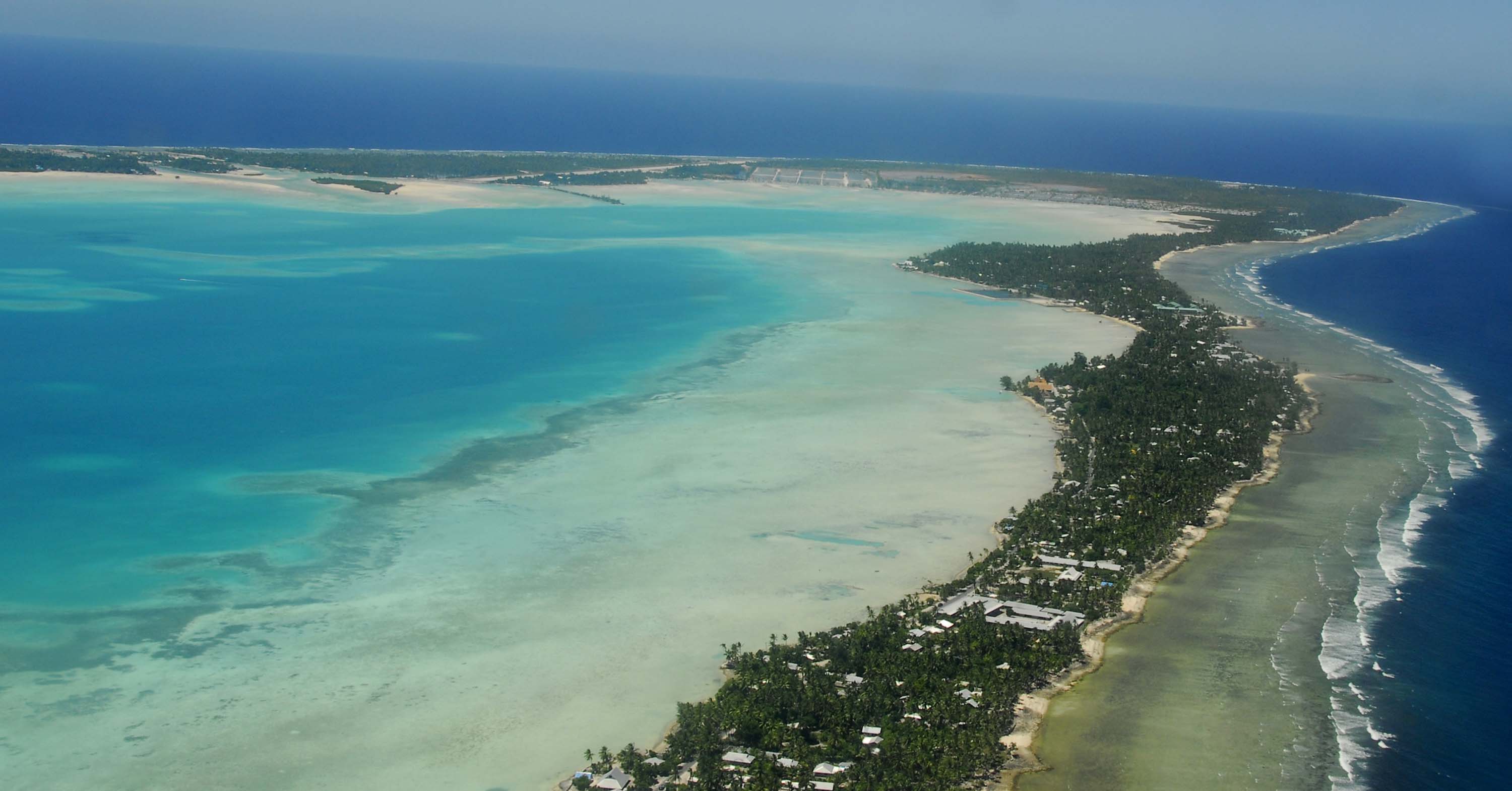
It's, uh, an island called Tarawa.
Grant SchofieldGUEST
It's part of a chain called Kiribati, which, uh, is most well-known, I think, for the Battle of Tarawa, a World War II battle where the Japanese were encamped on this island and the Americans pounded them, uh, a marine force for over a week this battle went on.
Grant SchofieldGUEST
And the population was decimated, but it had sat around a couple of thousand people for most of the time, the people that lived on this coral atoll.
Grant SchofieldGUEST
It's forty kilometers long, and it's about two hundred meters wide.

Aaron BennettNARRATOR
By the beginning of 1944, United States Marine forces had already made a dramatic start on the conquest of areas overrun by the Japanese early in World War II.
Aaron BennettNARRATOR
Successful American assaults in the Southwest Pacific, beginning with Guadalcanal and the Solomon Islands in August 1942 and the Central Pacific at Tarawa and the Gilbert Islands in November 1943, were crucial campaigns to mark the turn of the Japanese flood tide of conquest.
Aaron BennettNARRATOR
The time had now come to take one more decisive step, assault of the islands held by Japan before 1941.
Aaron BennettNARRATOR
These strategic islands, mandated to the Japanese by the League of Nations after World War I, were a source of mystery and speculation.
Aaron BennettNARRATOR
Original cautious plans for stepping stone attacks starting in the eastern Marshalls were modified, and the daring decision was made to knife through the edges and strike directly at Kwajalein Atoll in the heart of the Marshalls' cluster of thirty-two atolls, more than one thousand islands, and eight hundred sixty-seven reefs.
Aaron BennettNARRATOR
Kwajalein is the largest atoll in the world, sixty miles long and twenty miles wide, a semi-enclosed series of eighty reefs and islets around a huge lagoon of some eight hundred square miles.
Aaron BennettNARRATOR
Located six hundred twenty miles northwest of Tarawa and two thousand four hundred fifteen miles southwest of Pearl Harbor, its capture would have far-reaching strategic significance in that it would break the outer ring of Japanese Pacific defense lines.
Aaron BennettNARRATOR
Within the atoll itself, there were two objectives, Roi and Namur, a pair of connected islands shaped like weights on a four-mile barbell in the north end and crescent-shaped Kwajalein Island at the south end.
Aaron BennettNARRATOR
Originally, the buttons on the coat and the trousers were all copper-plated, but an emergency alternate specification was approved on 15 August 1942, eight days after the landing on Guadalcanal, which allowed for a variety of finishes on the buttons.
Aaron BennettNARRATOR
Towards the end of the war, a new, modified utility uniform which had been developed after Tarawa was also issued, in addition to a variety of camouflage uniforms.
Aaron BennettNARRATOR
All of these utility uniforms, along with Army-designed M1 helmets and Marine Corps-designed cord- and rubber-soled, rough-side-out leather boondocker shoes, would be worn throughout the war in the Pacific during the post-war years and into the Korean War.
Aaron BennettNARRATOR
Kenneth L. Smith Christmas LVT-1 The Amtrak While the Marine Corps was developing amphibious warfare doctrine during the 1920s and 30s, it was apparent that a motorized amphibian vehicle was needed to transport men and equipment from ships across fringing reefs and beaches into battle, particularly when the beach was defended.
Aaron BennettNARRATOR
The paddle treads on the tracks and the rigid suspension system were both susceptible to damage when driven on land and did not provide the desired speeds on land or water.
Aaron BennettNARRATOR
Although the LVT-1 performed admirably against undefended beachheads, its lack of armor made it unsuitable for assaults against the heavily defended islands of the Central Pacific.
Aaron BennettNARRATOR
This weakness was apparent during the fighting in the Solomon Islands, but LVT-1s with improvised armor were still in use at the assault on Tarawa, where 75% of them were lost in three days.
Aaron BennettNARRATOR
The LVT-1 proved its value and validated the amphibious vehicle concept through the great versatility and mobility it demonstrated throughout numerous campaigns in the Pacific.

Damon QuinnHOST
Yeah, and they'd seen what had happened.
Damon QuinnHOST
Tarawa, all that sort of stuff.
Damon QuinnHOST
Iwo Jima, they'd seen all the casualties it did.
Damon QuinnHOST
So when the boat was dropped, the initial reaction was, yes, he knew it was something very profound and it changed the world fundamentally.
30 more episodes mention Tarawa.
Create an account to see the whole feed, search across every transcript, and follow the entities you care about.