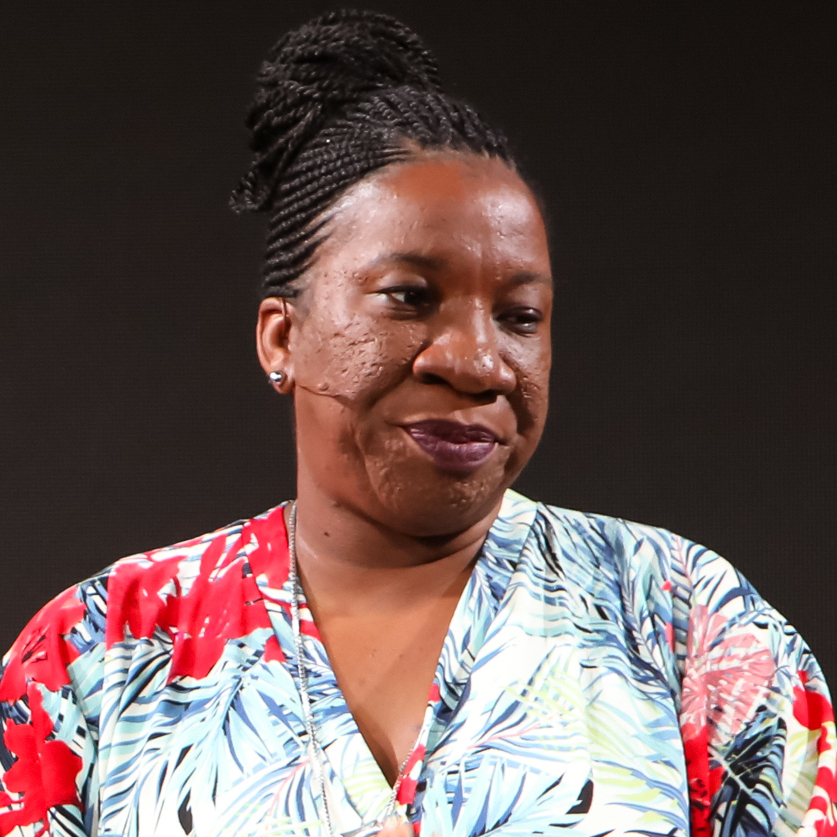
Tarana Burke
American activist
6
APPEARANCES
5
PODCASTS
Oct 8, 2026


Tarana BurkeGUEST
[laughs] But, but you know, we, you know, h- what's your relationship with, with women who feel that now? Because so many, you know, and again, it's, it, I can't equivocate sexual assault with getting fired.

Enrique AlvarezHOST
In your journey, when did you realize this was a problem? Take us back when you just first started and realized that this was something that not only was a problem, but it was something that you were going to dedicate your life to try to solve.
Tarana BurkeGUEST
I mean, as a survivor myself, I grew up thinking about it as my problem, right? Not a community problem, not something that happened to other girls and boys.
Tarana BurkeGUEST
When I started working with young people, and not about this work, right? Not about sexual violence at all.
Tarana BurkeGUEST
I was very committed to the idea of developing young leaders the way I had been.
Kristi PorterHOST
But how does that silence become normalized in a way that ultimately harms people and culture?


Tarana BurkeGUEST
So, you know, of course, we would have this incredibly indulgent person in the White House who would only look at America through one lens and is trying to make sure that we only look at America through one lens.
Tarana BurkeGUEST
They're trying to keep us keep our eyes away from the things that are most relevant, like the Epstein files.
22 MINS LATER


Tarana BurkeGUEST
Um, and, and I wanted to kinda bring it full circle because I'm, I'm talking about that line, I should say, "There was no air." And that's the best way I can think about- [clears throat] when I would see other people, when I would see other girls who were prettier than me, or more popular, or just what, from, from my estimation, seemed free, um, it just felt like the air was rare for them, right? It was just...
Tarana BurkeGUEST
They had- they, like, they breathed a different air, they lived a different life, and girls like me just didn't have it.
Tarana BurkeGUEST
I, I get it, I'm having it... not having it now, but it, recalling it now, like, this feeling of just not being able to have a full breath.
Tarana BurkeGUEST
Before, there was always something, whether it was a thought, or an action, or a thing, there was just always something, and it didn't allow you to [inhales] breathe in and breathe out, and just, like, live.
17 MINS LATER

Tarana BurkeGUEST
I was so traumatized by what was happening, and I was so deeply shamed by what was happening, that I felt like, one, I felt complicit in my own abuse.
Tarana BurkeGUEST
God's mercy was for those who were bad, but if you prayed hard enough, God would grant you mercy.

Tarana BurkeGUEST
And using my story and their stories to talk about, like, the commonality that we had amongst this, this trauma that these young girls had experienced, to say, like, "There's, there's a commonality in your trauma, and there's also power, and how can we build on that power to build leadership, to build healing, you know, to, and, and to take action against this?" Not really what went vi- the, the thing that went viral, but in a very similar way, the same things that my girls needed when we were having our meetings is exactly what these women who, were looking for when they were saying, "Me too" to each other-
17 MINS LATER
Tarana BurkeGUEST
And even before the trial when the, when the documentary happened 'cause I was in the documentary, you know, it's really difficult, um, particularly in the Black community for us to talk about sexual violence. And I think as a reaction to that, we go to defense. And so people were so ugly and they were just like, "Well, why would he..." They were m- they were conflating thinking that I was saying that he, that I was one of his victims.