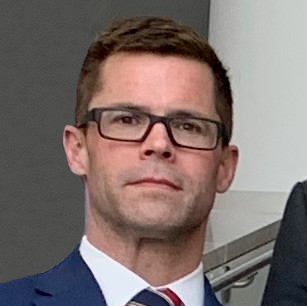
T.J. Harker
Former federal prosecutor and author of American Scapegoat; General Counsel of a Tennessee company and writer of the Amicus Republicae Substack.
10
APPEARANCES
8
PODCASTS
Nov 10, 2026


TJ HarkerGUEST
And it's deep in crisis because one political party does not care about the institutions that exist in the United States.
17 MINS LATER


TJ HarkerGUEST
Everything is functioning normally except the oxygenated blood is not getting to the brain.
TJ HarkerGUEST
Now, I want your audience to remember why this is a really useful theory for the prosecution.
TJ HarkerGUEST
It's really useful because if you compress the carotid artery, it doesn't take a lot of force to obstruct the flow of blood.
TJ HarkerGUEST
And so you can kill somebody by compressing both their carotid arteries without leaving any physical evidence.
TJ HarkerGUEST
The second choice is what we'll call, in contrast to the blood choke, we'll call it the air choke, all right? That is where you put a large amount of pressure, usually to the front of the neck, and actually crush the windpipe.
12 MINS LATER


TJ HarkerGUEST
And so, uh, let's, let's put ourselves in the mind of the typical American who's watching the news on May 25th or May 26th, the day after George Floyd died, 2020.
6 MINS LATER

T.J. HarkerGUEST
And feel free to interject, because I don't want to give an explanation that loses the forest for the trees here.
T.J. HarkerGUEST
But let's start with what everybody thinks they saw, okay? What you have is a nine-minute video.
T.J. HarkerGUEST
And it appears to show a white officer acting in a way that you might describe as indifferent or callously indifferent.
T.J. HarkerGUEST
kneeling on what appears to be the neck area of a black man okay you see that and it doesn't look good and then you have a media narrative that that is explaining to you what happened namely that this man who appears indifferent the white man killed the black man after all the black man died you see the kneeling on the neck and for most ordinary people that's enough right you don't you don't really need to get into causal mechanisms or mechanics but that is not enough for a prosecutor.
24 MINS LATER

Will ChamberlainHOST
So can you kind of explain what the original autopsy was and then the process and the sort of things that happened that led to net compression being added as part of the cause of, I should say, not part of the cause of death, but just in the vicinity of the cause of death?

TJ HarkerGUEST
The very next day, he explained to the prosecutors repeatedly that he avoided watching the video because he did not want to be biased.
TJ HarkerGUEST
Now, there's so many things here that your audience needs to hear, but remember that at the same...
TJ HarkerGUEST
So the prosecutors have now learned on May 26th that their chief medical examiner does not believe that asphyxiation had anything to do with George Floyd's death.
TJ HarkerGUEST
So the prosecution is now getting this influx of data from Dr. Baker that says there's no evidence of damage to the guy's neck.
13 MINS LATER

Liz WheelerHOST
Before you knew the facts, when you thought that that's what was happening, it was very difficult to watch.
TJ HarkerGUEST
But if that's all you watched, it seemed plausible to think, well, knee on the neck, can't breathe.
38 MINS LATER


T.J. HarkerGUEST
So remember, if you're a prosecutor and you've got a murder case that you're considering bringing, the thing at the top of your mind is going to be two issues.
T.J. HarkerGUEST
The first is, how did the decedent, that is the dead person, die? What was the cause? Let's call that causation.
T.J. HarkerGUEST
The second thing that's on the top of your mind is what's called intent causation.
T.J. HarkerGUEST
Everybody knows that if you didn't mean to do something here in America, the crime is less serious than if you did.
7 MINS LATER

T.J. HarkerGUEST
So remember, if you're a prosecutor and you've got a murder case that you're considering bringing, the thing at the top of your mind is going to be two issues.
T.J. HarkerGUEST
The first is, how did the decedent, that is the dead person, die? What was the cause? Let's call that causation.
T.J. HarkerGUEST
The second thing that's on the top of your mind is what's called intent causation.
T.J. HarkerGUEST
Everybody knows that if you didn't mean to do something here in America, the crime is less serious than if you did.
6 MINS LATER


T.J. HarkerGUEST
If I ramble on, you let me know because there's a lot here and there's really some interesting stuff the public doesn't know.
T.J. HarkerGUEST
One quick comment, and I think most people don't know this, but George Floyd did call for his mama several times, but mama was actually his pet name for his girlfriend, Courtney Turner, who played a very interesting role in this case, but we'll come back to that.
T.J. HarkerGUEST
So Yes, I'm going to tell your audience about what happened leading up to that video.
T.J. HarkerGUEST
And I'm going to tell them, for example, when George Floyd started saying, I can't breathe.
25 MINS LATER

T.J. HarkerGUEST
And so you raised the two issues that were of critical importance in the trial were one was the use of force authorized and separate and apart from that.
T.J. HarkerGUEST
The ordinary American says, oh, a knee on the neck, a man saying I can't breathe.
6 MINS LATER

Jack PosobiecHOST
What was the real situation going on with the amount of drugs found in his system?