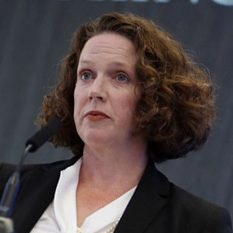
Suzanne Maloney
Political scientist
29
APPEARANCES
20
PODCASTS
Oct 27, 2026


Suzanne MaloneyGUEST
And thanks for having me here with Kareem, with whom I almost always vociferously agree.
Suzanne MaloneyGUEST
And I think he is precisely correct in the way that he characterizes the state of play within the Islamic Republic's political system.
Suzanne MaloneyGUEST
which is to say that the war in some respects has probably persuaded Iran's leadership to double down on their commitment to the revolutionary ideology that has really forged this regime over the course of the past 47 plus years.
Suzanne MaloneyGUEST
And that in many respects, it is the coherence and resilience of this system has been proven to be, I think, far greater than many inside and external analysts had presumed.
Suzanne MaloneyGUEST
You know, even in the run up to the war, as Karim described, there were these massive popular protests on the streets of major cities around the country.
13 MINS LATER
22:22

Is this at all a credible strategy? It is being the one pursued on the part of the administration for changing Iran's calculations? Or is the capacity to endure and to suffer pain unlimited, at least for the next six, eight, ten months? Suzanne?


Dan SenorHOST
So why? What, what makes you think Iran can withstand all this pressure we're talking about longer than Washington and other actors outside Iran and inside Iran can sustain it?
Suzanne MaloneyGUEST
It's a great question, and obviously we're all trying to see through the glass darkly with respect to what's happening inside Iran.
Suzanne MaloneyGUEST
But I would point out this, that we have managed to reconstitute near pre-war levels of oil exports.
Suzanne MaloneyGUEST
We have not managed to reconstitute near pre-war levels of exports of LNG, for example.
Suzanne MaloneyGUEST
And even the oil that we are, uh, helping to guide out of the Gulf, it costs an awful lot more to do it this way.
Suzanne MaloneyGUEST
It costs a lot more for the companies, for the producing countries, and for the American consumer and consumers around the world because it effectively requires ship-to-ship transfers.
Suzanne MaloneyGUEST
The Iranians have begun to apparently improve their ability to target the passage through dark of night, and we're seeing constraints on supertankers because of the necessity of essentially using multiple ships for every export cargo that comes out of the Strait of Hormuz.
15 MINS LATER
Dan SenorHOST
What's your read on his announcement? And if there is renewed fighting, what do you imagine it look-- it could look like whenever it would happen?

Suzanne MaloneyGUEST
They've assessed both the vulnerability of the US economy and the wider global economy to a long-term closure of the Strait of Hormuz, as well as the political consequences for the President if there were to be a disruption that impacted oil prices and the wider economy in advance of the midterm elections this fall.
Suzanne MaloneyGUEST
So, you know, they, they, they appreciate that his bluster is just that, but I think there's always the chance that he does deliver.
Suzanne MaloneyGUEST
Um, and, and they've now experienced two wars, the June 12 day war in 2025 and, and this longer war and more ambitious war, where the Iranians appear to have survived, but they, they've got a lot of work to do if they want to hang on to power.

Joe MathieuHOST
Suzanne, do you believe either side's version when it comes to the status of negotiations?
Suzanne MaloneyGUEST
I think it's very hard to take seriously what we've been hearing, because the president has his own incentive to sort of inflate what he's hearing from the Iranians.


Lakshmi SinghHOST
Suzanne Maloney, an Iran expert with Brookings Institution, a nonprofit think tank in Washington, D.C., responds to whether this pause in fighting might be able to accomplish what previous pauses could not.
Suzanne MaloneyGUEST
The president and his administration here in Washington seem to have rightly decided that there was no military value to continuing additional airstrikes on Iran.
Suzanne MaloneyGUEST
That was likely to lead to an escalation, not just by Iran, but by the Houthis who have sought to target traffic in the Red Sea, the Bab el-Mandeb, as well as Saudi oil infrastructure.


Jason BordoffHOST
What do you think is, uh, happening on the ground there, and, uh, what, what theory of change makes any sense, if any?
Suzanne MaloneyGUEST
Well, the adaptability a- and resilience of the Iranian economy has been persistently underestimated over the course of the past 47 years.
Suzanne MaloneyGUEST
Um, you know, we thought during the Obama administration when the Iran Central Bank was sanctioned that it, that would be a, you know, catalytic moment for the regime.
Suzanne MaloneyGUEST
It contributed certainly to the decision to e- engage in more serious and more substantive negotiations over the nuclear program, and that was acknowledged even by Ayatollah Ali Khamenei, the supreme leader who was killed on the opening day of this current war.
Suzanne MaloneyGUEST
So we know that sanctions can have some pressure, that economic issues actually are quite important to this regime, even if it has consistently mismanaged the economy and engaged in enormous corruption.
Suzanne MaloneyGUEST
Um, you know, they recognize that they, they have to have some kind of legitimacy with their people, and some of that legitimacy comes from the development that the regime has engaged in internally since 1979.
Suzanne MaloneyGUEST
Um, you know, what the waiting time is is, is very hard to tell at this point in time, um, simply because we don't have access to as reliable, as reliable information as we did even before the war.
19 MINS LATER
Jason BordoffHOST
Um, what's your best sense of Israel's perspective right now, what their aims are at this moment, what might happen in the upcoming election, and how Prime Minister Netanyahu might act to make it more or less likely that conflict gets resolved?


Suzanne MaloneyGUEST
Beginning on February twenty-eighth, massive US and Israeli airstrikes eliminated Iran's long-ruling supreme leader, along with an entire echelon of senior Iranian officials, quickly secured air superiority over the country, and exacted punishing blows on its nuclear program, ballistic missile capabilities, navy and air force.
Suzanne MaloneyGUEST
Despite these impressive operational achievements, Iran's deeply institutionalized ruling system mounted a stunningly effective retaliation, targeting regional e-economic and energy infrastructure and transit and jeopardizing the security of its neighbors and the global economy.
Suzanne MaloneyGUEST
The Trump administration quickly found itself pinned down in a conflict where Washington could not prevail at an acceptable cost or timeline, forcing Trump to offer massive concessions to a third-rate terrorist state in order to end the war.
Suzanne MaloneyGUEST
How do we define victory? Imposing steep costs on an adversary is not sufficient.
Suzanne MaloneyGUEST
Victory and war must be measured on the basis of strategic aims and outcomes.
Suzanne MaloneyGUEST
President Trump defined his goal as ensuring that Iran could not pose a threat to its neighbors or to the United States.
20 MINS LATER

11:42

So now give me your take on what you think is in the MOU from the US point of view.
Suzanne MaloneyGUEST
Um, he thought he was going to be a historic president who brought about the end of the Islamic Republic of Iran, which has been an adversary of the United States for the past 47 years and a, a disruptive and destabilizing force across the greater Middle East over the course of that period.
Suzanne MaloneyGUEST
And his initial promises were that this was going to be a transformative war that destroyed Iran's conventional capabilities, its nuclear program, its ballistic missile program, and brought about the freedom of the Iranian people.
Suzanne MaloneyGUEST
He has been left with a regime which is more hardened and in some respects more radical than its predecessors, potentially more prepared and more capable of extending its influence across the region because they have now discovered and been able to implement on their longtime ritualistic threats of closing the Strait of Hormuz.
Suzanne MaloneyGUEST
And so what the MOU provides to the United States is an end to the war, which was an essential condition because of the threat of physical disruption of oil supplies that was looming as a result of the extended closure, and it provides for at least a process of negotiation around Iran's nuclear program.
13 MINS LATER
Suzanne MaloneyGUEST
Well, thanks, Aaron, for having me back to Carnegie Connects, and especially for having me back with Karim, um, who has been, um, just masterful on this issue for many years.
Suzanne MaloneyGUEST
Um, uh, you know, I would say that the, the fundamental strategic dilemma that we've had since the outset of the war is-- relates to the miscalculations that fed the decision to go to war in the first place.
Suzanne MaloneyGUEST
Um, American presidents have contemplated military action against Iran have-- for forty-seven years and have occasionally used both coercion and direct military action against Iranian forces on multiple occasions, including most recently in June of twenty twenty-five with the, um, operation that did set back Iran's nuclear program in significant ways that was conducted jointly with the Israelis.
Suzanne MaloneyGUEST
Um, the- The decision to go to war again in February of this year appears to have been driven by the ambitions of a president who had seen the use of force in his second term undertaken very successfully, at least in his own presumption.
Suzanne MaloneyGUEST
Both the June war, the decision to unseat Maduro, and to install a more sympathetic to the United States figure at the helm of the Venezuelan regime back in January, um, did not, in fact, produce many of the negative consequences that skeptics had warned against, particularly with Iran over many, many years.
11 MINS LATER


Amna NawazHOST
Suzanne, you agree with that premise there that it would take additional U.S. military force to push Iran to a deal, a final deal?
Suzanne MaloneyGUEST
Look, I think the Iranians need and want to deal, but they want to deal on their terms and they want to be able to set a new strategic equation across the region that includes their own hegemonic role.
Suzanne MaloneyGUEST
And here we see, as Joel referenced, their efforts to try to insulate their proxies, to use their power to insulate their proxies, rather than using their proxies to extend their influence.
Suzanne MaloneyGUEST
I don't think that whatever limited success Project Freedom might have had has really changed the extent to which Iran is capable of truly harming the global economy and creating ripple effects for the American economy.
Suzanne MaloneyGUEST
We saw something like statistics of perhaps 200 ships that may have transited under some U.S. guidance without their transponders on, and so there has been a bit of leakage.
Suzanne MaloneyGUEST
But Contrast that with 130 to 160 ships that were transiting the Strait of Hormuz prior to President Trump's decision to try to promote regime change through the use of military force on February 28th in Iran.
Amna NawazHOST
Suzanne, is that kind of deal one that would essentially reopen the Strait of Hormuz but does not include specifications about the nuclear program, is that one worth the U.S. signing?

Amna NawazHOST
Suzanne, you agree with that premise there that it would take additional U.S. military force to push Iran to a deal, a final deal?
Suzanne MaloneyGUEST
Look, I think the Iranians need and want to deal, but they want to deal on their terms and they want to be able to set a new strategic equation across the region that includes their own hegemonic role.
Suzanne MaloneyGUEST
And here we see, as Joel referenced, their efforts to try to insulate their proxies, to use their power to insulate their proxies, rather than using their proxies to extend their influence.
Suzanne MaloneyGUEST
I don't think that whatever limited success Project Freedom might have had has really changed the extent to which Iran is capable of truly harming the global economy and creating ripple effects for the American economy.
Suzanne MaloneyGUEST
We saw something like statistics of perhaps 200 ships that may have transited under some U.S. guidance without their transponders on, and so there has been a bit of leakage.
Suzanne MaloneyGUEST
But Contrast that with 130 to 160 ships that were transiting the Strait of Hormuz prior to President Trump's decision to try to promote regime change through the use of military force on February 28th in Iran.
Amna NawazHOST
Suzanne, is that kind of deal one that would essentially reopen the Strait of Hormuz but does not include specifications about the nuclear program, is that one worth the U.S. signing?


Paula NewtonHOST
What does this tell you about any deterrence posture that the US and Israel w- were certain, told us, would come out of this war?
Suzanne MaloneyGUEST
Yeah, I, I think that, you know, in many respects our, our regional deterrence has been eroded as a result of this war.
Suzanne MaloneyGUEST
You know, prior to the beginning of the war, I think the general assessment was that Hezbollah, as well as other Iranian proxies, w- had been very heavily degraded, especially by Israeli actions over the course of the past several years.
Suzanne MaloneyGUEST
Um, and that Iran really wasn't the, the threat that it previously posed across the, the region to neighboring states through those proxies.
Suzanne MaloneyGUEST
And now what we see is, yes, the proxies have been eroded, but they're bouncing back, and the Iranians are now determined to establish a kind of new strategic posture in the region in which they attack other countries to defend those proxies.
Suzanne MaloneyGUEST
Um, and, and that is not actually an improvement in, in the broader strategic calculus of the Iranian regime.
Paula NewtonHOST
H- has Tehran essentially cracked the code on how to play this conflict? A- a- and what leverage does Washington actually have left? Suzanne, I want to point out that in March you were the one who said way back then that this conflict would not end quickly.

6:06

And if that is right, that they don't want to, does that mean that, y- you know, even though we're all saying how difficult it is to bridge the positions between the two sides, there might be some way that they get to that because they both want to, or certainly signs are that Washington wants to?
Suzanne MaloneyGUEST
The president does not want to resume major combat operations for a variety of reasons, including the domestic politics of, of the matter.
Suzanne MaloneyGUEST
Um, just last week he pronounced the war terminated, um, in order to, uh, alleviate pressure in Congress for a vote on the War Powers Act, which is required after 60 days of hostilities in which the Ame- American military is engaged, and there's ...
Suzanne MaloneyGUEST
That debate is, is ongoing, but he's trying to thread the needle effectively there and enable Republicans on the Hill, um, not to be forced into a position to have to make a determination on whether to support or oppose the war that the president launched back in late February.
Suzanne MaloneyGUEST
He's also watching markets, I think, and obviously we have seen significant, uh, escalation in the price of gasoline in the United States, but it is still, you know, within the realm of the tolerable, at least for the, the broader economy.
Suzanne MaloneyGUEST
If this crisis goes on for another month or two, or if we see a return to major combat operations, um, uh, you know, the, the markets are likely to panic, in part because we are now beginning to feel the supply disruption in the United States.
6 MINS LATER
13:11
Just, uh, you know, is there a zone, a landing place here for these two sides that you as a diplomat, you've advised presidents of both parties, if you were in the room, as it were, would you, would you be able to see an area where these two sides can come together? Or is this really an impossible task?

Paul SweeneyHOST
Um, uh, is that, is that accurate, do you think? A- again, it just kinda goes to the question of can the United States negotiate in good faith with whomever is there?
Suzanne MaloneyGUEST
Look, Iran has always had a kind of diversity of factions within its system, and really vociferous debates about both its foreign policy and its domestic policy.
Suzanne MaloneyGUEST
That isn't new, and it's not surprising that in the aftermath of the elimination of the senior echelons of the clergy as well as the security bureaucracy, that we're seeing at least some questions about how decisions are being made and, and differing positions.
Suzanne MaloneyGUEST
I don't think that that is fundamentally, um, it makes it impossible for us to negotiate with Iran.
Suzanne MaloneyGUEST
It has always required a high degree of, um, focus and patience from the international community to achieve any clear outcomes with Iran.
Suzanne MaloneyGUEST
I think the challenge that we face is not the internal politics, but the sense within the regime that they have the upper hand and that time is on their side.

Tom KeeneHOST
What's the number one thing we get wrong in our perception of the road from Tehran to Isfahan?

Paul SweeneyHOST
Is that accurate, do you think? Again, it just kind of goes to the question of can the United States negotiate in good faith with whomever is there?

Suzanne MaloneyGUEST
look iran has always had a kind of diversity of factions within a system and really vociferous debates about both its foreign policy and its domestic policy that isn't new and it's not surprising that in the aftermath of the elimination of the senior echelons of the clergy as well as the security bureaucracy that we're seeing at least some questions about how decisions are being made and in different positions i don't think that that is fundamentally um it makes it impossible for us to negotiate with iran it has always been complicated it has always required a high degree of focus and patience from the international community to achieve any clear outcomes with Iran.
Suzanne MaloneyGUEST
I think the challenge that we face is not the internal politics, but the sense within the regime that they have the upper hand and that time is on their side.
Tom KeeneHOST
What's the number one thing we get wrong in our perception of the road from Tehran to Istafan?
Suzanne MaloneyGUEST
I think the fundamental issue that we have is recognizing that this is a regime that has staked its existence on maintaining some kind of a nuclear infrastructure.
Suzanne MaloneyGUEST
They have suffered enormous trillions of dollars of damage and sanctions and lost opportunities as a result of their determination to maintain that.


Suzanne MaloneyGUEST
And I, at least from the early signs of the first round of negotiations, I think the Iranians are prepared to be serious about this.
Suzanne MaloneyGUEST
I think many of us were concerned that they might just As you said, they had been emboldened by their success in the early weeks of the war, and they might miss the opportunity to lock in whatever gains they think they can from this conflict and simply go for broke.
Suzanne MaloneyGUEST
And we saw that, for example, during the Iran Iraq war, when after having evicted Iraqi troops from Iranian territory, the Iranians had the opportunity to take an off ramp.
Suzanne MaloneyGUEST
They were offered reparations from the Saudis and the other Gulf states at that time.


Gideon RachmanHOST
But I mean, it's striking that you say not only do they want to emerge from this conflict stronger despite all the bombing that's happened and the killing of the top leadership, but you think it's quite likely, and if you listen to President Trump, he'll constantly say, "They've been devastated, they barely exist anymore." But you actually think it is plausible that despite the pummeling they've taken, they'll come out ahead.
Suzanne MaloneyGUEST
You know, certainly in the opening hours when the initial strikes were evident and the president released a video that essentially called on Iranians to seize their government, I think it could have gone in any number of directions.
Suzanne MaloneyGUEST
But it's also been clear from those early moments that the Iranians had a plan, that they were prepared for this, unlike the June 2025 conflict in which I think they were, to some extent, caught off guard by the decision to launch the strikes even as negotiations appeared to be still viable.
Suzanne MaloneyGUEST
This time around, they had a strategy, and they were ready to implement on it almost from the very beginning.
Suzanne MaloneyGUEST
Again, that shouldn't have been a surprise, but it appears to have been to the United States, and that those strikes were targeting soft targets in the beginning and then clearly directed at economic and energy infrastructure.
14 MINS LATER
Gideon RachmanHOST
Is it behaving any differently or are there new faces showing up? Any sense of change?
12:51

Suzanne, is this wishful thinking, or is it wish-A way to come out of this?
Suzanne MaloneyGUEST
Well, I think that there is a possibility of constructing an agreement that does require some meaningful concessions from the Iranians in the aftermath of the war, particularly around re-imposing constraints on their nuclear program and extracting the highly enriched uranium, which is believed to be buried near Isfahan, but may have been dispersed around the country prior to the June 2025 war.
Suzanne MaloneyGUEST
That's a really critical issue because the world needs to ensure that with this regime still intact, that it cannot move quickly toward nuclear weapons capability.
Suzanne MaloneyGUEST
And I think the Iranians appreciate that there is going to be some need for some concessions and what that looks like and how they phrase that.
Suzanne MaloneyGUEST
The Iranians can't, in fact, enrich uranium at the moment anyway because of the destruction of the program over the course of these two wars.
14:05
Now, the people have been left with, "Oh my God, what are we left with?" A ceasefire that leaves them in place, and, and what happens to us? W- what do you think is gonna happen to the people there?
Suzanne MaloneyGUEST
I think the, the Iranian people are, as has been the case for at least forty-seven years, um, really i- in the losing situation here.

Justin VogtHOST
In nineteen eighty-eight, the historian Geoffrey Blainey published a book called The Causes of War, and it contains this great famous line that goes like this, "Wars usually begin when two nations disagree about their relative strength, and wars usually cease when the fighting nations agree on their relative strength." What do you think the last six weeks of fighting have revealed about the relative strength of the two sides, and maybe just as important, about their abilities to estimate their own strengths and that of their opponents?
Suzanne MaloneyGUEST
Well, I think that quote gets to the, you know, fundamental miscalculation on the part of the Trump administration about the durability and institutionalization of the Islamic Republic of Iran.
Suzanne MaloneyGUEST
Uh, I believe, and what we've seen from the reporting suggests that the president presumed that the regime could be easily decapitated, and that with its decapitation, the system itself would collapse under the weight of mismanagement and corruption and its-- the immense, uh, unhappiness of the Iranian people that was manifested back in January with the very large protests across Iran.
Suzanne MaloneyGUEST
I think most of those of us who have watched Iran closely over the course of the recent decades would have been able to, uh, point that out to the president.
Suzanne MaloneyGUEST
And it does appear that, in fact, the intelligence assessments that were available to the administration in the run-up to the war also suggested that the, uh, a decapitation strike would not quickly supplant the regime.
Suzanne MaloneyGUEST
But I think that that was fundamentally the presumption of weakness on the part of the administration about Iran that led us into what very quickly became not a quagmire per se, but a situation that was very difficult for Washington to extricate itself from.
18 MINS LATER
Justin VogtHOST
Can you talk a little bit about what the first two Islamic republics were and what makes this third one different?
36:49
Now, the people have been left with, oh, my God, what are we left with? A ceasefire that leaves them in place? And, and what happens to us? W- what do you think is gonna happen to the people there?
Suzanne MaloneyGUEST
there?I think the, the Iranian people are, as has been the case for at least forty-seven years, um, really i-in the losing situation here.
Suzanne MaloneyGUEST
Um, they have risked their lives, uh, countless times, and most recently in January to try to push for some more responsible, more, uh, respected government in the world, and they have been repressed viciously by their own leadership.
Suzanne MaloneyGUEST
And what has happened over the course of the war is not just that the regime has remained intact, but the very people who were brutal- orchestrating the brutality in January are now in an, a stronger position, and they have been making that point through continued executions, through text message warnings to the Iranian people not to go back to the streets.
Suzanne MaloneyGUEST
It is incumbent on the world to ensure that their cause is not forgotten, that we continue to look for avenues to try to advance a democratic outcome over the long term in Iran.
Suzanne MaloneyGUEST
They just have a government that has been averse to it for forty-seven years.


Suzanne MaloneyGUEST
You know, it's very difficult to assess where the president's tweets and his, uh, actions connect, um, but I do think it's a realistic possibility that we will see American forces occupying so- or attempting to occupy some ground positions.In Iran the most obvious contenders are Kharg Island, which is the export terminal through which much of Iran's oil, uh, passes.
Suzanne MaloneyGUEST
It is not the production facility, it is really just the place at which the tankers are loaded and if that Kharg Island was taken by American troops, then theoretically the Iranians would not be able to export their oil.
Suzanne MaloneyGUEST
And that's been one of the interesting dimensions of this crisis, that in all the war gaming and p-planning and thinking about what might happen in a closure, the assumption was that the, uh, that Iran would feel some pressure because its economy would be hit.
Suzanne MaloneyGUEST
And what they've been able to do is, is very selectively enable their own exports to go.
Suzanne MaloneyGUEST
If that changed, then they might have some more time pressure, but of course, you know, the risks to American troops, uh, on Kharg Island, um, would be severe.
Suzanne MaloneyGUEST
Our ability to resupply them with munitions as well as just basic living conditions would also be severe.
6 MINS LATER


Ali VelshiHOST
He sort of changes his view every now and then, but at this point it's existential, so they are likely to be taking more serious moves now than they did last June.
Suzanne MaloneyGUEST
The Iranians certainly understood that this was not going to be a short war, and that it was going to be aimed not at just decapitating their nuclear infrastructure, but really decapitating the regime, and we saw that in the president's early comments, um, and he's repeated that on several occasions since this time.
Suzanne MaloneyGUEST
So the Iranians were not just prepared for the US attack, they were prepared to ensure that they could outlast the United States and that they, even though they were really outgunned in terms of the American and Israeli ability to degrade Iran's military infrastructure, they understood that they could fight asymmetrically and they could threaten the global economy by, um, simply threatening, not even necessarily inserting mines or taking other actions.
Suzanne MaloneyGUEST
They could drive oil prices up, and that that would have a galvanizing effect on their neighbors and on the world.
Ali VelshiHOST
At some point, does Iran run out of, uh, uh, ability to, to use the Strait of Hormuz as a, as a choke point?
Suzanne MaloneyGUEST
Well, if the United States did in fact take and hold Kharg Island, it would be a, a severe blow to the Iranian economy.


Nick SchifrinHOST
That sounds like Mojtaba does have options, and you were suggesting, Suzanne, that, well, this is kind of the natural position for any Supreme Leader to take.
Suzanne MaloneyGUEST
I, I think it is the natural position, and, and certainly, you know, they could, they, they may be looking for their own off-ramp, because at a certain point, this is, um, you know, costly for them to maintain, and they recognize that at some point the war is going to have to end, and they want it to end on their terms.
Suzanne MaloneyGUEST
Um, I, I am, uh, uh, not anticipating that Mojtaba somehow comes out or that the Revolutionary Guard come out offering some kind of an olive branch, either at home or to their neighbors, because what they're trying to also demonstrate to the international community and to Washington and Israel in particular is, "Don't do this again, because you will pay a price." And they probably recognize that they're not gonna be in the current moment for very long, or, and they're not gonna be able to recapture it.
Suzanne MaloneyGUEST
A moment where they have kind of turned the tables, at least briefly, on a campaign that was initially incredibly successful in terms of the very early assassination of Ali Khamenei, the Supreme Leader, and the, the complete degradation of Iran's ballistic missile capability, its navy, and, and other military assets.
Suzanne MaloneyGUEST
So they're, th- they're gonna have to play this in, I think, a really careful moment.
10 MINS LATER
Nick SchifrinHOST
And you're seeing j- just, just one of the many hits on those Gulf energy, uh, installations right now.
Suzanne MaloneyGUEST
Yeah, so I think that, you know, whether we like it or not, we're going to have to be back in some kind of a diplomatic arrangement with the Islamic Republic, which is, I think, anathema to many of us who felt that at this point in time, the regime was weakened.
Ali VelshiHOST
Uh, some argue that this, this group, the Revolutionary Guard, is, is not, not something we're familiar with in, in America in terms of the, the type of power it wields in Iranian society.
Suzanne MaloneyGUEST
The Iranian post-revolutionary state is a very complex and almost unique apparatus.
Suzanne MaloneyGUEST
Uh, it is both a theocracy and a republic with some, um, institutions that are subject to at least managed elections.
Suzanne MaloneyGUEST
Uh, but the Revolutionary Guard, particularly in the era since the end of the Iran-Iraq War in 1988, has become a, a huge power behind the throne.
Suzanne MaloneyGUEST
It is intricately intermingled with the, the, the clerical class, and so, you know, there's this symbiotic relationship between the clerics who ha-have ultimate authority and the Revolutionary Guard and the broader military and security apparatus that have both projected Iranian power around the region and of course sought to dominate the population.
Suzanne MaloneyGUEST
They also, both clerics and the Revolutionary Guard and the military, have extensive, um, control over the economy as well.
Ali VelshiHOST
Um, why, why is that not doable in Iran right now? Why, like Americans threw off the yoke of, uh, of, of the British, why can't Iranians throw off the yoke of this regime relatively easily?
Suzanne MaloneyGUEST
Um, as you noted in your, uh, overview there, i-i-Iran has only been through the process of succession with its supreme leader once, and that was a fairly fraught time as well.
Suzanne MaloneyGUEST
It was not long after the end of the Iran-Iraq War, which was a bloody nose for the Iranians, and, um, there was a lot of uncertainty about whether the revolutionary regime, which was still in its infancy, would survive that transition, in particular because Khamenei himself was not s-perceived as someone who was either particularly charismatic or necessarily very powerful.
Suzanne MaloneyGUEST
But what he did over his thirty-seven years in office was entrench the office of the supreme leader throughout the institutions of the Islamic Republic and build a network which enabled him to exert enormous influence over decision-making across the board.
Suzanne MaloneyGUEST
As you say, there are constitutional provisions that have put in place a three-member committee, a council that will govern Iran at its highest levels during this transitional period.
Ali VelshiHOST
So I, I guess the question is, do these guys all figure it out, or is there some sense that given the current pressure on the, uh, the Iranian regime, that something different happens? And when I say different, I mean that somebody with a different perspective, either more of a hardliner or more of a reformer, takes that role.


Fareed ZakariaHOST
Um, Suzanne, what do you make of this? The, the, the, the peace candidate, the no endless wars candidate has been tempted, as you know, honestly, so many American presidents have, into the morass of the Middle East and into some kind of military action.
Suzanne MaloneyGUEST
I think what we're seeing from President Trump is, uh, a man who in his second term in office is really enamored with the use of American force and really believes that American greatness is best advanced through a really forceful approach to the use of, of the military.
Suzanne MaloneyGUEST
He had the successful attack on Iran and, uh, the elimination effectively of its enrichment capabilities back in June.
Suzanne MaloneyGUEST
And I think in the aftermath of the momentous protests that took place in January in Iran, President Trump saw himself as something of a main character.
7 MINS LATER
Scroll for more appearances