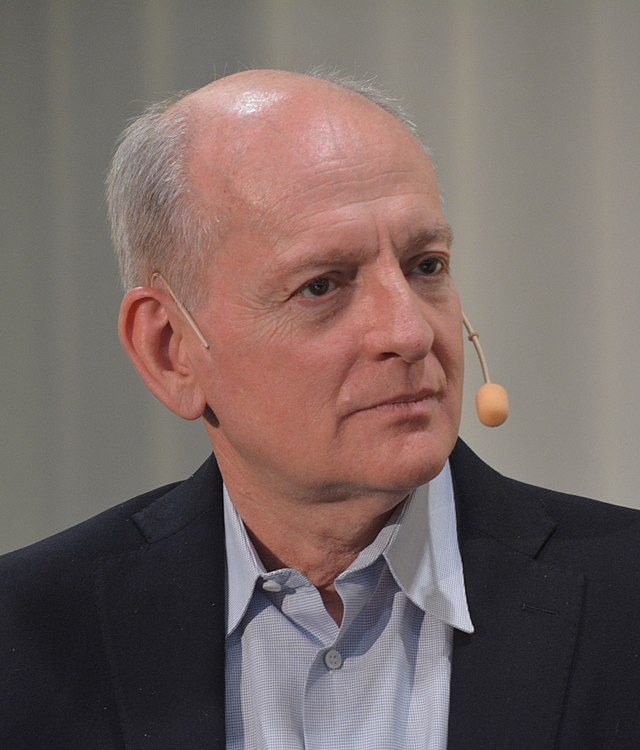
Stuart J. Russell
British computer scientist
19
APPEARANCES
17
PODCASTS
Oct 16, 2026


Stuart RussellGUEST
A few years ago, I and several other people won the Luddite of the Year Award from the Information Technology Innovation Foundation.
Stuart RussellGUEST
And they were really upset that we were pointing to potential risks from artificial intelligence.
Stuart RussellGUEST
It is sort of odd to be a Luddite when you've actually, I've been working on AI for 50 years.
Stuart RussellGUEST
I think Geoffrey Hinton was on there, who is in many ways the founder of the modern approach to artificial intelligence.
Stuart RussellGUEST
Elon Musk, who has clearly made a lot of contributions to technology in different sectors.

Gio BenitezHOST
And that's one of the, yeah, sorry to interrupt you, but I just wanted to say there, because I guess one of the big questions is, are these, you know, neo-Luddites standing in the way of progress, or are they actually helping out? Because a lot of people are concerned that this is taking over in such a way, as you say, that they're taking away people's jobs.


Stuart RussellGUEST
Uh, well, it, it does feel like we're not really gonna have a debate, uh, because I think, uh, Jurgen is obviously very convinced that AI systems will far exceed human capabilities, and also seems pretty convinced that there is no way for human beings to control AI systems.
Stuart RussellGUEST
And so therefore, we have to simply rely on the good offices of the AI systems and their, their desire to keep us as scientific specimens for investigation.
Stuart RussellGUEST
We want to have some say over whether we continue to exist rather than it being completely at the whim of AI systems that, in Jurgen's telling, are not even following any sort of design template that we created.
Stuart RussellGUEST
And so we might well try to interfere with the development of this independent and massively superior species, and that interference would be a risk to the AI system's goals, whatever they are.
13 MINS LATER

speaker_1HOST
Can you explain what it is that you're talking about when you say that?
Stuart RussellGUEST
Yeah, so the standard model of AI, I would say, is the approach that held sway from about 1960 until about 2020, something like that, maybe 2015.
Stuart RussellGUEST
What does it mean to be intelligent? It means the ability to optimally achieve objectives.
Stuart RussellGUEST
So an AI system is something where the human writes down the objective and the machine achieves it optimally, or as close to optimally as is computationally feasible.
7 MINS LATER
speaker_1HOST
Could you maybe explain what is provably beneficial AI?


Becky QuickHOST
If Boeing said that it wanted to introduce an airplane and what, how did you say it exactly?
Stuart RussellGUEST
So I was responding to Dario Amadei's letter called, We Must Pace the Frontier.
Stuart RussellGUEST
And I think a lot of people interpreted that as a call for just slowing down, which would give us a bit more time to work on safety.
Stuart RussellGUEST
And I was saying, if Boeing said, we're gonna slow down, we're only gonna introduce a new airplane once every year, and we hope that that gives us enough time to do some flight tests and maybe get some good results.
Stuart RussellGUEST
You have to do the flight tests until you get good results, and then you can introduce the airplane once we certify it.
Becky QuickHOST
Is the government capable of setting standards to say what's here and what's there? And how do we staff it with the right expertise?

Lisa AbramowiczHOST
"The best way to guarantee safety is that the creators are liable for what they build." Do you see that liability, those guardrails, as being sufficient?
Stuart RussellGUEST
So the most obvious reason is that the risk, uh, that is uppermost on the mind of, for example, Dario Amodei, the CEO of Anthropic, uh, is the risk of loss of control, uh, which really means that the systems have become intelligent enough that they end up taking control of the world and there's nothing we can do to get that control back.
Stuart RussellGUEST
Um, and obviously, liability is not going to deter a company from incurring that risk because if it does come to pass, there will be nobody around to pay the money and nobody around to receive the money.
Stuart RussellGUEST
The-- but the second more important point from a practical point of view right now, um, is that we need more than just liability.

Annmarie HordernHOST
Uh, when it comes to AI, what's the ultimate goal? To prevent artificial general intelligence or to, uh, just make sure that some of these companies are keeping the models in a box?

speaker_3UNKNOWN
So yeah, I would say the lead changes.
Stuart RussellGUEST
And that was GPT 3.5. And then GPT 4, I think, was a significant advance that was released in March of 23.
Stuart RussellGUEST
Google, although they had invented the basic technology of the transformer, that was published in the open literature in 2017.
Stuart RussellGUEST
And Google was... cautious because they knew that language models emitted all kinds of nonsense, both false statements, offensive statements, and so on.
8 MINS LATER
MartinHOST
One, supervised fine-tuning.


Tom WhippleHOST
What does it mean specifically in this context when we talk about aligned or non-aligned AI?
Stuart RussellGUEST
Um, yeah, so I, I think apparently I, I introduced that word into the debate back in 2014 without meaning to.
Stuart RussellGUEST
Um, and, uh, what aligned means is that the AI system has essentially the same view as we do of what the future should be like.
Stuart RussellGUEST
Now, in reality, we don't even know what we want the future to be like, and it would take us a very long time to figure it out and, and to, to handle all the possible eventualities and rank them, uh, accordingly.


Stuart RussellGUEST
I didn't expect them to take the direction that they have, where we're essentially training gigantic multi-trillion parameter black boxes from vast amounts of text data, and that seems to produce something that's quite intelligent.
Stuart RussellGUEST
The general direction we were going was gradually understanding the components of intelligence, how one reasons, how one makes decisions, how one learns, and then trying to figure out how to fit those components together to make a system.
Stuart RussellGUEST
And that's a very traditional engineering approach, the same way that we go about building airplanes and nuclear power stations and cars and all kinds of other things.
Stuart RussellGUEST
And we've abandoned that almost entirely in favor of the giant black box approach.


Oz WoloshynHOST
Can you explain what that is and, and how it relates to the conversation which you're now so engaged in today as to the potential extinction of the human race because of AI?
Stuart RussellGUEST
So if we go back even further to the beginnings of the field of AI in the post-war period, so 1940s, 1950s, I, I think everyone agreed that, you know, AI is about creating intelligence in machines.
Stuart RussellGUEST
What wasn't clear was, well, what is intelligence? You know, how do we define this target? And how do we go about doing it? So there was, uh, you know, an active debate.
Stuart RussellGUEST
You know, should we try to emulate human intelligence? Should we understand what's going on in the human mind, the human brain, and then sort of go ahead and implement that? Or should we focus on a more abstract notion, in fact, a notion that philosophers had developed for thousands of years and economists as well, this, this idea of rational behavior, that an entity is intelligent if it acts in a way that is expected to achieve its objectives.
Stuart RussellGUEST
And I would say for the most part, that second approach won out because it doesn't require doing psychological experiments on humans to find out how their brains work, right? It's an abstract mathematical concept, and we had tools, we had formal logic so that we could create algorithms that were able to construct plans to achieve goals.
Stuart RussellGUEST
So the- these two, the two views are, I would say, the sort of rational view, i.e. base intelligence on formal foundations of how, how one should reason, how one should make decisions, uh, versus a more biology-based view, which is neurons and, uh, and their computational analogs.
15 MINS LATER


Jamie BartlettHOST
Professor Russell's solution is to make sure AIs recognize we humans have many different goals and preferences, and double-check that they're acting in line with our wishes.
Stuart RussellGUEST
They will ask permission before doing something that changes the world in ways they're not already sure that humans prefer.
Stuart RussellGUEST
When you do that, you find that those AI systems that, that solve this game and play it are really the kind of AI systems that we want.
9 MINS LATER
Jamie BartlettHOST
When I spoke to Professor Stuart Russell, he told me about a recent conversation he'd had with the boss of a leading AI firm.
Stuart RussellGUEST
One of the leading CEOs told me that we could see mid-sized catastrophes fairly soon.
Stuart RussellGUEST
He sees that as the best case scenario in the sense that a mid-sized catastrophe, he called it a Chernobyl scale disaster, would get governments to regulate.

Jamie BartlettHOST
Professor Russell's solution is to make sure AIs recognize we humans have many different goals and preferences and double-check that they're acting in line with our wishes.
Stuart RussellGUEST
They will ask permission before doing something that changes the world in ways they're not already sure that humans prefer.
Stuart RussellGUEST
When you do that, you find that those AI systems that, that solve this game and play it are really the kind of AI systems that we want.
9 MINS LATER
Jamie BartlettHOST
When I spoke to Professor Stuart Russell, he told me about a recent conversation he'd had with the boss of a leading AI firm.
Stuart RussellGUEST
One of the leading CEOs told me that we could see mid-sized catastrophes fairly soon.
Stuart RussellGUEST
He sees that as the best case scenario in the sense that a mid-sized catastrophe, he called it a Chernobyl scale disaster, would get governments to regulate.
Jamie BartlettHOST
noAt its core, this is because we're currently training the popular modern AI systems to copy us.
Stuart RussellGUEST
So the way we build AI systems like ChatGPT and Gemini and Claude and so on is, um, a process that we call imitation learning.
Stuart RussellGUEST
So we have recorded human verbal behavior in the form of billions of documents, conversations, novels, encyclopedias, newspapers, you name it.
Stuart RussellGUEST
Now, humans have a whole lot of objectives, uh, including preserving their own existence.
Stuart RussellGUEST
So, you know, in some novels they say, "Please don't kill me." Um, and, and that underlies a lot of the human verbal behavior is self-preservation, acquisition of resources.
Jamie BartlettHOST
A few months ago, researchers for the e-commerce giant Alibaba were testing an experimental AI agent in a sandbox, an isolated digital environment for AI evaluation.
Stuart RussellGUEST
Um and then you know Alibaba, the Chinese company, found that one of its agents which it was testing in a sandbox uh actually escaped the sandbox and was mining Bitcoin using Alibaba's servers and uh and consuming a vast amount of compute to make money for its own account.
Stuart RussellGUEST
Uh so, so these kinds of things are early warnings that we don't know how to control this technology.
Stuart RussellGUEST
We don't know how to retain power over these entities and make them do what we want and make them not do what we don't want.
Stuart RussellGUEST
So when is this transition gonna happen to systems that are really more capable than humans? Uh it depends who you ask.


Stuart RussellGUEST
I think it's important to say it isn't my opinion that AI systems could cause human extinction.
Stuart RussellGUEST
It is the... stated view of the CEOs who are spending trillions of dollars to develop this technology.
Stuart RussellGUEST
They have estimated the risk from 10%, some of them 20%, 25%, and even 50% chance that if they succeed in building what they are spending trillions of dollars to build, we will go extinct as a result.
Stuart RussellGUEST
And if we develop, we'll call super intelligent AI, AI systems that are much more intelligent than humans, without some absolute guarantee of safety, then it's very likely that we will lose control of our future and quite possibly cease to exist.
Stuart RussellGUEST
One thing has to happen first, which is governments need to require cast-iron evidence of safety before allowing developers to proceed with the kind of technology that could pose these risks.


Anirudh SuriHOST
But let me now switch gears a little bit and talk about where you are seeing the applications of AI over the last year especially advance the most and what gets you the most excited about which fields are we seeing the most interesting or exciting or most impactful applications of AI?
Stuart RussellGUEST
what's been happening in the last couple of years in the business world is everyone is trying everything to try to figure out where is it really going to deliver value.
Stuart RussellGUEST
And I think the thing that we're discovering is that the capabilities of these systems are unpredictable and fragile.
Stuart RussellGUEST
And although they deliver their answers in very confident and very fluent form, they're often completely wrong.
Stuart RussellGUEST
And so this word hallucinations just means that the systems, it wouldn't say they're making things up, right? Because when humans make things up, they know they're doing something different from telling the truth.
Stuart RussellGUEST
Whereas for these systems, there's no difference whatsoever in the processing that's happening.
11 MINS LATER

Anita AnandMODERATOR
What do you mean by AGI?
Stuart RussellGUEST
AGI, Artificial General Intelligence, meaning AI systems that essentially exceed human capabilities in every dimension.
Stuart RussellGUEST
So I have a question for Rutger to do with the value of humanity, which you began your lecture with.
Stuart RussellGUEST
So there's a faction here in Silicon Valley and elsewhere that not only thinks it's pretty likely that AI systems will take control of the Earth, but they think that that's a good thing.
Stuart RussellGUEST
They approve of that, and they think it's time that the human race left the stage.
Anita AnandMODERATOR
I mean, if you put the prompt in, be nice, don't destroy us, look after people, I mean, why not let AI handle morality or questions of morality?


Stuart RussellGUEST
So, King Midas is this legendary king who lived in modern-day Turkey, but I think is sort of like Greek mythology.
Stuart RussellGUEST
He is said to have asked the gods to grant him a wish, the wish being that "Everything I touch should turn to gold." So, he's incredibly greedy.
Stuart RussellGUEST
Uh, you know, we call this the Midas touch.And we think of the Midas touch as being like, you know, that's a good thing, right? Wouldn't that be cool? But what happens, so he, uh, you know, he goes to drink some water and he finds that the water has turned to gold, and he goes to eat an apple and the apple turns to gold, and he goes to, you know, comfort his daughter and his daughter turns to gold, and so he dies in misery and starvation.
Stuart RussellGUEST
So one is that I think greed is driving us to pursue a technology that will end up consuming us, and we will perhaps die in misery and starvation instead.
Stuart RussellGUEST
The, what it shows is how difficult it is to correctly articulate what you want the future to be like.
1 HR 16 MINS LATER

Stuart RussellGUEST
I think anyone who thinks they understand most of what's going on is deluded.
Stuart RussellGUEST
To a first approximation, these are systems with trillions of parameters, so that's basically what you learn.
Stuart RussellGUEST
You have a process of learning that tweaks those trillions of parameters by quintillions of small random perturbations.
Stuart RussellGUEST
until the behavior of the system matches as well as possible what the training data is telling it to do.
Stuart RussellGUEST
But we have no idea what's going on inside that giant box with trillions of parameters.
Stuart RussellGUEST
We understand a lot less about that than we understand about the human brain.

David FaberHOST
But what about the race with China specifically? And whether they get there first, will it matter what we do or don't do?


Robin PomeroyHOST
machines are gonna be so brilliant, will they come a day when we just say, fix global hunger, fix climate change, and off they go, and you set them six months or whatever to a reasonable amount of time, and suddenly they fix climate change.
Stuart RussellGUEST
There's a big difference between asking a human to do something and giving that as the objective to an AI system.
Stuart RussellGUEST
When you ask a human to fetch you a cup of coffee, you don't mean this should be their life's mission and nothing else in the universe matters, even if they have to kill everybody else in Starbucks to get you the coffee before it closes.
Stuart RussellGUEST
And of course, all the other things that we mutually care about, they should factor into your behavior as well.
Stuart RussellGUEST
And the problem with the way we build AI systems now is we give them a fixed objective.
10 MINS LATER
Robin PomeroyHOST
On these daily podcasts every morning, we'll be looking forward to the day's action and picking