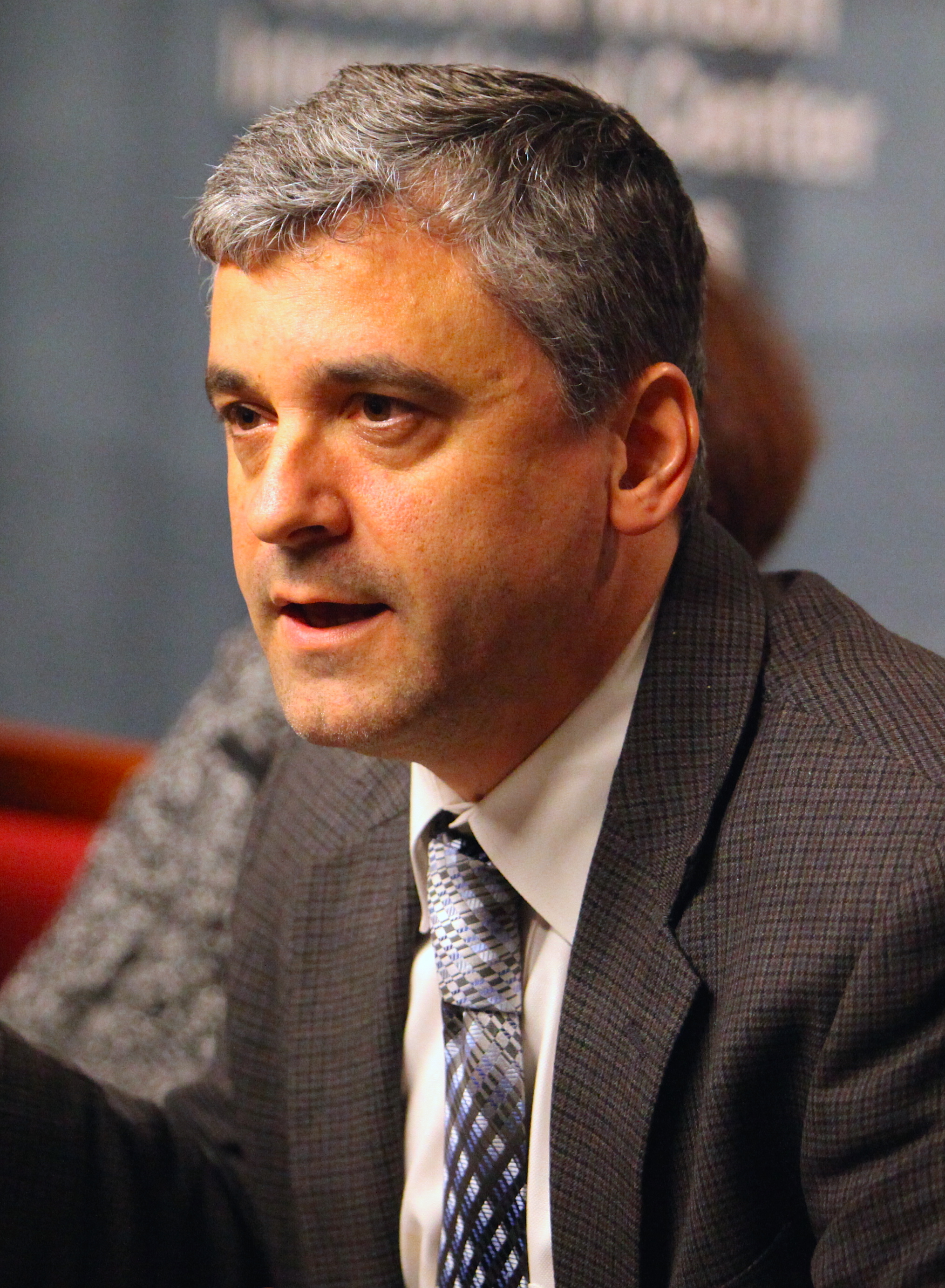
Steven Levitsky
American political scientist and professor
11
APPEARANCES
11
PODCASTS
Sep 24, 2026


Joshua DouglasHOST
So can you tell us a little bit more about kind of specific examples where we've seen people of their own side tolerating this type of behavior? And what do we do to combat against that specific part of this?

Steven LevitskyGUEST
Citizens are not going to be interested in democracy if all the politicians that do the same thing and speak the same language and promise the same things.
Steven LevitskyGUEST
And that means that there are going to be important, significant, meaningful differences of opinion across the political spectrum.

17:55

¿Cómo, cómo ve que está influyendo, eh, también en el Perú, eh, esta nueva fase de, de autoritarismo que hay en Estados Unidos versus la región?
Steven LevitskyGUEST
Em, uno, eh, que, que no fue precisamente tu pregunta, pero que es, eh, importante, es, em, una, una consecuencia de, de un gobierno cada vez más autocrática es que el, el, el presidente, sobre todo en la política exterior, puede hacer lo que le da la gana.
Steven LevitskyGUEST
Y Trump, primero, es muy ignorante, pero tiene una mentalidad del principio del siglo XX.
Steven LevitskyGUEST
O sea, tiene una actitud imperialista de la vieja escuela, antes de la Guerra Fría, o sea, de hace ciento y veinte años.
Steven LevitskyGUEST
Esa idea que, que, que Estados Unidos abiertamente puede instalar el gobierno que le da la gana y robar recursos, como están haciendo hoy en día en Venezuela, que pueden ponerse en Cuba, que pueden ponerse en Honduras.
14 MINS LATER

Steven LevitskyGUEST
In fact, one of the reasons why, even though I, I've obviously been writing for years about Trump's authoritarianism, one reason why I was always relatively confident in US democracy was, again, that we have such a wealthy, well-organized, well-connected society that's not dependent on the government the way that, say, Russian oligarchs are, and that have the resource.
Steven LevitskyGUEST
We, we have the muscle in our society to push back easily against Trump, and we didn't do it.
Steven LevitskyGUEST
So had you asked me prior to Trump's election whether it's a positive or a negative that we've got 8, 900 billionaires and more than 20 million millionaires in this country, I would say that's a good thing, because Trump cannot buy all these folks off, and they're gonna provide resources for the opposition.

Molly Jong-FastHOST
Talk us through, sort of if you look at the broad sweep of American history, what do you think it is?

Steven LevitskyGUEST
Um, in the case of universities, the attack was so thoroughgoing and so punitive that there has been a large-scale kind of preemptive appeasement or acquiescence.
Steven LevitskyGUEST
Uh, the degree of self-censorship, the degree to which university presidents are not speaking out, the degree to which campuses, colleges, and universities across the country have heavily restricted student protest.
Steven LevitskyGUEST
For the first time since before 1968, students are reluctant to protest 'cause they know they will be punished for just peaceful protest.
Steven LevitskyGUEST
The, the dismantling, the thoroughgoing dismantling of DEI programs, which are entirely legal, and anything that even smells of DEI.

Andrew MarantzHOST
But when acquiescence is rational to sort of protect your own work or the future possibility of your work, like how, how do you argue against it?


Harry LitmanHOST
So, do you see in general a, a kind of ch- shoulder shrug or even mild support for Trump, for now anyway, among the majority of the American people?
Steven LevitskyGUEST
Poll- polls show that, that a maj- a solid majority, and, and in fact a growing majority, of Americans oppose virtually all of what this government is doing.
Steven LevitskyGUEST
Obviously, there is still a, uh, a significant chunk of the population that supports him and, uh, that is indifferent to it.
Steven LevitskyGUEST
I think in ad- in addition to the fact that you're absolutely right, most authoritarian regimes, because they don't touch most people's daily lives, mo- most of the time people are not fixated on, "Well, this is a, this is authoritarianism.
7 MINS LATER
Harry LitmanHOST
Can you just explain that term and why that's your, um, lookout in, uh, today's US?


Ari MelberHOST
Um, professor, uh, given again your background in studying, uh, democracy issues in general, um, plus we have all of these immigration powers that the administration is trying to seize, your, your thoughts tonight.
Steven LevitskyGUEST
W- what we're seeing and what we've seen since the beginning of this administration is an administration that doesn't believe in the rule of law.
Steven LevitskyGUEST
Uh, not, not one, not one that is simply authoritarian, but one that is systematically violating the law until it gets stopped, and that's not how the rule of law works.
Steven LevitskyGUEST
I mean, Americans should reflect on why we're one of the richest, most peaceful, uh, most stable democracies in modern world history.
Steven LevitskyGUEST
It's because, not because of the air that we breathe, not because of the water, not because of something in the American character.
Steven LevitskyGUEST
It's the strength of our institutions, the strength of our rule of law, and that means that there are a set of laws and everybody, every citizen, every businessperson, every politician, no matter how powerful, obeys the law and when told to stop, stops.
Ari MelberHOST
And so I'm curious, to let you finish your point, what it means if we have that lawless mentality now by not only the people in charge at the top, but lawyers and DOJ trying to normalize it.

Frank LangfittCORRESPONDENT
Talk to many people who study political systems these days, but not all, and you'll probably hear something new and striking.
Frank LangfittCORRESPONDENT
For instance, Trump has issued executive orders barring lawyers with firms he doesn't like from entering government buildings and representing government contractors.
Steven LevitskyGUEST
There is a widespread perception in our civil society among CEOs, in the media, among university presidents, among, uh, leaders of nonprofits, among politicians of both parties that there is now a cost, a risk associated with publicly opposing the Trump administration.


Dave DaviesHOST
Is there anything comparable to this in other democracies that have slid towards authoritarianism?
Steven LevitskyGUEST
When Lucan and I wrote our Foreign Affairs piece, we, it, it was published in February, but we wrote it in December before Trump took office, and so it's a speculative piece, and I think we really nailed it in a bunch of areas in terms of the weaponization of government and its deployment against critics.
Steven LevitskyGUEST
This is an entirely new dimension that all of our studies of authoritarianism elsewhere had really provided us no, no comparable example.
Steven LevitskyGUEST
I still don't fully understand exactly what Musk is after, but I consider it probably the most dangerous element of the whole process these last few months.
Steven LevitskyGUEST
I've never seen, never remotely seen, a concentration of economic, media, and political power as we see today in Elon Musk.
Dave DaviesHOST
Final question, how optimistic or pessimistic are you about the future of American democracy (laughs)?


Rachel MaddowHOST
Can you help us understand how the decision was made and- and- and what was compelling to the powers that be there to convince them to take the stand?
Steven LevitskyGUEST
Um, I think, for one, Harvard's leadership looked at what happened to Columbia.
Steven LevitskyGUEST
All it got was more demands a- and- and didn't even get their... the- the money released.
Steven LevitskyGUEST
So, that's what happens when you negotiate, make concessions to an authoritarian extortionist.
Steven LevitskyGUEST
And so Harvard realized that- that- that- that strategy was- was- was- was a dead end.
Rachel MaddowHOST
Can- can you talk just, uh, from your academic perspective, in terms of talking about, um, the way other countries have dealt with this in other times and in other places, other contexts, can you talk about the value of fighting together, of not fighting alone, and whether or not that, um, makes you th- not just a bigger target (laughs), it, it, whether that makes you, you more effective and more resilient?


John BermanHOST
So, Professor, what's your reaction to Harvard potentially losing its tax-exempt status and what kind of impact could that have?
Steven LevitskyGUEST
This is part of an authoritarian assault, uh, against our country's institutions.
Steven LevitskyGUEST
It- uh, it's an assault on, uh, on the media, on law firms, on, uh, critics of the Trump administration on both sides of the aisle.
Steven LevitskyGUEST
In democracies, universities are not, uh, uh, are not attacked by the government.


Jon FavreauHOST
So I know the transition from democracy to autocracy is more of a, a sliding scale than an on/off switch, especially in the modern era, but what do you see as the primary differences between Trump 1.0 and Trump 2.0 that makes this version seem more like competitive authoritarianism to you?
Steven LevitskyGUEST
I mean, o- one of the big problems in recent months is that a awful lot of Americans responded to Trump's s- uh, victory in 2024 with a shrug because they said, "Well, you know, the first time people like Levitsky started s- you know, r- raising, talking about democracy dying, and, and we, you know, we were fine.
Steven LevitskyGUEST
First, i- in, in the first time around, Trump didn't think he was gonna win.He had no plan, he had no team, he did not control the Republican Party so he c- and he didn't understand how the machinery of government even worked.
Steven LevitskyGUEST
He believed when he, when he began his presidency that all the institutions of the state were there at his beck and call, that he would be able to, um, to get public servants across the, the US government to, uh, to work towards his own personal and political ends and was shocked and angered to find out that things don't work that way.
Steven LevitskyGUEST
So he governed for the most part in to, his first term with either conservative technocrats or traditional, more or less traditional Republicans, and they constrained him.
Jon FavreauHOST
From where you sit, is there anything that can be done about this? Or like what are, what are the best strategies for, um, opposition forces or media outlets to fight this?