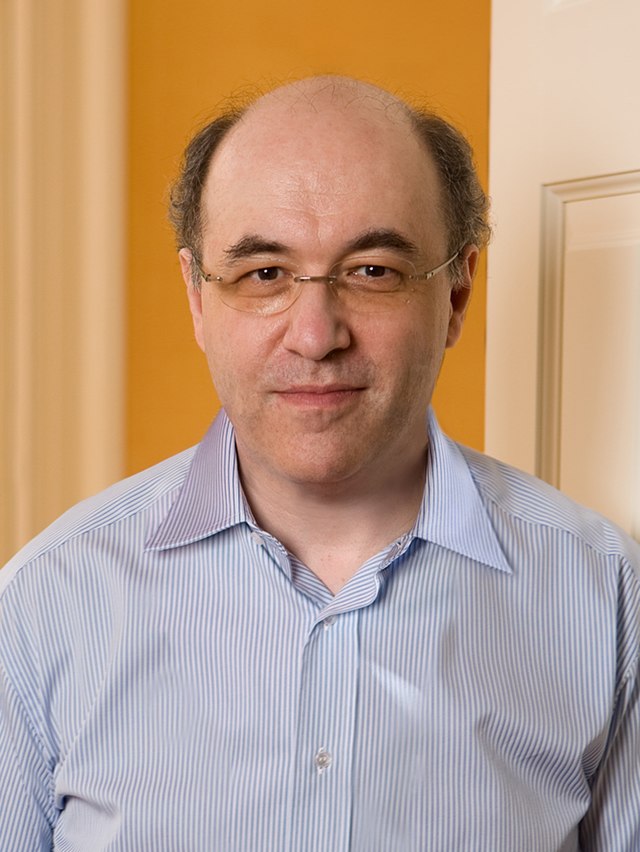
Stephen Wolfram
British-American computer scientist and physicist
5
APPEARANCES
3
PODCASTS
Jul 28, 2026


Stephen WolframGUEST
So I mean, the- there's kind of in the development of science You know, 1600s is a big, big period when people realized you could apply mathematics to understand the natural world.
Stephen WolframGUEST
You know, Newton's mathematical principles of natural philosophy was, uh, sort of a surprise at the time.
Stephen WolframGUEST
You could use this idea of mathematics, you could predict things about the natural world.
Stephen WolframGUEST
People got used to the idea that science can predict things, that by using methods typically from mathematics, you could say, "We observe things, we now can predict what's gonna happen in, uh, in the motion of planets or the development of a pandemic or other kinds of things." You could...
21 MINS LATER
27:23
On the one hand, what you think it can and cannot in principle do, and on the other hand, what you think the risks, uh, or dangers or possibilities are for, for, for human beings.

Stephen DubnerHOST
Visit a Sleep Number store near you or learn more at sleepnumber.com. [upbeat music] [gentle music] Chapter 8: Do We Still Live in a Scientific Culture? Stephen Wolfram, a computational scientist and entrepreneur, studied physics at Caltech and stayed friendly with Richard Feynman until Feynman's death.
Stephen WolframGUEST
Near the end of his life, he was like, "Well, now I'm gonna experiment with all kinds of drugs because I'm dying anyway, more or less." I think he was a little embarrassed about that.
Stephen WolframGUEST
I think he viewed himself as a think-for-yourself but nevertheless law-abiding citizen.
Stephen WolframGUEST
I don't think he felt that he was having brilliant insights rushing in because he was in some altered state.
Stephen WolframGUEST
One of the things he said to me was, "If you want to do creative science, peace of mind is an essential feature."
Richard FeynmanSOUNDBITE_SPEAKER
... very small machines, okay?
Stephen WolframGUEST
There wasn't a field called nanotechnology when Dick Feynman was thinking about nanotechnology.

Mark JefferyHOST
Where do your ideas come from? And when you have an idea, how do you know whether it's promising? And, and maybe even how has the way you think and had ideas changed through your lifetime?
Stephen WolframGUEST
Well, what can I say? I, I-- My general approach is to try and understand the foundation of things, to try and sort of get to the essence of things.
Stephen WolframGUEST
That seems to be something that I am prepared to fearlessly try to do, and that's a consequence in part of the fact that I've done okay at doing that.
Stephen WolframGUEST
And so I've developed the confidence that that's a thing that's possible to do.
Stephen WolframGUEST
I mean, when you see some field and it's like there's, you know, 100,000 academic papers written about some particular thing, and there's, you know, there's endless detail, and people have assumed the foundations for, for, uh, 200 years or whatever.
Stephen WolframGUEST
I mean, I would probably go further than him and say any field for which there is a prize that's defined is a field that already has had its best days behind it.
Stephen WolframGUEST
It's a field that barely has a name that's going to have the most fertile moment.
Stephen WolframGUEST
I happened to get one of these MacArthur awards in the very first batch of those things.
14 MINS LATER
Stephen DubnerHOST
place.Stephen Wolfram
Richard FeynmanSOUNDBITE_SPEAKER
I don't understand how it subtracts.
Stephen WolframGUEST
Oh, I think he had what one might call childlike curiosity, which I think most children have.
Stephen WolframGUEST
The question is, do they lose it before they get to adulthood? And I think that he was a strong enough willed person who wanted to think in his own way for himself, that he kept that childlike curiosity.
Stephen WolframGUEST
I'm Stephen Wolfram, and I do science and technology, and I've done that for many years.
Stephen WolframGUEST
I happened to organize the theoretical physics seminars at Caltech for a while and would invite all sorts of people, and Feynman would come, and he would try and have this competition with me for who could find the fatal flaw first, which was, a- actually, in the end, there was some terrible moments there where [laughs] it was an embarrassing thing, although some interesting science got done as a result.