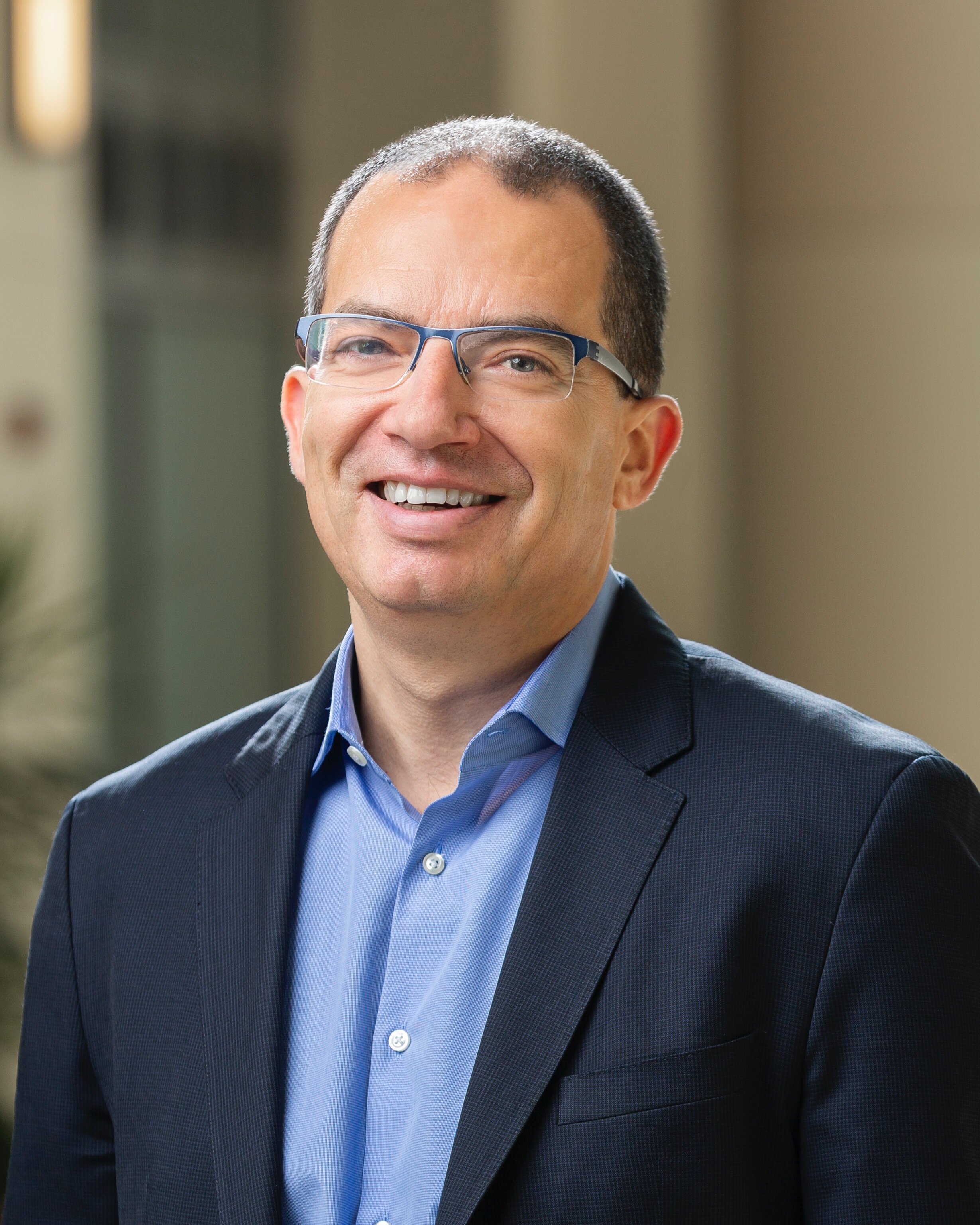
Stéphane Bancel
CEO of Moderna Therapeutics
12
APPEARANCES
12
PODCASTS
Oct 29, 2026


Stéphane BancelGUEST
So why do some people believe over time, again, not next week, over time it could be bigger than K2 drug? First, because we believe it's going to work everywhere where K2 drug works.
Stéphane BancelGUEST
But then also another piece that we believe, with Merck and Moderna, is if you go early in disease, like stage 1 disease, there might be a very interesting use of intismeron as a monotherapy, meaning by itself, without cathedra.
Stéphane BancelGUEST
And we announced in the spring that we have started a phase 3 clinical study, so a big 1,000-people study.
Stéphane BancelGUEST
Because today, if you have lung cancer diagnosed in stage 1, which you can do with a CT scan, especially to former smokers, the standard of care is surgery and monitoring.
Stéphane BancelGUEST
Why are checkpoint medicine like Ketudra and others not used early in disease? Because of the lifelong side effect profile.
13 MINS LATER

Andy SerwerHOST
And final question, Stefan, I want to ask you, why should investors buy Moderna stock now? And what is the TAM? How big an opportunity, how big could this company be? And also, can you address the competitive moat that your company has? Why can't some other company do what you're doing, for instance?

Romaine BostickHOST
How much confidence do you have that we will start to also see efficacy and commercial availability for kidney or bladder cancers and other types of cancers?
Stéphane BancelGUEST
We believe that it's going to work in more cancers than melanoma because of a mechanism of action.
Romaine BostickHOST
But when you look back to 2015, 2016, when there was a lot of skepticism about this, what is the message here in 2026 that you give some of those skeptics today?


Jodi GoldsteinHOST
Talk about diversity in your organization and the culture that you're building and how do you achieve this vision?
25 MINS LATER
Alice LeeHOST
So Phoebe is actually wondering, what's the reasoning behind the business model of having multiple ventures?

Stéphane BancelGUEST
You handicap what is the regulatory risk on top of, let's say, the drug risk or the marketing risk.
Stéphane BancelGUEST
Say, if we had this drug, we phase III positive data, let's say in two years after you do your clinical study.
Stéphane BancelGUEST
What is the probability that we go into a regulatory complex situation? The thing that has been really encouraging, and you have seen it what happened with flu as you describe, which is the working team at the FDAs have stayed very focused on the science and the data.
Stéphane BancelGUEST
And I think what happened with the flu program of Moderna this year is a good example of that, which is we started to review a file.

Brendan VaughanHOST
But I, I, I started with quickly because that's what I feel like I've heard most about, is that it just simply can move so much faster and do computations and, and, and make predictions that would take humans a, you know, a, uh, a, such a different amount of time to, to do on their own that it's not even comparable.

Stéphane BancelGUEST
You handicap what is the regulatory risk on top of, let's say, the drug risk or the marketing risk.
Stéphane BancelGUEST
Say, if we had this drug, we phase III positive data, let's say in two years after you do your clinical study.
Stéphane BancelGUEST
What is the probability that we go into a regulatory complex situation? The thing that has been really encouraging, and you have seen it what happened with flu, as you describe, which is the working team at the FDAs have stayed very focused on the science and the data.
Stéphane BancelGUEST
And I think what happened with the flu program of Moderna this year is a good example of that, which is we started to review a file.
Brendan VaughanHOST
But I, I, I started with quickly because that's what I feel like I've heard most about, is that it just simply can move so much faster and do computations and, and, and make predictions that would take humans a, you know, uh, uh, such a different amount of time to, to do on their own that it's not even comparable.

Stéphane BancelGUEST
of mRNA side, what we have known and published, actually with Karolinska, as you know, the institute in Sweden that gave the Nobel Prize for Medicine back in 2015, is that with all technology, I cannot speak about all the mRNA companies that have different mRNAs, different lipids and so on, but with all technology, when we inject our mRNA in a muscle, whether it's a COVID shot or flu shot or this cancer treatment, basically the mRNA goes down to your lymph node and enters the APCs, the antigen-presenting cells, which, as you know, are key components of your immune cells.
Stéphane BancelGUEST
And then it basically translates the message contained in the mRNA inside the APCs, inside your immune cells, and presents it from within.
Stéphane BancelGUEST
So we think it's a very important differentiation from most of the previous vaccine in cancer in the field that were made by protein or peptide that basically are made in reactors, are injected in the patient, but they basically turn into the blood because, as you know, recombinant or protein, when you inject them, they just go into your blood and they turn around.
7 MINS LATER

Jorge CondeHOST
How do you think about essentially the vein-to-vein time? Like what needs to be true from the moment you, you know, sort of see a patient and get access to the tumor to the moment that patient receives their personalized vaccine?

Jorge CondeHOST
So why don't I hand it over to you and tell us what have you announced, what have you seen in this phase three trial? And then I do want to dig in into what Moderna is doing in cancer.
Stéphane BancelGUEST
So indeed, last week now, we shared the news with our colleagues at Merck that after working ten years on a individualized treatment against cancer using mRNA technology, that the phase three was positive.
Stéphane BancelGUEST
It's a f-first time that there is an agent in melanoma that is better than Keytruda alone, so it's a big deal for patients, of course, with melanoma.
18 MINS LATER


Stéphane BancelGUEST
Uh, we believe that this is just a first step for INTIS MEHR and plus KEYTRUDA.
Stéphane BancelGUEST
Already just hearing stories from patients in clinical studies has been really, uh, heartening.
Stéphane BancelGUEST
That's the type of things we're trying to do at Moderna, is take very big scientific clinical bets.


Stéphane BancelGUEST
They clearly were aware already before, uh, the news [laughs] report of Wall Street Journal was aware, uh, and they were monitoring.
Stéphane BancelGUEST
And when the sequence, the genetic instruction of the virus was put online in early January, we started to prepare a product to put a clinical trial because I thought, like everybody at the time, it was gonna be like SARS or MERS or a local outbreak, and then it will go away.
Stéphane BancelGUEST
But I wanted to prove to ourselves, to myself and to Tony Fauci, that we could go in a clinic i- in 60 days, which was what I told him before in 2019, that he didn't believe me, could be done because when SARS happened, it took the NIH, Tony had told me, twenty months to go to the clinic.
36 MINS LATER
Stéphane BancelGUEST
... doing things in parallel so you don't do them one after the other," which is what people do usually to manage business risk, financing risk, where they do things one after the other once they know things are working, uh, because if not, they will be, uh, irresponsible financially in normal times.
Stéphane BancelGUEST
But in war times, when you fight a virus and people are dying and economies are stopped, the government basically just threw money at the company to say, "Everything you can do in parallel, do in parallel," which is what we did.


Angelica PeeblesCORRESPONDENT
So tell us about those results and what we should expect to see from the Phase III based on these Phase II results.
Stéphane BancelGUEST
So indeed, this morning, we presented very exciting data for five year of our Phase II study.
Stéphane BancelGUEST
I remind you it is a, a randomized study against Keytruda, the standard of care.
Stéphane BancelGUEST
And what is exciting this morning is we showed that at five years the hazard ratio of the improvement versus Keytruda is the same when at three years.
Stéphane BancelGUEST
So there's duration of efficacy, which of course is great news for patient.
Stéphane BancelGUEST
And because as time has gone by, the P value of a statistical power of a analysis is actually stronger than it was at, uh, three years.
Angelica PeeblesCORRESPONDENT
And how widely used do you think that this, uh, this approach could be, whether not just outside of melanoma, but do you think it'll only be in the adjuvant setting? Like, how big of a drug could this become?


Eric KutcherCORRESPONDENT
So what does that mean for something like a cancer treatment going forward?
Stéphane BancelGUEST
forward?If you think about cancer, what we know today is that cancer is basically an instability of your DNA, either caused by a genetic, you know, mutation or caused by a virus, think about hepatitis leading to liver cancer, uh, or caused by an external factor.
Stéphane BancelGUEST
Think about sun driving exposure into your DNA of your skin and driving, uh, melanoma skin cancer.
Stéphane BancelGUEST
Think about the number of cells you have in your body, the number of exposure you have.
6 MINS LATER
Eric KutcherCORRESPONDENT
Talk a little bit about Moderna, Moderna's role in this kind of evolution of the biotech life sciences space.


Stéphane BancelGUEST
And so between Christmas and New Year 2019, as I was reading the Wall Street Journal, I heard about COVID.
Stéphane BancelGUEST
And so I reached out to the NIH asking, hey, this new thing in China, what is it? And after a few days, we realized it was a virus.
6 MINS LATER