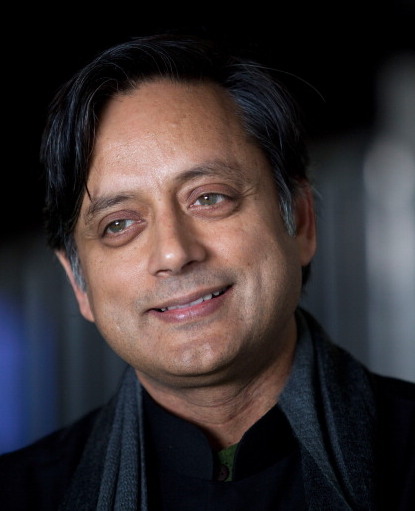
Shashi Tharoor
Member of the Lok Sabha
5
APPEARANCES
5
PODCASTS
Oct 22, 2026


Shashi TharoorGUEST
I clearly wasn't the guy they wanted because they knew me well as somebody who was all over the U.S. media.
Shashi TharoorGUEST
I was regularly the fellow wheeled out to appear on even hostile news channels like Fox News to defend the UN.
14 MINS LATER


Shashi TharoorGUEST
Um, on the 10th, Rahul Gandhi was to go off and address another protest in Chennai in South India, and that was the space then occupied by the Congress-- Cockroach Janata Party, which had already held a protest in parallel to the Congress' but in Mumbai.
Shashi TharoorGUEST
I landed from Europe, uh, uh, on, on the, uh, Friday night around 1:00 a.m., got home around 2:00 a.m., and I was astonished to see barricades across many of the streets in my neighborhood and towards Central Delhi, um, spike strips and other barriers laid across the roads, um, an extraordinary warlike deployment of over 25,000 security personnel the next morning, um, and, uh, uh, uh, an astonishing decision to shut down the metro system, the, the, the, um, the tube system, as you would call it-
10 MINS LATER
Shashi TharoorGUEST
And to be honest, everything we've seen in India in these last 79 years has, has very much been of an Indian model, and we've been through everything.

Kal RaustialaMODERATOR
So I thought we could start with that and just ask you to say a little bit about what are we transitioning from and what are we transitioning to?
Shashi TharoorGUEST
Well, it's easier to answer the first part, what are we transitioning from? And I think we're looking at a world which really was constructed in 1945.
Shashi TharoorGUEST
People often don't realize that first half of the century, or more precisely the 30 or 31 years from the start of the First World War to the end of the Second, were a catastrophic time for humanity, right? So you had two world wars, countless civil wars, mass displacements of population, massacres of people and the horrors of the Holocaust and Hiroshima.
Shashi TharoorGUEST
And at the end of that, I think we had, fortunately, we were blessed by far-sighted visionary leaders around the world who realized the world couldn't go on like that and there'd be no world left for all of us to enjoy.
Shashi TharoorGUEST
And so the victors of World War II decided in 1945 at San Francisco to convert themselves into a peacetime alliance.
Shashi TharoorGUEST
And what was, I think, profoundly valuable then is best encapsulated in President Harry Truman's famous speech at San Francisco.
Shashi TharoorGUEST
There was a guy heading a country which then accounted for 50% of global GDP.
19 MINS LATER
Kal RaustialaMODERATOR
So let me just ask you, since we're in this moment where it's 80 plus years, there's a Secretary General race going on, does the UN really have a future in your view? And what is that future?

Javed AnsariHOST
What precisely does the Congress need to do to win, to connect with the youth and win back some of them?
Shashi TharoorGUEST
I think the youth are a very important segment that we have really woken up well to.
Shashi TharoorGUEST
You were mentioning to me that you were in Allahabad and saw the energy and enthusiasm there.
Shashi TharoorGUEST
I think today as you and I are speaking, we have Rahul Gandhi on dharna, uh, defending the rights of a pellet gun victim from the Jantar Mantar protests.
Shashi TharoorGUEST
And I must say to you, Javed, that we are in a situation today where the Congress seems to have reached out more effectively to the youth than perhaps it had done earlier, and than perhaps many of the mainstream parties have done at all.
Shashi TharoorGUEST
But that's not the only segment we need to reach out to, and that's where I think, uh, in many ways my central argument, and perhaps I'm limited by the fact that I come from a sort of middle class, urban, professional upbringing and that's the world I'm most familiar with.
Shashi TharoorGUEST
But I've often argued that while we are very good at appealing to sectional interests, whether it's caste, whether it's religion, whether it's a, uh, a specific, um, uh, kind of group that has been victimized, let's say tribals in a particular area, whatever, we also need, and this is where we seem to have been found lacking in the past, to reach out on those issues that affect all Indians irrespective of caste or creed or anything else.


May-Elin StenerHOST
So, you know, What are you thinking then? Why did you use the word samban when you wrote about Norway and Indian relations?
Shashi TharoorGUEST
I'm a firm believer in the fact that we need to strengthen the relationship with the Nordic countries.
Shashi TharoorGUEST
And Indians and India generally have been spending more time in relationships with the Nordic countries than ever before.
Shashi TharoorGUEST
The summit process started just two summits before this, so it's been every four years.