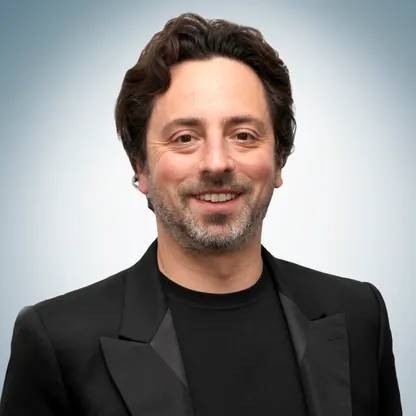
Sergey Brin
American computer scientist and former president of Alphabet
3
APPEARANCES
3
PODCASTS
Jun 3, 2026


Astro TellerHOST
And before we s- get into reminiscing, what were you thinking 15-plus years ago? Like, what did you think maybe it could become?

Sergey BrinGUEST
Well, I think you're giving me too much credit, but there were a bunch of folks back then who aspired to create something like X. Um, I guess we had really benefited at the time from a lot of success on the internet, Search, Gmail, Chrome, and hoped to take that sort of aspirational, uh, technological idea, uh, into new fields and new areas that were ambitious.
Sergey BrinGUEST
It spurned this question, could we now push technology farther in a broader set of domains?
7 MINS LATER
Sergey BrinGUEST
And by that I mean a lot of times people say, "Okay, oh, look at, there's this new model and it can do X, Y, and Z, um, and therefore, okay, I'm gonna do like customer support on that, and that's all gonna change." But of course, like, the issue with thinking about it in those terms is that it's a moving target because the thing that the AI model is gonna do the next year is gonna be that much greater.
Sergey BrinGUEST
So if you just sort of redesign the world based on today's AI capabilities, like, uh, if you were to just freeze AI progress, all of a sudden, okay, this is as good as it's gonna...
Sergey BrinGUEST
Yeah, the world will still change a lot, um, but you can basically do that for any specific level of AI, you could kind of imagine, you know, the world that that gives.
Sergey BrinGUEST
I think the hard thing to do is to figure out, well, what's gonna happen if the AI continues to develop at the rate that that has been, um, and doesn't freeze?Uh, and that's kind of a, that's a very complicated treadmill to think through.


Alex KantrowitzHOST
Do you think that AGI is gonna be reached by one company and it's game over? Or could you see Google having AGI, OpenAI having AGI, Anthropic having AGI, China having AGI?
Sergey BrinGUEST
I mean, I guess I would suppose that one, uh, company or country or entity will reach AGI first.
Sergey BrinGUEST
It's not, like, a completely precise thing, so it's conceivable that there will be more than one roughly in that range at the same time.Um, after that, what happens, I, I mean, I think it's very hard to foresee.
Sergey BrinGUEST
Uh, but you could certainly imagine there's gonna be multiple entities that come through and...
9 MINS LATER
Alex KantrowitzHOST
What did you learn from Glass that Google might be able to, uh, apply today now that it seems like smart glasses have made a reappearance?

speaker_0HOST
Yeah, do you, and do you believe in the humanoid form factor robots, or do you think that's a little overkill?
Sergey BrinGUEST
I'm probably the one weirdo who doesn't, who's not a big fan of humanoids, but maybe I'm jaded because we've, you know, we at least acquired at least two humanoid, uh, robotic startups and later sold them.
Sergey BrinGUEST
I mean, the reason people want to do humanoid robots for the most part is because the world is kind of designed around this form factor.
Sergey BrinGUEST
And, you know, you can train on YouTube, you can train on videos, people do all the things.
Sergey BrinGUEST
Like, AI can learn, you know, through simulation and through life pretty quickly how to handle different situations, and I don't know that you need exactly the same number of arms and legs and wheels, which is zero in the case of humans, as humans to make it all work and uh...
speaker_0HOST
Is the number of foundational models in the future, Sergey, a multiple of what they are today, the same, something in between?