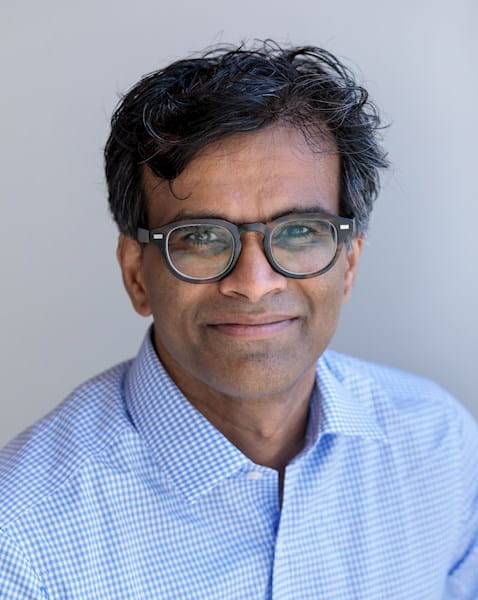
Sendhil Mullainathan
American professor
5
APPEARANCES
3
PODCASTS
Sep 5, 2026


Sendhil MullainathanGUEST
The second thing I do is I always tell people ideas I've heard, whether they're my own or something else.
Sendhil MullainathanGUEST
Creating new ideas is largely reassembling stuff you've seen or putting things together.
Sendhil MullainathanGUEST
So part of what you want to do is just, Enjoy having this wealth of stuff inside of you that you love and cherish sharing and do it.
6 MINS LATER

Steve LevittHOST
Is there any research you've done, ideas you've had, that you think are really important but just got ignored for some reason? This is
Steve LevittHOST
So you think that school should be more like life, or the point of school should be to teach people to be learners?
Sendhil MullainathanGUEST
Could school teach us to be learners, but learners in environments? And in psychology, there's this notion of a wicked environment.
Sendhil MullainathanGUEST
A wicked learning environment is one where there's very little feedback.
Sendhil MullainathanGUEST
And how would you arm people to be learners in a wicked environment? I don't have an answer to it, but that's the kind of question that I'm throwing around in my head, because that seems like it would have very high return.
Sendhil MullainathanGUEST
If we could even make a little bit of progress on that, given that everyone is about to be thrown out into this world.
5 MINS LATER
Steve LevittHOST
Do you have advice for young people who are trying to figure out their place in the world?


Sendhil MullainathanGUEST
There's this term, though a bit technical, I think is very helpful, called closed world versus open world problems.
Sendhil MullainathanGUEST
Let's say chess satisfies that, but I'm going to come back on how even chess may not satisfy that in a second.
Sendhil MullainathanGUEST
All the rules are known, all the objectives are known, everything is there.
20 MINS LATER

Pablo TorreHOST
Can you explain supervised learning and how your fandom of sports has led you to see sports through that lens?
Sendhil MullainathanGUEST
There's this term, though a bit technical, I think is very helpful, called closed world versus open world problems.
Sendhil MullainathanGUEST
But I'm going to come back on how even chess may not satisfy that in a second.
27 MINS LATER
Pablo TorreHOST
Can you explain supervised learning and how your fandom of sports has led you to see sports through that lens?


Luigi ZingalesHOST
But actually, how do we know that they're not doing something worse in opening eyes? I think the nuclear reaction thing is a perfect example.
Sendhil MullainathanGUEST
It's an unbelievable, powerful technology, and I think it's a good starting point.
Sendhil MullainathanGUEST
So let me articulate two things that I think are very different, which actually make it an even harder problem.
Sendhil MullainathanGUEST
Enriching uranium or plutonium to be able to get a sustained reaction is a lot of money.
Sendhil MullainathanGUEST
On the other hand, building a large language model is not, and it's getting easier and easier.
Sendhil MullainathanGUEST
And while it's in the benefit of companies to tout that they're light years ahead of everybody else, the open source models are getting really good.
7 MINS LATER