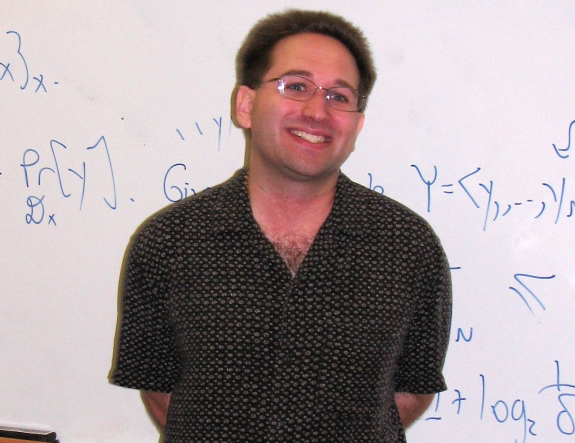
Scott Aaronson
American computer scientist
5
APPEARANCES
5
PODCASTS
Sep 29, 2026

SebHOST
In fact, they can even be complex numbers

Scott AaronsonGUEST
So I'm assuming that I've already explained to our five-year-old what is a complex number.
Scott AaronsonGUEST
And the key thing about these amplitudes is that you have to add up you know, all the possible amplitudes by which something could happen.
Scott AaronsonGUEST
Okay, so just like, you know, in probability, right, if I say, how likely is this particle to show up at a certain spot on a screen, you know, then there might be different ways that the particle could have gotten there, right, different paths that it could have taken.
50 MINS LATER
SebHOST
How do you see the two by comparison?

speaker_1HOST
about
Scott AaronsonGUEST
You know, although although I actually, you know, well, it's certainly not about those one million dollars.
Scott AaronsonGUEST
I mean, I mean, OpenAI is probably more interested in its upcoming trillion dollar IPO.
Scott AaronsonGUEST
And, you know, and so like like unsolved math problems, you know, were previously very esoteric.
20 MINS LATER
speaker_2HOST
Is there a distinction?

speaker_0NARRATOR
And in terms of
Scott AaronsonGUEST
what we have clinically, it primarily is ECT, electroconvulsive therapy, and TMS.
Scott AaronsonGUEST
And the powers that be decided that once the grant support ran out, they were afraid that it would not be financially feasible to continue.
Scott AaronsonGUEST
And what you'll also see is that What exists in the community is largely esketamine clinics are existing outside of academic or hospital situations just because the margins are so small in terms of making this profitable.
Scott AaronsonGUEST
That's actually what we're going to wind up seeing once psychedelics start to roll out.

Ritu BaralHOST
So from your perspective, working with patients in a real world interventional psychiatry setting, where do you still see the biggest unmet need for patients with TRD, treatment resistant depression?

Scott AaronsonGUEST
think we have to be careful in separating these concepts, right? I mean, so first of all, you know, even purely classical things can be highly nonlinear, can be, you know, incredibly complicated concepts.
Scott AaronsonGUEST
There are even mysterious phenomena like turbulence, even just within classical physics that we don't fully understand yet.
Scott AaronsonGUEST
And of course, the entire theory of computation up until the last few decades was about classical computation.
Scott AaronsonGUEST
But what distinguishes a classical system is really that in principle, you could know its state to arbitrary accuracy, even if you don't.
23 MINS LATER
Malcolm Out LoudNARRATOR
building an arbitrarily reliable quantum computer.

Robinson ErhardtHOST
But for our listeners who have only heard the name quantum computing, but don't know anything about it conceptually, I'm wondering how you would introduce it to them, preferably without getting too much into the mathematics or the actual mathematical physics of it.
Scott AaronsonGUEST
I mean, I mean, I mean, the the trouble is, you know, like, you know, every week I'm talking to journalists who say, like, can you explain what quantum computing is in one sentence? Right.
Scott AaronsonGUEST
And and I'm like, well, you know, if I could do that, or can you analogize it to something that, you know, you know, people already know.
Scott AaronsonGUEST
And like it wouldn't be so interesting if it were if it were easy to do that.
26 MINS LATER