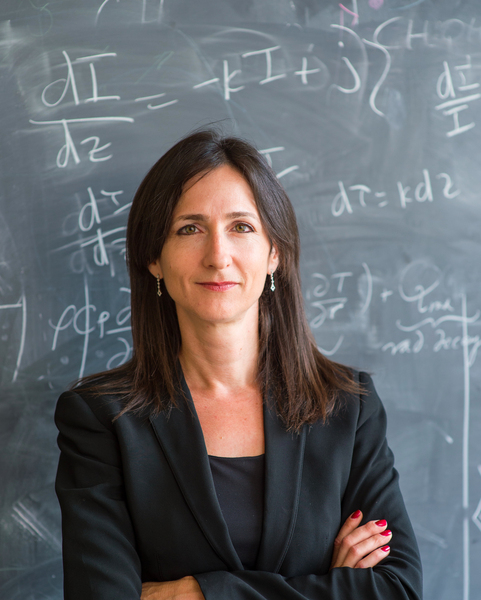
Sara Seager
Canadian-American astronomer and planetary scientist
17
APPEARANCES
14
PODCASTS
Nov 5, 2026

7:02

So it seems to me you were there at the birth of this, if not having birthed it yourself.

Sara SeagerGUEST
And in fact, but just to go back even further before my time, perhaps even before yours, but in the decades past.
Sara SeagerGUEST
No. OK, well, you know, if you look back, like even, you know, just after the time of Sputnik, like in the early 1960s, there's actually a report.
Sara SeagerGUEST
And it actually talks about planets and exoplanets and the chance for other Earths.
19 MINS LATER


Angela SainiHOST
you just describe to me where the book starts? It starts with you learning about your husband Mike's illness.

Sara SeagerGUEST
And everything was going really well until one day my husband Mike had a stomach ache.
8 MINS LATER

Jeyan JeganathanHOST
I am curious, what were some of the sacrifices or losses that you've had to make to make this move?
Sara SeagerGUEST
Well, I would say saying goodbye to friends, of course, is a tough one and colleagues and, you know, the brainpower here.
Sara SeagerGUEST
It's not necessarily something I want to advertise on national TV, but I'm taking like a pay cut to come home, leaving quite a lot of money on the table for pension.
Sara SeagerGUEST
And as everyone else already chimed in, the resources to get our work done is not only a huge personal gain, but it's also something we need to take Canada to its next level.


Sara SeagerGUEST
If we didn't have life on Earth, if we didn't have plants and photosynthetic bacteria, we would have no life.
Sara SeagerGUEST
So we astronomers and astrobiologists, we have a long list of molecules that could be a sign of life.
7 MINS LATER

Tom WhippleHOST
Now that we've found these exoplanets, how do we start categorizing the ones that might just be the civilization?

speaker_16UNKNOWN
C'est ça ?
Sara SeagerGUEST
Cette image de la Terre a vraiment marqué le début du mouvement écologiste moderne.
Sara SeagerGUEST
Quand j'étais à l'université, j'ai demandé à quoi la Terre ressemble-t-elle vue de très loin, quand on ne peut voir ni les continents, ni les océans ? Et peut-on vraiment affirmer qu'il y a de la vie sur cette planète ? Alors, on a regardé la Lune, quelques jours après la nouvelle lune, quand on commence à voir ce croissant très fin juste au coucher du soleil.
Sara SeagerGUEST
On remarque que la partie sombre de la Lune est aussi visible parce que la Terre brille sur cette partie de la surface lunaire.
41 MINS LATER
speaker_9UNKNOWN
Donc, nous pourrions être vraiment seuls.


Ira FlatowHOST
Do you view it that way, why you've changing, why you're changing directions? I'm not, I'm not saying it's a less of a thing that you're working on, but I'm just w- wondering personally why the change in direction?
Sara SeagerGUEST
One is the kind of more thoughtful reason, and one is the reality, [laughs] okay? So the thoughtful reason is that I love doing new things.
Sara SeagerGUEST
I'm really comfortable pushing the envelope, inventing new things, starting new fields.
Sara SeagerGUEST
And my original field of exoplanets, and specifically exoplanet atmospheres, got very mature, and there's a lot of amazing young people, and even now people not so young, doing a fantastic job there, and I try to not do things that other people can also do.

No mention dialogue available.


Sarah SeagerGUEST
She wasn't asking me to legit validate it, but she definitely wanted me to, you know, just to listen.


Adam GrantHOST
Okay, so timeline-wise, how long do you think it might take to discover life if it's out there?
Sara SeagerGUEST
Well, let's just start with simple bacteria, like, not even complex life, just the simplest life form we can think about, maybe even simpler than our bacteria here on Earth.
Sara SeagerGUEST
We really hope to accomplish that in our lifetime, starting with our solar system, the subsurface of Mars.
Sara SeagerGUEST
One of my favorites is the clouds of Venus, little primitive microbes just floating around.
11 MINS LATER

Adam GrantHOST
So timeline-wise, how long do you think it might take to discover life if it's out there?
Sara SeagerGUEST
Well, let's just start with simple bacteria, like not even complex life, just the simplest life form we can think about, maybe even simpler than our bacteria here on Earth.
Sara SeagerGUEST
That we hope to have evidence for, maybe not robust, solid findings, but kind of suggestions.
Sara SeagerGUEST
We really hope to accomplish that in our lifetime, starting with our solar system, the subsurface of Mars.
Sara SeagerGUEST
One of my favorites is the clouds of Venus, little primitive microbes just floating around.
Sara SeagerGUEST
Perhaps subsurface of one of Jupiter's or Saturn's icy moons, like Enceladus is one of the favorite targets.
8 MINS LATER

Matt GallowayHOST
Have you felt this in your own research? Has, has your research been cut or threatened?
Sara SeagerGUEST
At this moment in time, my main research is very extremely frontiers, and it's not fundable by government agencies.
Sara SeagerGUEST
So for my little isolated universe, it's okay, but everyone all around me, including my son who works in research or my adjacent colleagues, everyone is suffering somehow.
Sara SeagerGUEST
Just for example, MIT, that you haven't probably heard much in the news about, we're getting a...
Sara SeagerGUEST
We have a, a new endowment tax on our endowment, which a lot of which, which we use for our operating budget, and MIT is facing $300 million cut from endowment and other things permanently, annually.


John BatchelorHOST
So Professor, an unlimited budget is yours, where do you wanna go next? Thank you.
Sara SeagerGUEST
That is scooping up part of Venus's clouds, Mars, other planets, and bring it back to Earth to look for literally cells moving around.
Sara SeagerGUEST
However, I do wanna give you what is my dream for the very far future, and that is a special telescope called the Solar Gravitational Lens Telescope.
Sara SeagerGUEST
It's a telescope that would have to travel 500 times the Earth-sun distance, and would use our sun as a lens using gravity, that mass-bend space, to magnify a distant background planet.

David LivingstonHOST
Um, if it's not water, uh, would this type of liquid, uh, how could it sustain life, or would it be radically different life than we know it?
Sara SeagerGUEST
It's probably different life than we know it, and radical depends on your opinion.
Sara SeagerGUEST
But basically, the cool thing about these liquids, called ionic liquids, is they're held together by ionic bonds.
Sara SeagerGUEST
If you imagine like just spilling a bit of water in your kitchen, if you're lazy like me, you just let it evaporate, it'll go away.
Sara SeagerGUEST
But these liquids have a very, very low vapor pressure, so we don't need oceans of them.
John BatchelorHOST
Why did you go looking for such a thing if, and find it? Was there some suggestion, some hypothesis said maybe something's there?
Sara SeagerGUEST
You know, we could have had a hypothesis about the potential formation of this ionic liquid, but in fact my post-doc, Rachna Agrawal, who's a professor in India now, actually discovered this by accident.
Sara SeagerGUEST
We are actually, believe it or not, trying to send space missions to Venus to find signs of life or life itself in the Venus clouds.
Sara SeagerGUEST
But one thing we need to do on Venus is to collect the cloud particles and condense them so we, you know, could collect a whole bunch of cloud particles as a liquid.
Sara SeagerGUEST
Then we would have to evaporate most of the liquid, and the clouds of Venus are made of sulfuric acid, because we need to see if we could evaporate most of the collected liquid, what's left over, perhaps molecules that could indicate life.
Sara SeagerGUEST
So in a laboratory setting, Rachna was building, uh, a system, a precursor of what could go to Venus and evaporate concentrated sulfuric acid, which by the way has a very high boiling point, so you need to create a very low-pressure pumping system.

speaker_6UNKNOWN
Neil is always-
Sara SeagerGUEST
... what's interesting is if, if you look back like even, you know, just after, um, the time of Sputnik, like in the early 1960s, there's actually a report from a, a think tank kind of company and it actually talks about planets and exoplanets and the chance for other Earths.
Sara SeagerGUEST
And even in the decades after that, you know, there were always studies on how would we go about finding another Earth.
Sara SeagerGUEST
And so when exoplanets was born in the mid-1990s, and yes I was there, I was a graduate student working on exoplanets at the time, you know they were hot Jupiters, they were not suitable for life in any way.
Sara SeagerGUEST
But slowly those two things came together, you know, all the past decades of thinking about Earths, then switching gears to the hot giant planets.
Sara SeagerGUEST
And so the thought of finding Earths and life, it was kind of always there in the background, even though it might have been a bit of a stretch.
32 MINS LATER

Matt KirshenHOST
What is Professor Seager's opinion on the use and def- definition of Goldilocks zones as it applies to what galactic locations are prioritized in searching the vast cosmos?"


Derek ThompsonHOST
Tell me about your work on Venus and why you're so interested in studying Venus for biosignatures.
Sara SeagerGUEST
Well, I think I should share with you how I got into studying Venus, because I was one of the people who, for literally 15 years, maybe 20 now, have been trying to come up with a menu of options of biosignature gases.
Sara SeagerGUEST
Which gases in which context are a sign of life? And my favorite gas has been phosphine.
Sara SeagerGUEST
Now, one, why is it my favorite? One of the reasons is on Earth, phosphine is only associated with life.


Tom CostelloCORRESPONDENT
K2-18b could have an ocean teeming with life in a sort of Goldilocks environment.
Sara SeagerGUEST
We're looking for those special planets that are not too hot, not too cold, but just right for life, and that's what this planet might be.
Tom CostelloCORRESPONDENT
MIT planetary science professor Sara Seager says the possibility of primitive life is very real.
Sara SeagerGUEST
I want you to think of more like the mold in your fridge or the smells coming off trees.