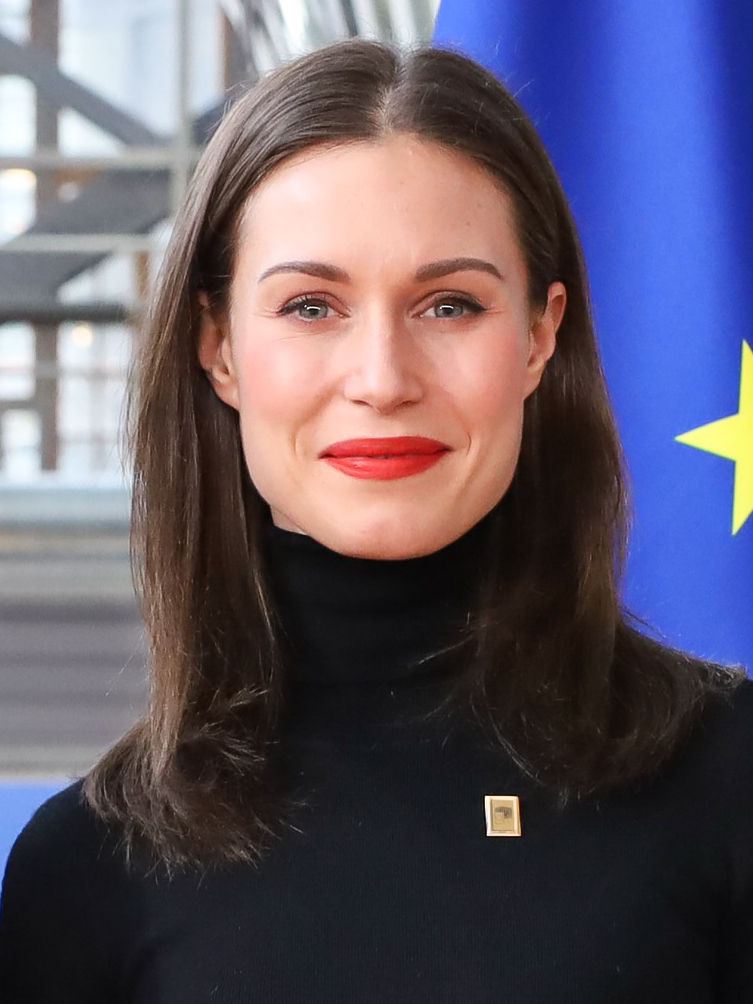
Sanna Marin
Former Prime Minister of Finland
9
APPEARANCES
8
PODCASTS
Sep 13, 2026

8:10

Do Fins feel the threat, and is that why you've managed to get almost a million people to become military reservists?
Sanna MarinGUEST
Everyone in each country that shares a border with Russia feels the threat, uh, because it's really real.
Sanna MarinGUEST
Finland were able to stay independent when many countries like the Baltics and, and Polish, uh, and others were under the Soviet rule.
Sanna MarinGUEST
And looking from that perspective, I think that we were fortunate even though we also did suffer a lot, uh, during the wars.
Sanna MarinGUEST
Um, so we understand the threat, and we understand that it is really real, and we understand also the mindset, uh, of, of Putin.
6 MINS LATER

Rory StewartHOST
Do you think there is a reasonable strategy for Europe to try to get a little bit more independence and control with some of these basic elements of life?


37:57

How did you, in your context as Finnish prime minister, approach weighing those very different concerns?

Sanna MarinGUEST
Well, I fully understand that this is a difficult, uh, discussion, uh, when we have to boost our defense capabilities, uh, and when we have to do our fair share, uh, also as Europeans to reach that, uh, 5% level, uh, which I think is correct.
Sanna MarinGUEST
But at the same time, countries that are closer to Russia, uh, for example, in Europe, uh, they are already spending much more in defense capabilities than the countries that are farther away from the border because the countries that are farther away, uh, they don't feel the pressure, uh, and the fear and the threat the same way that those ones that are nearer, uh, to Russia.
Sanna MarinGUEST
So actually, for example, Finland has always invested heavily in our own s- own defense capabilities because we have that difficult history.
5 MINS LATER


Sanna MarinGUEST
But as you explained, it, it, it is much deeper kind of happiness that the sta- statistics, uh, tell us, and of course it is to do with the Nordic welfare model, the Nordic welfare society, um, that enables everybody, uh, to choose their own paths in life.
Sanna MarinGUEST
So every child will have a good education and opportunities that you might not otherwise have if you don't have wealth or a background that will support you.
Sanna MarinGUEST
So of course that happiness that comes within the society and the structures that help everybody to build their own paths and decide their own future, I think that is the key, uh, there.
Sanna MarinGUEST
And also it builds trusts, uh, to one's society, and as a prime minister I would say e- able to enjoy the deep trust that we have in our society in a way that people, um, participated voluntary in the first phases of COVID when everybody was scared.
Sanna MarinGUEST
But because we trusted each other, our institutions, also the trust that if people, citizens, showed that they're politicians, it was extremely helpful.
5 MINS LATER

Kavita PuriMODERATOR
It was very clear that the rules were different for you and for male politicians.
Sanna MarinGUEST
Well, I do have a whole chapter about my scandals that are not very political, as you can read from the name, so nothing to do with political corruption, misuse of public money or power.
Sanna MarinGUEST
But more like these moralistic scandals, me wearing a blazer showing too much skin on a photoshoot and it didn't show actually anything except this part here.
Sanna MarinGUEST
And then breakfast scandal, phone scandal where I did bring only one work phone with me.
Sanna MarinGUEST
And then the dancing scandal, me dancing in a private apartment, friend's apartment and singing at the same time, having fun.
26 MINS LATER
RitwajUNKNOWN
I come from New Delhi, and I can see the level of pollution and the air quality index over there and we can't even just stop talking about how much we are doing to combat climate change but in general the impact is very limited so what can we do to measure the gap between thought leadership and impact thank you very much

Kavita PuriHOST
Sanna, before we kind of get into the body of the interview, what was that moment like when you were 34 and you were told you were going to be prime minister? Because that wasn't part of your game plan, was it?
Sanna MarinGUEST
We have been traveling a lot and I've been speaking maybe too much, but I'm still extremely excited to be here with you today.
20 MINS LATER


Clare McDonnellHOST
How do you reflect on that now? And do you think, had you been a male prime minister, you would have come under the same scrutiny, had to come to the same conclusion that you had to do a drug test to say, no, there were no drugs in my system?
Sanna MarinGUEST
Well, if I would have been a male prime minister, there would have been, of course, some news, but not weeks long lasting scandal or media scrutiny.
Sanna MarinGUEST
And I think there are different standards for women and for men, double standards.
Sanna MarinGUEST
But then when these videos were leaked, there were all these different kinds of questions that still feel extremely bizarre.
6 MINS LATER


Sanna MarinGUEST
I want to support women, uh, and I want to commit my life to that, because I've also seen how difficult it is to be a woman in those positions.
Sanna MarinGUEST
We need your voices and we need diff- different people from different backgrounds to participate in our democracies or otherwise our democracies will die.


Ben RhodesHOST
Um, h- how do you explain to people the kind of, as someone who's sat with him, w- what's the weight on his shoulders, and, and wha- wha- how do you, uh, how would you describe for people, um, how he's managed that?
Sanna MarinGUEST
Well, I would only say that President Zelenskyy is extremely tough and talented leader, uh, that has gone through so much like his whole nation has.
Sanna MarinGUEST
First, COVID, uh, 19 that everybody, uh, met, and that was a big global crisis that we had to deal with and face.
Sanna MarinGUEST
And just as after that when, when things were going easier, uh, the full-scale invasion towards Ukraine.
Sanna MarinGUEST
That was a burden, uh, for any leader, and he has handled it, I think, very, very talented.
Sanna MarinGUEST
And Finland, like Nordic countries, Baltic countries, Poland, uh, countries with that closeness to the Russian border can really feel their pain, and that's why we have s- shown, uh, support like rest of Europe and like US has.
7 MINS LATER
Ben RhodesHOST
Um, what ad- what's your advice essentially about what social democrats can do to both better prevail against far-right parties inside, uh, their countries, um, but also kind of beat back this global tide of, of far-right politics?