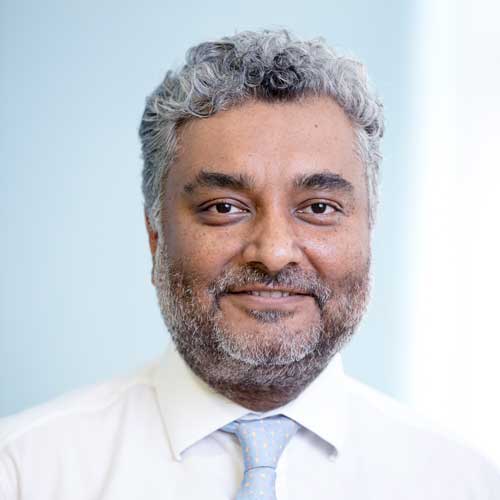
Sanjay Popat
Researcher
4
APPEARANCES
4
PODCASTS
Oct 6, 2026

Parker MossHOST
patients.I would love to hear a little bit from you about really how the experience of a lung cancer patient today is different to when you first joined that clinic back in the early 2000s.

Sanjay PopatGUEST
If I see a patient today, I need to give them a specific pathological diagnosis, what it looks like under the microscope, um, and what it looks like under the microscope and its precise name is very different to how it was back in the mid-2000s.
Sanjay PopatGUEST
You know, as long as it wasn't small cell, that was fine, right? Because small cell's treated in a very different way to non-small cell lung cancer.
8 MINS LATER
Parker MossHOST
Talk us through what a liquid biopsy is, the different settings that it can work in, and the importance for lung cancer, 'cause this is a piece of news that I think is not widely appreciated and is gonna really impact people across the country, and not just in lung cancer, but in, in many of the cancers.


Prunella BlinmanHOST
Sanjay, can I ask you to comment about the squamous versus adenocarcinoma, the difference in squamous and adenocarcinoma that Nick has so eloquently described and how that played out in the UK in particular?
Sanjay PopatGUEST
I think there was four deaths in the original phase two of development of pevacizumab in lung cancer, and that really meant that in the original phase Registrational phase three study, 2006, all squamous tumors were removed from the eligibility.
Sanjay PopatGUEST
I think this really undoubtedly has held back the development of androgenesis inhibitors over the years.
Sanjay PopatGUEST
And Trying to understand exactly why that is the case has been quite problematic for the biological reasons that Nick has said.
Sanjay PopatGUEST
The benefits that we've seen with bevacizumab adding on to chemotherapy, I think many would argue of being relatively modest, although there has definitely been a survival advantage with bevacizumab.
Sanjay PopatGUEST
carbotaxel regimes, but carbotaxel regimes had never really kicked off in the UK.
8 MINS LATER


Justin GaynorHOST
And maybe Sanjay, you can tell us a little bit about kind of what you expect to see with these agents in clinic.
Sanjay PopatGUEST
The field of oncogene-addicted disease has been spawned by the finding of oncogenic drivers.
Sanjay PopatGUEST
And drugging a driver has been shown to cause rapid tumor shrinkage, which is durable.
Sanjay PopatGUEST
And that has really stood the test of time with all of the drivers that we've identified, particularly when it comes to end track fusions in end track one, two, and three.
11 MINS LATER


Rahul GosainHOST
But given improved OAS with just three cycles of chemo and nivolumab, Sanjay, in your clinic, who gets that post-op IO?
Sanjay PopatGUEST
This is really the hot question that we have in our clinics day to day, right? And I don't think we really know the answer to this question.
Sanjay PopatGUEST
You know, there is one trial ongoing in Europe, which is actually looking at this.
Sanjay PopatGUEST
The ADOPT study is a non-US global study randomizing to just preoperative or periop in non-PathCR patients.
Sanjay PopatGUEST
But in the interim, you and I have to make decisions in clinic, right? So what do we do? So these are where I think the decision-making between the individual physician and the patient is paramount, because you can argue things both ways, right? You know, we see some patients who've sailed through the chemo IO, they've had a path CR, you know, quite comfortable, I think, with many of those patients with a path CR that, you know, maybe more immunotherapy is not necessarily going to be that beneficial for them.
6 MINS LATER

Rohit GosainHOST
So the big question here, Sanjay, is who should get chemo in addition to these targeted therapies? Any patient population that you would omit chemo and just go for targeted therapy here?