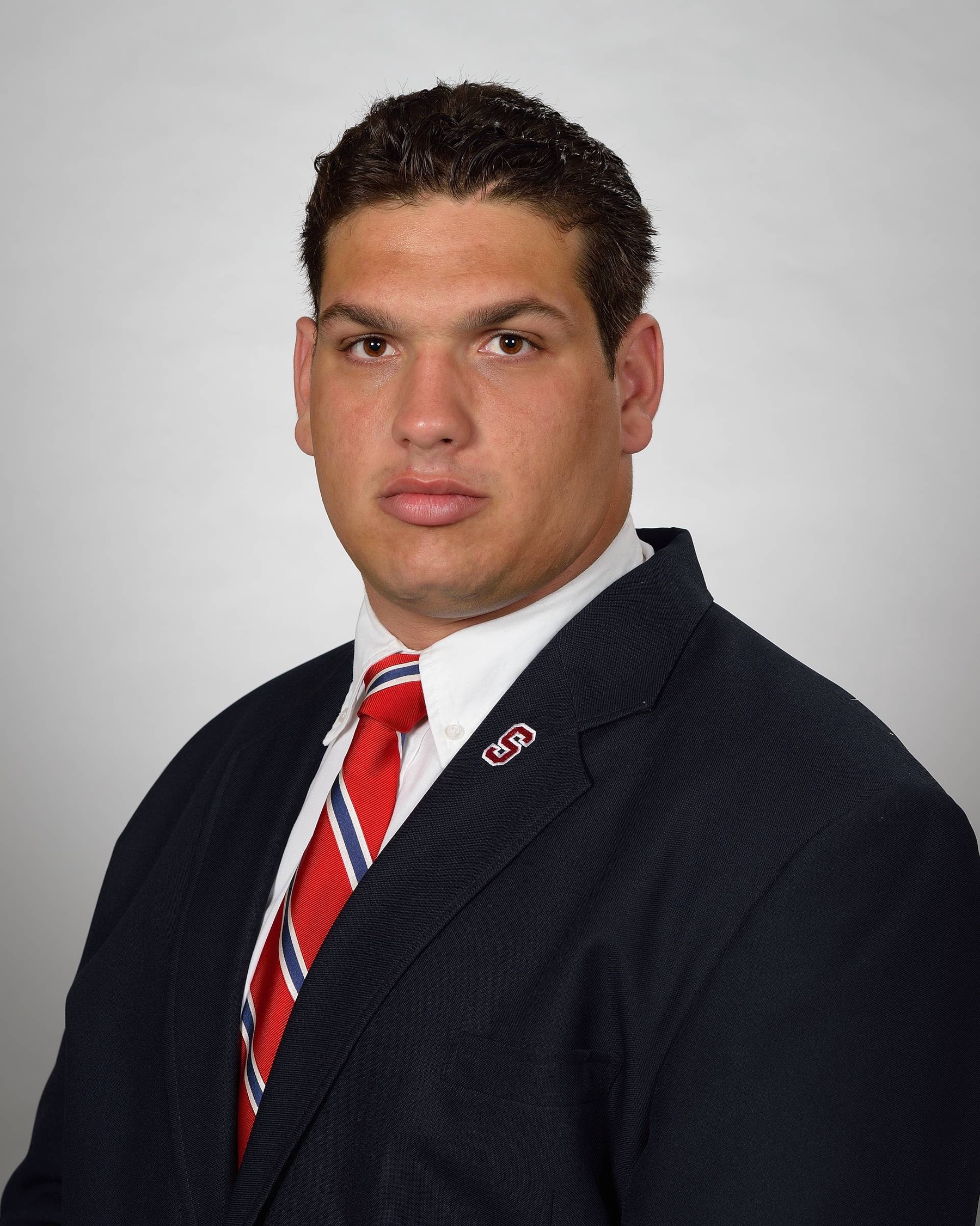
Sam Schwartzstein
American football player
10
APPEARANCES
6
PODCASTS
Nov 19, 2026


Garret WilliamsHOST
You want to kind of expand on those things we might see this Thursday with the Texans Colts.

Sam SchwartzsteinGUEST
Yeah, so we've launched a bunch of different AI-powered features on our broadcast.
Sam SchwartzsteinGUEST
And AI is this weird word or weird phrase, but its capabilities, these big models, are what enables us to do everything not just well, but super fast.
Sam SchwartzsteinGUEST
So you've seen defensive alerts on your main broadcast for TNF as well as on PrimeVision with NextGenStats.
Sam SchwartzsteinGUEST
which is a red orb to identify a player who's likely to blitz haven't we all watched film and been like i can see that or i wish i knew known which guy was going to come pre-snap and give some more anticipation pre-snap to the audience at home and that's been really fun we've done a lot of different things since then whether it's pocket health which we saw in the main broadcast last week as well as we do it live on prime vision next gen stats which helps show like where the quarterback should navigate the pocket and when should they get rid of the football And then last week was a really cool one.
Sam SchwartzsteinGUEST
We launched a product that lets you see on a first replay where the quarterback's eyes were throughout their read process.
Sam SchwartzsteinGUEST
So whether it's JJ McCarthy going to a first read and missing a guy, I could have been on that.
24 MINS LATER
Garret WilliamsHOST
yeah that's going to be great to see and then i mean just a real quick one i mean i know it's going over but i would just ask you like the analytics as far as the teams go like obviously it's becoming more prevalent just a generic question like is every team doing it and then like for the texans like as fans like on decision making and stuff it feels like they probably have a department but it's like domico just like hears it and still does what he wants like to me like a lot of his in-game decisions like one to go for one not to go for it one to kick he's just kind of winging it you know


Sam SchwartzsteinGUEST
And they're one of the most telegraph teams they have been since Joe Brady got there, they get under center and they have three tight ends and it's a run, right? Like Jackson halls is on the field.
Sam SchwartzsteinGUEST
So what's been interesting is the, You know, we had this 11 personnel boom and it made sense, you know, 2018 to 2022 because colleges all run the air raid.
Sam SchwartzsteinGUEST
And so the talent you're getting is mostly going to be wide receivers because more wide receivers are playing football.

Brian NemhauserHOST
But how did you first meet Neil? Uh, maybe let's, before we even get to Neil, what was your first Khosla moment? Uh, the first person you met from the family, and, and what was that, what was that like?
Sam SchwartzsteinGUEST
Anu, uh, and I were the same year and lived in the same dorm freshman year at Stanford.
Sam SchwartzsteinGUEST
And so it was like, it's kind of like Harry Potter or summer camp, Stanford dorms.
Sam SchwartzsteinGUEST
Or I was in Wa- uh, Loro, and they were in Gavilan, and, and Anu was in Gavilan.
Sam SchwartzsteinGUEST
And so whenever I'd go hang out with my friends in that, in their house in our dorm, uh, Anu would always be there.
16 MINS LATER
Brian NemhauserHOST
How would you respond to people that might be curious or maybe a little concerned, um, about what that dynamic could be like and where Neil fits into that kind of a situation?

Sam SchwartzsteinGUEST
So I think mostly it's gonna be how to, um, work through the roster, because one of the things is Brian Ayers and I have been very close for about four or five years now.
Sam SchwartzsteinGUEST
Um, and my favorite org structure of, of an analytics department has been the Seahawks where he was the assistant to the head coach when it was Pete Carroll He was, but he's an analytics person, right? And so why, why do teams do that? About five or six teams do that in the, in the NFL, is have an analytics person be the assistant to the head coach, to build trust.
Sam SchwartzsteinGUEST
Build trust in that person, which ultimately will build trust into fourth down decisions.
Sam SchwartzsteinGUEST
Um, it's cool that Coach McDonald gives Brian feedback and, and, and, and kudos in press conferences.
Sam SchwartzsteinGUEST
Um, but they also have, they've also had two analytics people that worked on the current state of analytics, whether it's current roster modeling or, uh, current fourth down decisions or strategy, in-game strategy, but also two future-looking people.
Sam SchwartzsteinGUEST
So what is the next thing? What's the next technology? How, uh, right now it would be how do we utilize AI better? Do we use foundational models or not? Do we use certain computer vision modeling to be able to make sure we, we are able to get efficiencies as well as unearthing things? And that's the next step.
Brian NemhauserHOST
How would you respond to people that might be curious or maybe a little concerned, um, about what that dynamic could be like and where Neil fits into that kind of, uh, situation?


Robert MaysHOST
Anything that's come across your timeline in the last couple, in the last few minutes here that is in front of mind for you? What's, what, what are you thinking about right now as we're three and a half, half hours into this thing?
Sam SchwartzsteinGUEST
I, I, I've been, I've been mixing it up on the Linderbaum news, right? And you know, there's the sides of it where I, I was looking for the tweet where I said Linderbaum should win the Heisman.
Sam SchwartzsteinGUEST
As a former center, my talent evaluation is can you do the things I could never do? And him reaching two eyes as a Shane, running outside zone.
Sam SchwartzsteinGUEST
He's the best outside zone center I'd seen since like Chris Myers or some of those old Alex Gibbs style outside zone teams.
Sam SchwartzsteinGUEST
Uh, I hear a lot of people talking about, "Hey, we should, uh, evaluate a quarterback and center being paired up and giving this, a quarterback a veteran center." So I see why you wanna do it with Kubiak.
Sam SchwartzsteinGUEST
The, the problem is, is that they don't nee- you don't need a massive center or a huge center, um, contract style player to operate an offense that runs play action 30% of the time.
5 MINS LATER
Robert MaysHOST
Like, what were the bigger picture thoughts that you kind of had o- on your mind as you were thinking about this group and how the money would get thrown around?


Dan PatrickHOST
Analytics sounds like I'm smarter than you, as opposed to probability, y- y- we just, I don't know, I, we don't recoil when we hear probability.
Sam SchwartzsteinGUEST
Y- you're hitting the nail on the head, and a large w- part of the decision-making process in analytics, as you say, is the conversion probability, right? And that fourth and one, the Next Gen Stats model had it 65% to convert.
Sam SchwartzsteinGUEST
But when you look at it from a run versus pass scenario, it was 70% on the run and 55% on the pass, and they choose to call a pass play, right? So it's changing the math based on the play call, and I think that's what's hard when you have these public models, like the Next Gen Stats model or different models, that can often come up with different solutions.
Sam SchwartzsteinGUEST
We're never gonna have all the information that the team has, but what these models can do is help inform how should you game plan? When I used to consult with teams, I would say, "Just like you have a third down period, you should start thinking about having a fourth down period, and new play designs." Things like the Tush Push come out of it.
Sam SchwartzsteinGUEST
I moved the ball forward a yard and a half typically until Notre Dame found out.
Sam SchwartzsteinGUEST
[laughing] Uh, and then, or on the other side of it was we had a unique play design, looked a lot like the Tush Push.
Dan PatrickHOST
You, you already are factoring in Jared Stidham into this equation before the game, but how do you upgrade during a game?
Dan PatrickHOST
Analytics sounds like I'm smarter than you, as opposed to probability, y- y- we just, I don't know, I, we don't recoil when we hear probability.
Sam SchwartzsteinGUEST
Y- you're hitting the nail on the head, and a large w- part of the decision-making process in analytics, as you say, is the conversion probability, right? In that fourth and one, the next-gen stats model had it 65% to convert.
Sam SchwartzsteinGUEST
But when you look at it from a run versus pass scenario, 70% on the run and 55% on the pass, and they choose to call a pass play, right? So it's changing the math based on the play call, and I think that's what's hard when you have these public models, like the next-gen stats model or different models that can often come up with different solutions.
Sam SchwartzsteinGUEST
We're never gonna have all the information that the team has, but what these models can do is help inform how should you game plan? When I used to consult with teams, I would say, "Just like you have a third down period, you should start thinking about having a fourth down period and new play designs." Things like the Tush Push come out of it.
Sam SchwartzsteinGUEST
One, I moved the ball forward a yard and a half, typically, until Notre Dame found out.
Sam SchwartzsteinGUEST
[laughing] Uh, and then, or on the other side of it was we had a unique play design.
Dan PatrickHOST
You, you already are factoring in Jarrett Stidham into this equation before the game, but how do you upgrade during a game?
Sam SchwartzsteinGUEST
I, I think what I've been fascinated with is the, the fourth down, um, execution by teams, and it's different across the board.
Sam SchwartzsteinGUEST
There's a lot of teams that have instituted the tush push, false starting or not.
50 MINS LATER
Robert MaysHOST
The, the two things, two or three things that you have in front of mind that you studied this week that you think are gonna go the furthest in determining how this Rams Seahawks game goes tonight.
Sam SchwartzsteinGUEST
Um, but I use an LLM a- a lot as a- a tool to teach me about what RPMs and throttle can do to be able to spit out the miles per gallon on a broadcast.
Sam SchwartzsteinGUEST
And using AI to get me to the right passageway, it was a huge value add there, and I think that's where you're gonna see a lot of things for it.
Sam SchwartzsteinGUEST
So, if you're watching Thursday Night Football and you're seeing, um, uh, defensive alerts or coverage ID or pressure alert, you're gonna see those models are built off of likely what's called a transformer model, which is, um, an AI model that's taking data, a lot of information, run it through a neural network, and then spitting out a result.
Sam SchwartzsteinGUEST
I was just explaining to somebody else, it's- it's two, uh, input, a lot of different outputs or- or, uh, neural network working together, and then an output that comes out of it.
21 MINS LATER
Robert MaysHOST
So, as that process has become more efficient, what elements and what spots on the cycle where offensive innovation, uh, widespread apti- like, uh, acceptance and then defensive response and then how it all goes back around again, what spot on that circle is most interesting to you? And who do you think has the hardest job on that circle?


Sam SchwartzsteinGUEST
Yeah, it's a really weird rule because overtime we don't see too much of it, and so there's a ton of overtime research that you can try and do, different styles of overtime.
Sam SchwartzsteinGUEST
In the regular season under the old rule, it was about a 50-50 win rate plus the ties.
Sam SchwartzsteinGUEST
So there wasn't actually in regular season a need to change it, but we saw in the playoffs before they changed it to the, you know, after what happened to the Bills-Chiefs game, one of the best games we ever saw, We saw that in the playoffs when the teams were much better on offense, they won nine of ten opportunities in that overtime style.
Sam SchwartzsteinGUEST
Well, you didn't really need to because it's still 50-50 win rate when you look at every possible team.

Ryan FitzpatrickHOST
What took so long to implement this and why is it not as easy as people think?