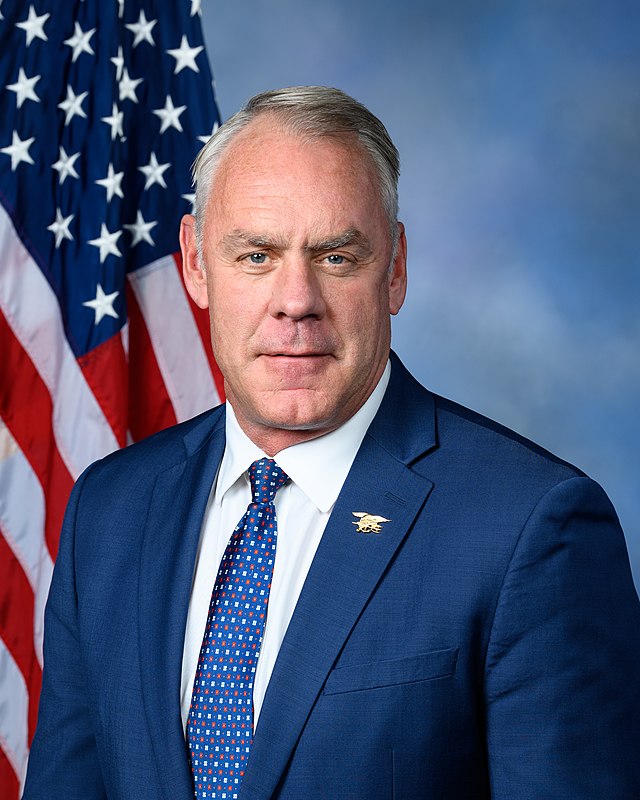
Ryan Zinke
United States Representative
36
APPEARANCES
13
PODCASTS
Oct 19, 2026

Ryan ZinkeGUEST
You know, look, you know, as a military, and I've talked to almost, you know, I sit on the Foreign Affairs Committee, and I talk to almost every foreign ambassador in the region, and we all agree on four main points.

Ed MartinHOST
How does Montana feel? How do you feel about where the economy is? How are you feeling about universities there have, you know, great programs? Give me a little thumbnail on Montana and how people are feeling about this moment.

speaker_9CORRESPONDENT
What does this tell you about the November 3rd?
Ryan ZinkeGUEST
He's been to Montana probably more times than all the presidents combined, you know, and, and Montanans gravitate to the American First agenda, but they love President Trump.

speaker_5SOUNDBITE_SPEAKER
I moved to this country 26 years ago the legal way, and I am a proud American citizen.
Ryan ZinkeGUEST
Please protect our president that we love and support with all of our hearts, and God bless the United States of America.


Kurt AlmeGUEST
And if they, if they get the chance to go to Washington, they're gonna take us right back to those Biden-era policies of open borders and defunding the police.
Ryan ZinkeGUEST
[cheering] [applauding] As senator, I'm gonna fight for common sense policies that rein in Washington spending- [cheering] [applauding] ... keep our taxes low, protect our public lands- [cheering] [applauding] ... secure our borders and our elections- [cheering] [applauding] ... and confirm judicial conservatives to the United States Supreme Court.
speaker_11SOUNDBITE_SPEAKER
A little less fight and a little more smart.
Ryan ZinkeGUEST
I think Montanans are trying to f- are figuring out, you know, what the opposition is.
Ryan ZinkeGUEST
This agenda, you know, from the Democratic Socialist Party, that's a lie in itself.
Ryan ZinkeGUEST
It's a communist party 'cause you look at open borders, you know, boys playing girls' sports, sex change operations for children.

Michelle BackusPANELIST
And when you talk about that, what, why is that, this race with Aaron Flint, a combat decorated veteran, served in Iraq, served in Afghanistan, and his opponent, why does that matter, that contrast?


Ryan ZinkeGUEST
Well, you know, I always have to say I was a commander at SEAL Team 6, and I loved being around people that were focused, patriot, hyper-competitive.
Ryan ZinkeGUEST
And I was never the best jumper, diver, explosive expert, et cetera, but I always knew who was.
Ryan ZinkeGUEST
And to be associated and be a part of that group I think was an honor in my life.
Ryan ZinkeGUEST
The secretary job, I think Article 2, you know, they always say, you know, administration has the ball.
6 MINS LATER
8:06
And I think if you look at it as a business person on a balance sheet of the United States of America, it's worth trillions of dollars.
Ryan ZinkeGUEST
And I was never the best jumper, diver, explosive expert, et cetera, but I always knew who was.
Ryan ZinkeGUEST
And to be associated and be a part of that group, I think, was an honor in my life.
39:12
And I think if you look at it as a business person on a balance sheet of the United States of America, it's worth trillions of dollars.
53:23
The Secretary of the Interior has more power over energy than necessarily the Department of Energy, in your opinion.
Ryan ZinkeGUEST
Well, in the Department of Energy, 90%, and I love Chris Wright and the Department of Energy are great folks, but mostly what they do is regulate and look at our nuclear arsenal.
Ryan ZinkeGUEST
But the core of producing, leasing, inspections is actually the Department of Interior, all offshore.
Ryan ZinkeGUEST
is Department of Interior at one state or another, and then onshore federal lands comes the Department of Interior.
Ryan ZinkeGUEST
And as Interior, I helped write the executive order to go to energy dominance, and I was in a room when that energy dominance term was made the president.
54:59
And I think if you look at it as a business person on a balance sheet of the United States of America, it's worth trillions of dollars.
49:24
The Secretary of the Interior has more power over energy than necessarily the Department of Energy, in your opinion.
Ryan ZinkeGUEST
Well, in Department of Energy, 90%, and I love Chris Wright and Department of Energy are great folks, but mostly what they do is regulate and look at our nuclear arsenal.
Ryan ZinkeGUEST
But the core of producing, leasing, inspections is actually Department of Interior.
Ryan ZinkeGUEST
All offshore is Department of Interior at one state or another, and then onshore, federal lands.
50:59
And I think that if you look at it as a business person on a balance sheet of the United States of America, it's worth trillions of dollars.


Ryan ZinkeGUEST
So they can use trail, uh, clearing method, you know, during the season, all right? And, and to make sure that the trail and public access, uh, is, is there.
Ryan ZinkeGUEST
You know, Lewis and Clark, uh, had much the same view in a lot of these different areas.
Ryan ZinkeGUEST
And now what we have done is we've, we've looked at what's important, how to manage it to make sure that your children and your children's children can have the same landscape view that was given to us that-
12 MINS LATER

Calin BrierleyHOST
So we do have the chance to stay abreast of these modern cutting edge technologies and safeguard the lives of our service members and our capital assets overseas.
Ryan ZinkeGUEST
In many ways, the five-year plan, the fight up, is configured on a peacetime navy or peacetime army, where time isn't of the essence.
Ryan ZinkeGUEST
In many ways, those conventional pieces of power either have been diminished or no longer effective on the battlefield because drones that are fairly inexpensive and numerous can counter a tank and to reproduce a tank is time.
Calin BrierleyHOST
to have that trickle-down effect from these new acquisitions policies and high-level DOW and State Department policies to impact that military doctrine in a timely manner or even that law enforcement doctrine to make us successful in these massive acquisitions that are now being driven by our soldiers, sailors, airmen, and law enforcement officials?
Ryan ZinkeGUEST
You know, I got to tell you, just to be around, you know, I was a commander at SEAL Team 6.
Ryan ZinkeGUEST
And just to be around talent of young Americans brought from the full breast, from New York, from New Mexico, it's kind of like the Rough Riders.
10:35
Give us what you see through your eyes in Iran, in Saudi Arabia with the Houthis, in Lebanon with the Hezbollah, in Hamas with Palestine.
Ryan ZinkeGUEST
And just to be around talent of young Americans brought from the full breast, from New York, from New Mexico, it's kind of like the Rough Riders.
Ryan ZinkeGUEST
You know, I was a commander at SEAL Team 6, so I was the operational unit at the time.
Ryan ZinkeGUEST
And just to be around talent of young Americans brought from the full breast, from New York, from New Mexico, it's kind of like the Rough Riders.
Ryan ZinkeGUEST
And, you know, Delta Force, very, very similar in construct, only want to be the best.

Ryan ZinkeGUEST
There cannot be an arsenal of destruction, and the Straits of Hormuz has to be opened.
Ryan ZinkeGUEST
I've talked to almost every ambassador from the region, and all are united, and this is, this is unique.
3:52
Uh, what are your thoughts, um, you know, just about this moment and, and how beautiful that his sister is, is filling that void?

Rita CosbyHOST
What are your thoughts, you know, just about this moment and how beautiful that his sister is filling that void?

3:50
What are your thoughts, you know, just about this moment and how beautiful that his sister is filling that void?
speaker_4UNKNOWN
And how much of a border you have with Canada?
Ryan ZinkeGUEST
You know, as you said, my background, I was a seal, like fifth generation, Montana, and I've served in the, in the Congress before that I became secretary and, And now, you know, I'm back on the front lines.
speaker_2HOST
How do you keep this separate? I mean, Hezbollah is Iran, and if they're going to be attacking our allies and attacking Americans, which they do as well, how do we keep this separate from this deal? It's not easy.

Ryan ZinkeGUEST
When I came in, uh, every battle was-- there was gonna be some federal judge somewhere that was gonna, uh, was gonna dictate policy, and I, I think the Supreme Court, while not conservative, I think has, has been, uh, less biased, and I think the team's very, very good.
Ryan ZinkeGUEST
But if you're voting against the chairman's bill, at least have the courtesy to say, "Mr.
Unknown podcast
From Washington: Rep. Ryan Zinke And His Life Of Service
Jun 21 · 31m

Jared HalpernHOST
Was there an issue that you changed your mind on as a member of Congress as you met members from other parts of the country or other political parties? Or maybe an issue that you think differently about now, maybe serving in the administration, coming back to Congress?
Ryan ZinkeGUEST
And even by Teddy Roosevelt's words, conservation is as much development as it is preservation.
Ryan ZinkeGUEST
And that was a lot harder to push, you know, reasonable mining, reasonable energy production.
Ryan ZinkeGUEST
And then I was surprised on when the issue of public lands for sale came up, which was a reason why I think I came back and defend that and make sure we don't we don't have a fire sale of our of our public land experience.
8 MINS LATER
Jared HalpernHOST
Are you troubled by that trend? Is that a trend you see continuing? And if so, how do you reverse it?

3:09

Congressman, so great to have you back on the show, and thank you again so much for your service.
Ryan ZinkeGUEST
And quite frankly, when you go back to Trump 45, when we walked in as a nation, we were producing 8.3 million barrels a day and declining.
Ryan ZinkeGUEST
In just two years, we were 12.5 million barrels a day and the world's largest exporter.
Ryan ZinkeGUEST
Fast forward, now we see 40 miles of the straight-circuit news, really a two-mile channel, holding Asia and Europe hostage.
7:35
Is there anything behind the scenes that you're hearing about ways to help Americans get through the next few months?
Rita CosbyHOST
Am I right, Congressman, that you trained the Luttrells? That Marcus and, obviously, Lone Survivor?
Rita CosbyHOST
Am I right, Congressman, that you trained the Luttrells? That Marcus and, obviously, Lone Survivor?
Ryan ZinkeGUEST
So not a lot of room, and it is unacceptable that Iran, Given what they are, and I think the conditions that President Trump set are absolutely just and defendable, and we all need to get behind it.


Pamela BrownHOST
So do you support the Trump team's efforts here to continue talks with Iran, or should they be wary given Iran's unwillingness to consider U.S. demands over the weekend?
Ryan ZinkeGUEST
You know, I always support dialogue, but I don't think we can move on the core position.
Ryan ZinkeGUEST
They cannot possess material to make a nuclear weapon, and they can't have an arsenal of evil.
Ryan ZinkeGUEST
I think those are issues that we're not going to move on, but there's a lot of things we can move on.
Ryan ZinkeGUEST
Look, You know, the regime change, obviously the first echelon of the regime change is gone.
Ryan ZinkeGUEST
Their e- entire plan was develop a missile arsenal, uh, with ballistic and, and, and, and numerous s- surface to air missiles, et cetera, et cetera, that would inundate any defense.
Ryan ZinkeGUEST
And having one nuclear weapon, uh, remem- remember, it's not only, you know, Israel, it's not only our bases, but having a nuclear capability with that regime would mean that you could put it, let's say, in a shipping container.
Pamela BrownHOST
So just to be, just to be clear, i- i- is it fair to say that this was more of a window of opportunity to attack Iran to prevent a potential imminent threat in the future rather than there being an imminent threat in this moment?
Scroll for more appearances