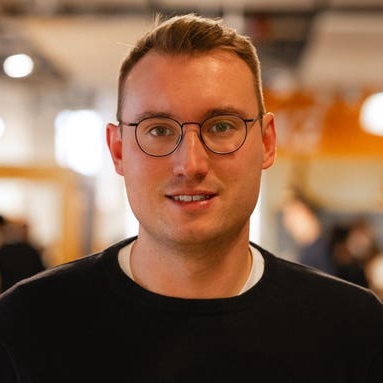
Ryan Beal
Physician-entrepreneur Ryan Beal, MD, co-founder and CEO of Dyve Biosciences, a biotech developing transdermal drug-delivery therapies targeting the acidic tumor microenvironment.
3
APPEARANCES
3
PODCASTS
Sep 30, 2026

Daniel LevineHOST
At what point did the tumor microenvironment acidity become a, a central part of Dive scientific strategy?

Ryan BealGUEST
Well, Dive was, as you said, we were built around our delivery science, uh, DMAX, that moves molecules from the surface of the skin into the circulation and, and we do it, you know, roughly at the, the speed of a needle and bioavailability of, of a pill.
Ryan BealGUEST
Um, the first molecule we moved was sodium bicarbonate, and we were actually looking at this in, um, uh, also to buffer acidity.
Ryan BealGUEST
Um, and we reali- in, in essence, to buffer lactic acidosis in, in athletic performance for elite athletes.
Ryan BealGUEST
Um, and once we realized we could modulate that, the question then became: where does pH matter most biologically? And the answer, you know, in the literature for over two decades has been the tumor microenvironment.
5 MINS LATER
Daniel LevineHOST
And, and what makes delivery through the skin compelling as a way to address this problem?

John SimboliHOST
When you said to your family and your parents and your loved ones that you were starting off perhaps after the consulting and striking on something with no clear definition, how did that go? It
Ryan BealGUEST
was interesting because I grew up essentially with a single mom in Greeley, Colorado.
Ryan BealGUEST
She had a very... supportive approach and and I think didn't didn't push me in any direction was more explore your interest find your passion let you get you know you're gonna get tugged in a certain direction and I'm gonna support you whatever that is there were no physicians in my family so and no scientists in my family and so I think that was interesting to everyone I had a real passion and draw to math and science and loved it.
Ryan BealGUEST
And I think what connected with me very early was not just the math and the science, but it was more that problem solving approach.
24 MINS LATER
John SimboliHOST
What do those misunderstandings tend to be? How do you bring them back into where you really are?

Ryan BealGUEST
Well, the big milestones is, you know, again, we've, we've known about the underlying biology for a couple decades.
Ryan BealGUEST
It's just been a delivery challenge and, and we've shown that we can k- can do this in animals on the cancer side and, and, you know, upregulate the immune system and ultimately lead to better survival, less tumor growth, et cetera.
Ryan BealGUEST
And then in our parallel path in inflammation, we've shown that we can deliver it in humans, in, in non-oncology patients.
Ryan BealGUEST
And so the big goal here is to show that those two fields of work that we've been focused on can merge together, and we can not only deliver it in, uh, the oncology setting in the h- in the- in patients, in humans, uh, but we can also take advantage of that same biology.
Ryan BealGUEST
We'll be looking at a bunch of, uh, you know, different readouts, both in terms of tumor growth and, uh, a number of different biomarkers on the, looking at the immune response in particular.

Karen JagodaHOST
particular.Are you getting the feeling that there are certain tumors that are gonna be more responsive to this approach?