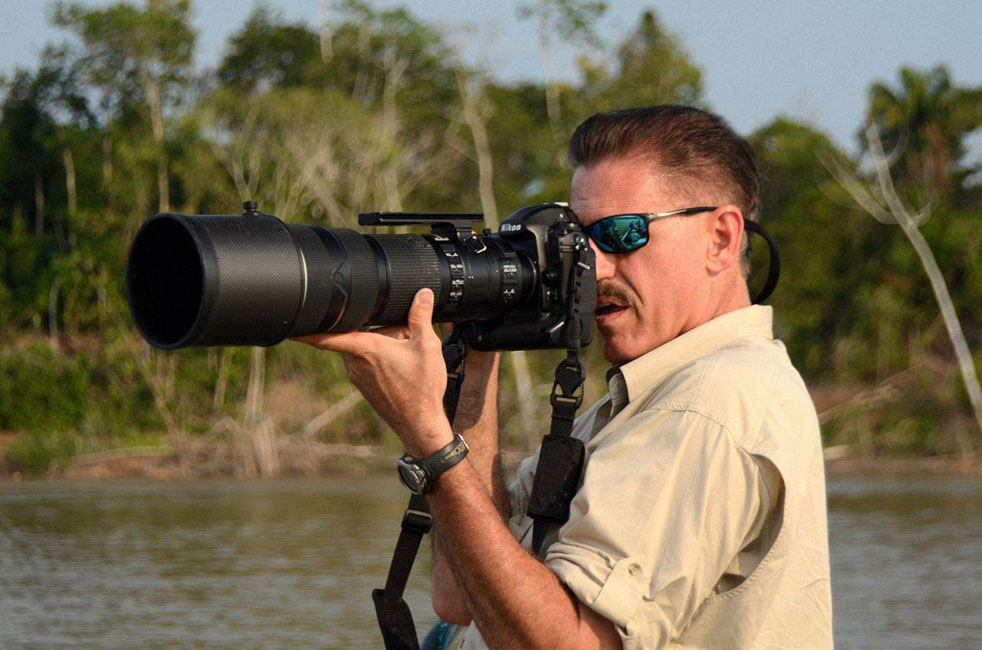
Ron Magill
American photographer
21
APPEARANCES
4
PODCASTS
Sep 22, 2026

AndreHOST
When was it that you realized, okay, obviously you grew up around it, but I want to actually make a career out of this?
14 MINS LATER
AndreHOST
F-L-A, yeah.


Ron MagillGUEST
Well, listen, we've had all kinds of things happen at the zoo, but I'm going to tell you the story that's most important to me.
Ron MagillGUEST
Actually, it didn't happen at the zoo, but it was when I was working with animals.
Ron MagillGUEST
I was the animal handler, or an animal handler, there were several of us, for the show Miami Vice.
22 MINS LATER


Gregg GoldfarbHOST
For those worried that you're riding off into the sunset, how are you doing, Ron? Let's talk about the next chapter.
Ron MagillGUEST
After 46 years of working under the county, the county administrates the zoo, I retired from the county, but I was given a tremendous opportunity by the Zoo Miami Foundation, which is the 501c3 foundation.
Ron MagillGUEST
I've been given an opportunity to be the goodwill ambassador and conservation liaison for the foundation.
8 MINS LATER
Gregg GoldfarbHOST
Is there an animal that taught you a lesson about humanity that you would like to share on the show?
speaker_14ADVERTISER
Uh, but what is the most compassionate act you've seen in the wild, which can be very cruel?
Ron MagillGUEST
I mean, uh, you know, I, I, I, I've seen that with elephants, but I've seen, like, with primates.
Ron MagillGUEST
I've seen, uh, you know, I've seen baboons, which normally are just not my favorite animal.
Ron MagillGUEST
But I've seen them with youngsters and other baboons coming up and, and offering, you know, to, to groom the youngster and to stroke the youngster and even share food sometimes with the youngster.
Ron MagillGUEST
Um, so I, I've seen that kind of, uh, community effort to, to, to make the, you know, the troop stronger.
6 MINS LATER
speaker_16UNKNOWN
Can you put, like, it into context when you say these are smart animals? Like, the dol-

Ron MagillGUEST
Eventually he will surface to the water to take a big gulp of air, but these turt- And there's also some fish.
Ron MagillGUEST
You see the, the tangs on the back? They're kind of eating the algae off of his shell.
Ron MagillGUEST
So he's kind of being groomed, and he's kind of setting himself to get any external parasites.

Dan Le BatardHOST
There's never been anything like you in the history of this city, and there will never again be anything like you in the history of this city.
Ron MagillGUEST
That's layers of gla- of glass, and that's designed to crack, and in various ways, it, it's not going to break.
Ron MagillGUEST
That's not something that was ever a present, uh, danger of the gorilla actually escaping.
Ron MagillGUEST
That glass is made to do that under extreme forces, uh, and that's exactly what happened there.
Ron MagillGUEST
Um, so it's, it's, it's rare that even the crack occurs, uh, but the crack should not make people think, "Oh, my God, it's gonna get out," because it's not even close to that.
speaker_6UNKNOWN
I was gonna say, it just stops?
Dan Le BatardHOST
Uh, I don't know actually, Ron, if, uh, you're involved with GiveMiamiDay.org. Are you? You know Dave Lawrence, right?
Ron MagillGUEST
Um, and listen, guys, you know, like I- I've always told people, I love what I do, what I do with the animals, and- and- and the endowment is very important, but there's no single animal life that's more important than a human life.
Mike Ryan RuizHOST
... mini- uh, medium-sized whippet.

Greg CotePANELIST
Because I fly a lot, I see these service dogs all the time, but I feel like, like Ron, when someone's on the flight with a Shih Tzu that's wearing the service dog vest, like, that's not a service dog, right? Isn't it only like, certain breeds are service dogs?
Ron MagillGUEST
I mean, th- the bottom line is, a service dog can be designated as an animal that is necessary to maintain the patient's, or whatever your, the owner's, you know, state of mind.
Ron MagillGUEST
Now, having said that, I think there are a lot of people that abuse that, uh, that, that, that o- opportunity.
Ron MagillGUEST
You know, some of these psychologists, you know, write them a check, they'll write you a note.
8 MINS LATER
speaker_4UNKNOWN
Um, when are you gonna get another lion because I assume you want one badly?
speaker_22UNKNOWN
What's happening?
Ron MagillGUEST
Yeah, that's, uh, that's exactly what he's doing here, is that this is an alligator that has obviously been accustomed to being fed by this person.
Ron MagillGUEST
Or it's a girl, actually, um, who actually, you know, feeds him all the time this way.
9 MINS LATER
speaker_3HOST
Tell us, uh, all the good things you got going on here.
Dan Le BatardHOST
Give us the best fact you can about the sea turtle, your favorite sea turtle fact.
Ron MagillGUEST
The fact is that a sea turtle can hatch out on a beach, swim out of that beach, and for the next 20 to 30 years, swim literally around the world, okay? And when it becomes sexually mature, that sea turtle will go back to the same beach that it hatched out 20 to 30 years ago to lay its own eggs.
Ron MagillGUEST
Let's say you were born in a hospital down here at, uh, you know, Jackson Memorial Hospital and 30 years later, you live over in India and Africa or whatever, and you say, "You know what?" Well, assuming you're a female, you're going to have a baby.
Ron MagillGUEST
"I'm gonna go have a baby back..." But never having been there except for the time you were born and left and know how to get back there.
Dan Le BatardHOST
Can you explain to me the where and why this happens the way that it happens and what is happening here, uh, with what is called, I guess, it's murmuration? Uh, what is, what is murmuration?
Ron MagillGUEST
When birds synchronize their flight as part of a defense mechanism, it's the same thing, you see it in fish, except it's in the air.
Ron MagillGUEST
If you watch a school of fish, watch a shark go in there or a sea lion go into a big school of fish, basically, they form this confusing dance, so to speak, which basically blends them all in with each other so the predator cannot focus on one animal.
Ron MagillGUEST
Uh, it, it's the same thing in a lesser scale of, like, when a lion is going after a herd of zebra, all the zebra run together and all the stripes blend together.
Ron MagillGUEST
It confuses the predator and it's harder for that predator to concentrate on a single animal.
Ron MagillGUEST
More often than not, (laughs) it doesn't work out for the zebra, but, um, the safety is in numbers here with these animals.
Ron MagillGUEST
And they know if they stay synchronized like that, again, it's very difficult to pick one out against the other to be predated on.
Dan Le BatardHOST
And I wanted Ron Magill to set 'em straight because, uh, just because we're used to how w- unusual our wildlife is doesn't mean there's not ama- like, more amazing wildlife in the Everglades than there is just about anywhere.
Ron MagillGUEST
I mean, you know, you go into the Everglades and you can see, you know, 20, 30 species of birds, alligators, turtles, snakes.
Dan Le BatardHOST
So what, what did you see that was foreign? What did you see that you had never seen before?
Mike RyanHOST
Are we gonna be seeing them come closer and closer to shore, trying to find new sources of food?
Ron MagillGUEST
Now, I hope that people took notice of that video, for instance, of that bull shark out there on South Beach.
Ron MagillGUEST
How many people it went right by without biting them, without attacking them? That's not to say it's not possible, of course.
speaker_10UNKNOWN
Is that a- a survival of the fittest thing, where we say, "Ah, birds are dumb"? Or is there something that should be done to save birds?
Dan LeBatardHOST
Ta- take any one of the photos off of the wall and take us through a- a-
Dan LeBatardHOST
All of your media friends.
speaker_8UNKNOWN
It looks like an aggressive make out session, I'd say.
Ron MagillGUEST
They're, they are definitely bonding, but it's not like you would think a make out session.
Ron MagillGUEST
So they're pretty admirable birds, but they're not the most intelligent of the birds.
8 MINS LATER
speaker_22UNKNOWN
Mm-hmm.
speaker_19UNKNOWN
I got it.
Ron MagillGUEST
I made, I made it very clear in my interview, listen, you've gotta be able to go in there and realize the first few guys are basically on a kamikaze mission, okay? They're on a kamikaze mission.
Ron MagillGUEST
But understanding that, if you're willing, if this is your goal, if you're fighting for the greater good, even though a gorilla is a gentle giant, is a vegetarian and would never be in this predicament and would run away from 100 men if he saw it coming at him.
Ron MagillGUEST
But people wanna insist, "Well, what if he couldn't run away and you had this fight and who's gonna win this fight?" Well, okay, at the end of the day, the 100 men are gonna survive.
Ron MagillGUEST
Now some of those 100 men, there's gonna be collateral damage, okay? There's gonna be, uh, bites and arterial bleeding.
Ron MagillGUEST
There's going to be broken necks, there's going to be suffocation, there's going to be, you know, uh, just, you know, horrible concussions that are gonna lead to fatal brain, b- brain bleeds.
Dan LeBatardHOST
They, the, the, the gorilla doesn't have much stamina, does it?
Jessica SmetanaPANELIST
In terms of, like, things that haven't been discovered yet that we know are out there, uh, like animal species, is- is there anything more than the giant squid that would be... that would trump that as a scientific discovery?
Ron MagillGUEST
If you Google, you'll find video that they have got video of a giant squid in the very deep.
Ron MagillGUEST
It's, it's a fleeting video but it is a verified, you know, true video of giant squid.
Ron MagillGUEST
Because they occur at such depths that when they finally get to the surface, they, they are not able to survive.
Ron MagillGUEST
They need that pressure, I think, of the ocean at those great depths to survive.
Dan LeBatardHOST
Uh, Ron, how smart is that creature? Do we have any idea, do we have any information on what that creature, uh, uh, living, uh, knows or can do?
Jessica SmetanaPANELIST
So please, please explain this.
Ron MagillGUEST
This is all about kind of s- uh, you know, getting people's attention, uh, to drive money.
Ron MagillGUEST
Now the, the company is gonna say, "Oh, no, we're de-extincting this animal." First of all, they're not de-extincting because, as you mentioned Jessica, they have just basically-...
Greg CotePANELIST
R- Ron, what is an example of an animal that is gravely endangered, near extinction or threatened with extinction, largely because of man's abuse, where you would be in favor of bringing that animal back?
Dan Le BatardHOST
The, the greatest example you have, the animal coming awake 'cause the anesthesia didn't last as long as it should have, and all of a sudden you got some real danger in the, uh, surgical area.
Ron MagillGUEST
And we anesthetized him, and we had to pull him out of the enclosure and we put him on the grass next to a canal there.
Ron MagillGUEST
He was totally out, you know? They used a drug which everybody knows about now called ketamine, um, and he was out and Dr.
Ron MagillGUEST
Hubble, I'll never forget the d- the veterinarian was kneeled between his legs, leaning over.
5 MINS LATER
speaker_20PANELIST
What was the story with the Crandon Park Zoo?
StugotzHOST
... uh, to, to get, uh, to get high. Uh, what is, what is happening here, uh, to this lemur? This, this lemur, uh... Th- this is, uh, millipede toxin that prevents, uh, pests from biting, and they're using it here to, to just, uh, do drugs.
Ron MagillGUEST
No, they're not trying to do drugs. What they're doing is they're getting the thing to spray the, the, the, the, uh, secretion that causes a repellent for insects, and they rub it on their fur to keep the mosquitoes from biting them. Okay? They're not getting high, Dan. They're actually doing some... They bite it because when they bite it, that an- that an- that arthropod, that millipede squirts out that secretion, which then can be used as, uh, a repellent for insects. So they bite it. They don't eat the thing or they're not getting high on it, but when they bite it, then they rub the, the millipede all over their fur to get the secretion on their fur. It's fan- it's fantastic when you think about it, how smart this animal is to utilize the biochemical of another, uh, animal to help defend it against mosquito bites. We should all be that smart, man.
Greg CotePANELIST
What else can be learned from tagging animals or placing video cameras on them?
Ron MagillGUEST
Well, we first of all, we learn what they eat. We learn that they prefer certain types of grasses, certain types of foods. Uh, we learn what the conspeci- what other species they hang out with. What's the environment they hang out with? You know, uh, what animals might be leaders, uh, how they, is it, is it a herd reaction to things or are they individual reactions to things? Um, you know, how they defend themselves. If an animal is being attacked, if an animal's being predated on, what do they do to defend themselves? So we learn about their behaviors and we also learn about range. You know, how much, how much area does an animal need to adequately survive, not just survive but thrive in a natural environment? So those cameras provide a lot of data. A lot of those cameras also have, uh, components in them that give us weather, temperature, humidity, rain, all that kind of stuff. So we know the ideal environment that these animals are looking for.