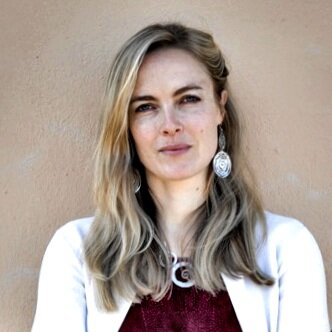
Robyn Scott
Writer and entrepreneur
5
APPEARANCES
5
PODCASTS
Aug 16, 2026

Josie CluerMODERATOR
What do you think's driving this, and how can we build people's confidence?

Robyn ScottGUEST
First of all, great to, to be here and, uh, such an interesting piece of research, and look forward to hearing more questions from, from those in the audience.
Robyn ScottGUEST
I wanna just approach this from the leadership perspective, 'cause that came out strongly in this research, and mention some live research we're doing on AI specifically, which I think sheds some light on this question, and on a particular asymmetry.
Robyn ScottGUEST
So when you ask government leaders if they think they are ready to lead a transition to an AI-enabled government, 50% of them say yes.
Robyn ScottGUEST
But when you ask- Individuals, whether they think their leaders and managers are ready to lead, it's 25%.
Robyn ScottGUEST
[laughs] So we do have a, a dynamic of blind leading the blind, but a, a, a clear, uh, trust problem as well, and that, I think, is underpinned by a couple of dynamics.
Robyn ScottGUEST
One, it is self-evident to anyone who's playing with these technologies, the pace of change and how that's increasing, and the comparatively slow change in government.
16 MINS LATER
Josie CluerMODERATOR
Um, Robyn, w- what are you thinking when we, when we say, you know, who's doing a really good job of this, and is there this demographic difference anywhere?

Jenny GillMODERATOR
I now hand over to you to introduce yourself and just give us a heads up about what you're going to be presenting to us.
Robyn ScottGUEST
and have been since late last year and it's a real privilege to be back in this space again where such amazing work goes on through the work of philanthropy and of the community and voluntary sector in New Zealand.
Robyn ScottGUEST
So I feel really privileged to have been invited back into the space and it's great to see so many colleagues on this call today.
36 MINS LATER
Jenny GillMODERATOR
What's your sort of feeling on the best way that we might take this


Robyn ScottGUEST
So currently, if you choose to give away a million dollars to an organisation, providing that that is no greater, as you suggested, than your taxable income, you are able to claim a rebate of $333,000.
Robyn ScottGUEST
uh you can do a variety of things with that rebate that you receive you can give it to some other charities or you could give it on to the charity if you've made a single donation of a million dollars if that's the example you're thinking of you could give them the additional 335 000 or 333 000 you could gift that on so effectively your donation to them might become 1.33 million dollars or you could choose to keep the rebate So there's a variety of things that you can do with the rebate.
Robyn ScottGUEST
I think the biggest concern, Lisa, for us and for the charitable sector is that the charitable and community sector is so critical to the fabric of society in Aotearoa.
Robyn ScottGUEST
We like to think of ourselves as people who care for others and believe everyone should have a fair go and that we all appreciate this beautiful country we live in and yet...
Robyn ScottGUEST
Quite often it's left to the charitable and community entities to actually deliver on that vision for Aotearoa.


Robyn ScottGUEST
But the tax incentives to give are an incentive for some donors and particularly those we know that are what we might call higher net worth donors.
Robyn ScottGUEST
At the moment, the rebate amount, the additional amount that you can receive if you give $1 million or $2 million, can be given to the charity.

Cindy MitchenerPANELIST
How are you misusing it? Is it the charities that have been misusing it or is it the people giving it that are misusing it? I just don't understand.


David RothkopfHOST
Why don't we start in the, uh, natural place, which is for you to tell us a little bit about Apolitical.
Robyn ScottGUEST
A, a big impetus for me in founding Apolitical just over 10 years ago was having worked in prisons, which are a lesson in systems failure.
Robyn ScottGUEST
You only have to spend a few weeks in our toughest prisons anywhere in the world to see that most people are there not 'cause of personal failures, but because of very upstream policy failures.
Robyn ScottGUEST
So I, when I was looking at the next chapter of my career, and I've, I've been a tech entrepreneur for some time, I was very motivated to look at government because there is so much agency within the public sector to address many of the wicked problems and huge opportunities of our age.
Robyn ScottGUEST
Uh, it's difficult to work with the public sector, but if you move the needle a little bit, it has enormous consequences.
Robyn ScottGUEST
You can be a mid-level public servant and control a, a billion-dollar budget if you're in a large country.
David RothkopfHOST
So maybe you could tell us a little bit about how that one has evolved and, and, and what you see as the consequences of it.