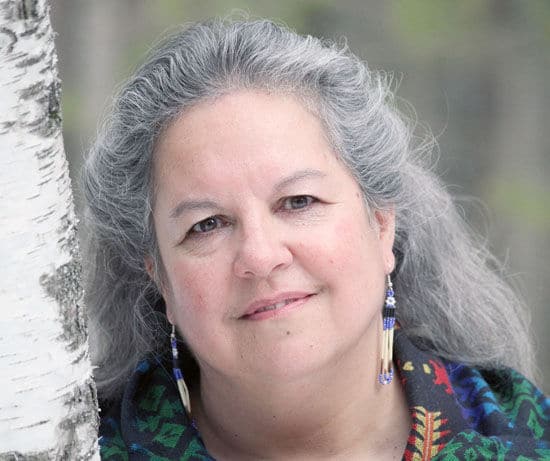
Robin Wall Kimmerer
Botanist and author
12
APPEARANCES
12
PODCASTS
Oct 30, 2026


Krista TippettHOST
And mosses, I mean, this is beautiful, this is very poetic, right? Because mosses actually, in some ways, stitch the world together, right? And so, I'm just, what do you know from mosses that would teach us about this recreating what is actually the deepest truths?

Robin Wall KimmererGUEST
Really? And, oh, there's so much to say about them, but I guess what I would want to say say in this moment is that those mosses who are practitioners of the small, practitioners of taking very little and giving a lot back, these ancient beings, in the evolutionary history of the world, 99.9% of all the beings who have ever lived are extinct.
25 MINS LATER

18:43
So I'm curious what questions you think we should be asking ourselves right now to guide us towards a future we actually want to live in, one that is not dystopian.
Robin Wall KimmererGUEST
You know, I'm so interested in the way that you framed that, Ayanna, is that oftentimes our protection and care for the land is supposedly wrapped up in our self-interest, that it's good for our health and well-being, which it is, right? But to me, what we're called to do, one of the important questions, is this expansion of what does the self mean? What does self-interest mean? I can't be well unless the plants that I eat are well.
Robin Wall KimmererGUEST
as Western science is showing us at every turn, right? That we are all permeable, that we are all both genetic and ecological and biogeochemical kinfolk.
Robin Wall KimmererGUEST
And so I think one of the questions that really can reshape our imagining of the future is to reconsider what does the self mean? And I also think of, and thank you for highlighting teaching, because for me, that's really where I learn.
Robin Wall KimmererGUEST
I think of myself as a translator from what the land is teaching to help my students learn from the land.
11 MINS LATER
31:46
So I'm curious what you have learned about the relative effectiveness of collaboration versus competition that might serve us well in this particularly bananas moment in human history.


Nate HagensHOST
And I was hoping you could share about, uh, one story about one plant and how, uh, knowing about plants can influence things about ourselves and human society.
Robin Wall KimmererGUEST
Yeah, you know, both as, as a plant scientist and as a Potawatomi scientist, plants in my culture are understood as our elders, as our teachers, and as a Western-trained plant ecologist, they are my teachers, and as an Indigenous woman trying to figure out how it is that we live well here, they are my teachers.
Robin Wall KimmererGUEST
And I think that I would want to invoke the contemporary science of biomimicry that says, "Oh, given the evolution and problem-solving by, by plants throughout evolutionary time, how might we take lessons from them? How might we have the humility to view them as, as, as teachers and models?" So hard to choose which plants to talk about, but I think I would choose the embodiment of traditional ecological knowledge as it regards plants and choose corn, beans, and squash growing together in the Indigenous polyculture that we know of as the Three Sisters.
Robin Wall KimmererGUEST
Because as we know, in contrast to contemporary monoculture agriculture, by growing corn, beans, and squash together in a polyculture, it's better for the soil.
Robin Wall KimmererGUEST
You don't need any fertilizer because it is the interaction between those three species provides everything that they need.
43 MINS LATER


Robin Wall KimmererGUEST
... what if you magnified that so that, you know, you ha- you're living in a interspecies neighborhood where the, the aspen tree is taking care of you, um, as well and demands your reciprocal care? It's like suddenly you're living in this world of, of, of relations that, um, uh, that demand our respect and our, and our curiosity as well.
Robin Wall KimmererGUEST
An important question is how did we lose that sense of connection to the living world, to this respectful engagement with the living world as, as, as kinfolk? And I think it's really important that we recognize the role of colonialism and colonization in that process.
Robin Wall KimmererGUEST
At root, when I think about colonization in the Americas, much of that enterprise was designed to replace a sense of the land as provider, as sacred, as teacher, as a place of belonging, and replace that notion with the idea of land as property, um, not as a place of belonging, but as a source of belongings.
Robin Wall KimmererGUEST
That was manifest destiny writ large, was the erasure of land as sacred homeland to land as commodity.
17 MINS LATER


Robin Wall KimmererGUEST
The way that I like to talk about economic thinking grounded in indigenous principles, as I understand them, and natural law, um, is this notion of the gift.

SarahGUEST
[laughs]
Robin Wall KimmererGUEST
Um, you know, as I travel around, which I do a lot, what I hear from people relentlessly is, "What can I do? What can I do?" And, um, so to try to direct people with that longing, we've...
Robin Wall KimmererGUEST
we're trying to launch Plant Baby Plant as a counter-narrative to drill baby drill, um, and say that what we really need to do is restoration.
Robin Wall KimmererGUEST
What we need to do is to counter those forces of destruction with forces of regeneration.
Robin Wall KimmererGUEST
And so the idea is a, is a call to action, and to try to help connect people to the work.
Robin Wall KimmererGUEST
And for some people, that means a little pocket pollinator garden in the city, and for other people, it means call you up-

Robin Wall KimmererGUEST
Um, and eventually what we wanna do is to have online workshops and conversations.

Amanda SturgeonHOST
What do you think Western science and traditional ecological knowledge have in common as we relearn how to learn from what the plants and animals know?
Robin Wall KimmererGUEST
[upbeat music] In terms of epistemology, scientific, Western scientific ways of knowing, and traditional knowledge or indigenous sci- ways of knowing, um, have, they have different foundations, right? But they also have something deeply in common with biomimicry.
Robin Wall KimmererGUEST
What they have in common is the knowledge that the land teaches us, because to me, both traditional ecological knowledge and in my experience as a scientific plant ecologist, um, both of those are just human knowledge systems with their own frameworks and wor- and worldviews.
Robin Wall KimmererGUEST
But ultimately, we're trying to figure out, what does the world know? What does the plants and animals know? That commonality of deep attention to the living world is a place where, where we have common ground.
Robin Wall KimmererGUEST
The way that we generate knowledge and communicate knowledge and validate knowledge, all of which are im- important in both TEK and, and SEK, are really different.
Robin Wall KimmererGUEST
But indigenous epistemology, there's great honor given to the fact that we human people certainly do have our intellect as a way of knowing, our big old brains.
Robin Wall KimmererGUEST
We also have physical knowledge, those things that we can measure and observe and sense, right? And in Western science, we say those are the two data sources that we will use to understand the world.
Amanda SturgeonHOST
[instrumental music] I wonder how we make this happen at the sort of pace that we know we need, given the, the crisis sort of point that we're in.

Robin Wall KimmererGUEST
It's such an important question, and one of the first, of course, is that collective small action multiplies.
Robin Wall KimmererGUEST
If you have a small native plant garden, let's say, that creates pollinator habitat, you might say, "Oh, my little square meter of, of pollinator habitat, what good does that do?" It does a great deal of good for the, for the beings who are using that, and it's a stepping stone to the next square meter that your neighbor has planted or is present in a park.
Robin Wall KimmererGUEST
It connects the habitat dots in a very pragmatic way, and there's some pretty good science to show that these, the accumulation of these small patchworks of habitat really does support regeneration of, of biodiversity.
Robin Wall KimmererGUEST
But I think the work of Plant Baby Plant is even bigger than that because I think we all know that when we take any kind of action, it prepares us to take the next action.
Robin Wall KimmererGUEST
When you cultivate agency, that agency then expands and has this real ripple effect.


Robin Wall KimmererGUEST
It's so coherent with the philosophy of your question, right? Yeah, here's the story, and again, thinking of how it is grounded in Indigenous practice and philosophy.
Robin Wall KimmererGUEST
But the story is that one of my graduate students and I were planning to do research around the threats to sweetgrass because sweetgrass basket makers were telling us that it seemed to be dwindling.
Robin Wall KimmererGUEST
And we needed to evaluate what was the relationship between sweetgrass harvesters and sweetgrass.
Robin Wall KimmererGUEST
Because some people said, well, you know, if people are picking it, that's the problem.
10 MINS LATER

10:18

Can you talk about the gifts that you think the serviceberry have to offer our modern way of thinking?
Robin Wall KimmererGUEST
You know, I chose the serviceberry when I was invited to write an essay about economics.
Robin Wall KimmererGUEST
And I chose the serviceberry because, partly of its name, that economics is all about the delivery and distribution of goods and services.
Robin Wall KimmererGUEST
And so the serviceberry seemed like a really good companion in that examination of our economy.
Robin Wall KimmererGUEST
But also because I wanted to use essentially a kind of cultural biomimicry to think about how does the economy of nature, as evinced by the serviceberry, contrast with the human market capitalist economy that we have today? created.
Robin Wall KimmererGUEST
And because serviceberry is such a generous plant, it seemed to me, again, a really good model of the abundance of nature.
15:08
So I was wondering if you could explain what that means, particularly in the context of an ancient but altered ecosystem like the Thane family forest.

Robin Wall KimmererGUEST
One of the most prevalent responses that I get from people after reading Breeding Sweetgrass is they see themselves in the book.
Robin Wall KimmererGUEST
They're able to say, I want to live in this state of wonder and this orientation around gratitude to the abundance of the world.
8 MINS LATER

Steve LevittHOST
I think it's a really interesting concept and something that, as an economist, I've never really thought about before I read your book.

Robin Wall KimmererGUEST
But in fact, perhaps you know, mosses have long been used as diapers by humans.

Alie WardHOST
How do you mentally bridge Indigenous culture and intuition with Western science? I'm really grateful