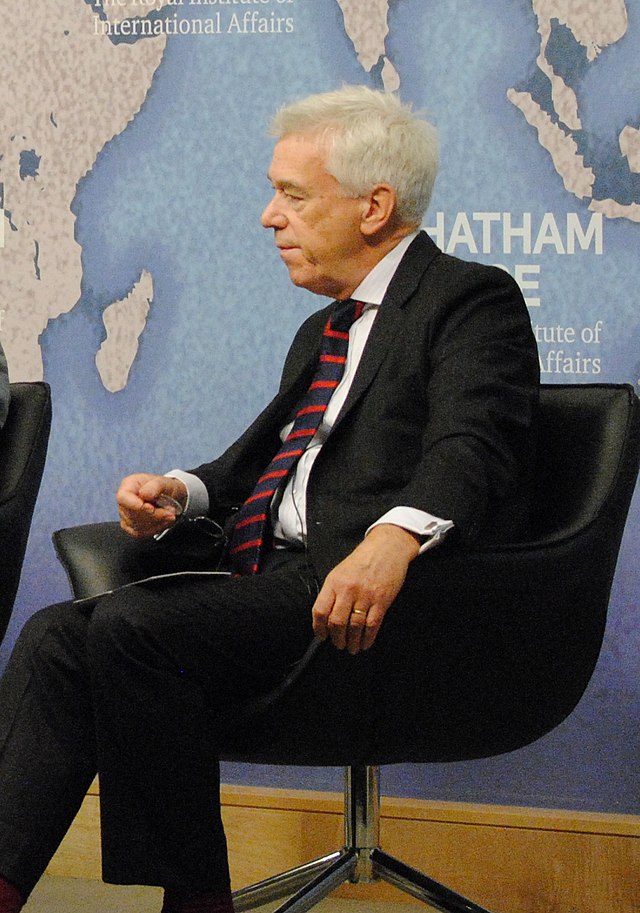
Robert Tombs
British historian
8
APPEARANCES
7
PODCASTS
Nov 9, 2026


Robert TombsGUEST
If you were to accept the principle of reparations, you would have to say, but there would be huge practical problems in deciding who deserves reparations, who deserves to pay reparations.
Robert TombsGUEST
But if you say, well, we could solve those problems, I doubt if we could, but assume that there is a case for reparations.
Robert TombsGUEST
The campaign that is being carried on seems to me to ignore or evade much of what a proper discussion about reparations would have to take into account.
Robert TombsGUEST
You know, you might say, well, the obvious thing is why focus on essentially more than on any other country, on the one country that renounced slavery and the slave trade and did an awful lot to try to stop it.
Robert TombsGUEST
If you're going to focus on some country that's guilty of slavery, why this particular one? If the United Nations was going to have a great international conference to discuss which countries should pay reparations to whom, it would not be anything like the one that we're actually witnessing, I think, which, incredibly enough, is being led by Ghana, which was itself a great slave-trading country.
5 MINS LATER

Fraser MyersHOST
So what do the critics get wrong, would you say, when the British Empire in particular is taken down a notch


James HealeHOST
I just wanted to get your take on what the Prime Minister has said, which seems to be a slight evolution of the longstanding government position that we weren't going to apologize for the crimes of our forefathers.
Robert TombsGUEST
Well, I think, I think this is what you call a Burnhamism, isn't it? It's a, a new concept.
Robert TombsGUEST
It means something that you say which you said you wouldn't say, but you-- that you say in terms that are so obfuscated that it may not mean anything at all.
Robert TombsGUEST
So he talks about being open to doing something or listening to something, which means-- doesn't mean he'd actually do anything about it, but it means that he's sending a signal to, uh, well, parts of the Labour Party, some Commonwealth governments, which he seems to think will have, uh, his desired effect of keeping his troops happy and, uh, and then probably calming things down.
Robert TombsGUEST
The reason I say it's reckless is because previous prime ministers have been very careful to choose their words carefully, because the-- it's obvious that what's going on here is that a number of governments are asking for large sums of money from us, and they're trying to extract a certain form of words which will give them some sort of legal basis at some sort of UN tribunal, perhaps, to, to push us into paying a lot of money.
9 MINS LATER
James HealeHOST
What do you make of the Commonwealth and its potential future and the UK's role in all of that?

Robert TombsGUEST
between? Well, I don't think it was ever, it's only ever been said to be a kind of...
Robert TombsGUEST
If you're on the right, you're interested in making the economy work, making money, going into the city, going into business and so on.
Robert TombsGUEST
You don't want to have a job in a museum because these things are not totally well paid and so on.
49 MINS LATER

Winston MarshallHOST
The idea of English here, I think, is a really important thing to give to kids.


Robert TombsGUEST
The problem was, as she discovered, in fact, I think it was in a television debate with Emmanuel Macron, that once you're in the Eurozone, you can't really get out of it.
7 MINS LATER


Robert TombsGUEST
Um, well, I believe it's happened because, uh, one can see it almost everywhere one looks, in museums, in school textbooks, university courses, and so on.
Robert TombsGUEST
That's w-- Now, the question, if the question is why actually has it happened, then I think the answer is much more complex.
Robert TombsGUEST
It's something that, uh, that affects not only Britain, but much of the Anglosphere.
Robert TombsGUEST
Y- you see this very similar phenomena in Canada, the United States, Australia, and New Zealand, in which the whole-- It's as if the whole of Western, modern Western history is now seen as being, uh, destructive, damaging, oppressive, and essen- and racist.
Robert TombsGUEST
Uh, now it's-- This is something that I think reflects to a g- a good deal, to a large extent, American cultural influence.

Robert TombsGUEST
Uh, so this, this, this goes back to the 1950s very obviously when, when European integration after the Second World War got off to another, another start.
Robert TombsGUEST
So, and, and what happened, of course we all know about this, well, I'm not sure how many of you under the age of 30 do, but we, we sort of know about the Suez Crisis in which both France and Britain made an attempt together to assert their power as imperial powers.
Robert TombsGUEST
You know, the last hurrah, if you like, of France and Britain as independent global powers.
Robert TombsGUEST
Uh, and it, it didn't work because the Americans and to some extent the Russians said no.
Robert TombsGUEST
So what happened? The French say, "We must therefore, we'll never trust the Americans again.
16 MINS LATER

Konstantin KisinHOST
And I imagine that, you know, you- the two of you being historians is being affected by this, your fields being affected by this as well, and people now questioning, well, are we being told the truth when we're told history?
Robert TombsGUEST
Well, I can give you an, an example of this affecting history because it, a friend of mine did this, Lawrence Goldman.
Robert TombsGUEST
Um, he, he wanted to look at some documents held by the, uh, State Library of New South Wales, um, which, written by a, a, a chap called Eyre in the 1830s who, who traveled a lot in Australia and observed and wrote about indigenous culture very sensitively, though he came to a sticky end, Eyre, later, but that's another matter.
Robert TombsGUEST
And he was told that they, they were no longer a- available online at least because they concerned des- 19th century descriptions of indigenous cultures, which were not to be seen by the prying eyes of 21st century Westerners.
Robert TombsGUEST
So here are historical documents which cannot be consulted by historians because of, because long dead people, there was no evidence that they disliked it, because after all, he traveled among them and he, they, they, they allowed him to do so.
Robert TombsGUEST
But this might upset the, the spirits of the ancestors, therefore you cannot do historical research on this person.
12 MINS LATER


Robert TombsGUEST
Uh, well, thanks, thanks very much, Clare, for that v- very flattering and quite unjustified introduction.
Robert TombsGUEST
I hope so, but I'm not optimistic, at least not about this country in the short term.
Robert TombsGUEST
A recent piece by the always thought-provoking writer Mary Harrington made me sit up.