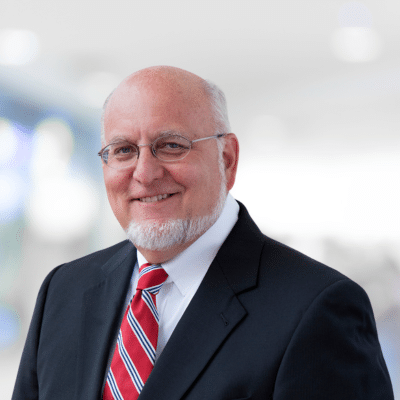
Robert R. Redfield
American virologist and former director of the Centers for Disease Control
34
APPEARANCES
20
PODCASTS
Oct 15, 2026

Kevin McCulloughHOST
And do you perceive, when you say an avian flu, that it's gonna be a weaponized version of that, and th- this is gonna be created on purpose to take people down?

Robert RedfieldGUEST
I mean, uh, we know now in 2019, uh, our, our chickens and turkeys became infected with an avian strain.
Robert RedfieldGUEST
In the CDC, when I was the director, we had very large programs that monitored these avian vi- flu viruses all over the world, particularly in Southeast Asia, and there were several of them th- that I was very concerned about.
Robert RedfieldGUEST
Uh, H7N9 would be one of them, okay? H5N1's another, and there's another one, H11.
Robert RedfieldGUEST
Um, um, but worried about that they could evolve into a virus that could infect humans.
13 MINS LATER


Jesse WeberHOST
Dr. Redfield, going back to something you said at the beginning, and we heard from Dr. Punjabi say this as well, how would Russia know for sure that this researcher died from pneumonia, not the plague? What's the process exactly that they would go through to determine that?
Robert RedfieldGUEST
As was mentioned, they can obviously do molecular diagnosis pretty quickly, but they also could look at tissue and see the organism in the lung, for example.
Robert RedfieldGUEST
So the fact that they haven't released the diagnosis has caused me some concern that they're hiding something they don't want in the public domain.
Robert RedfieldGUEST
For example, if they had a bioweapons program going on in that plague lab, they may not want to present evidence for that.

Robert RedfieldGUEST
I will say the most important thing, and the president's gonna try to do this today I think, i- is we need transparency for the Russians to tell us what's really going on.
Robert RedfieldGUEST
What's been reported is a 27-year-old woman who worked in the laboratory has died from what is presumptively a pneumonic plague.
Robert RedfieldGUEST
One is, uh, if she was working in a plague laboratory, which she was, uh, if this was regular wild type plague, uh, she should have done fine as long as she was treated with antibiotics within 24 to 48 hours.

Vince CoglianeseHOST
Uh, but the other s- the other side of it is there are governments that are using this to create bioweapons, that are actively using this as a part of a weapons program, and, uh, there's a, there's a lot of peril that comes with that.


Martha MacCallumHOST
How serious is this, knowing what we do know about the plague and, you know, the circumstances right now?
Robert RedfieldGUEST
Well, I agree with Secretary Rubio that I don't think there's cause for alarm at this point.
Robert RedfieldGUEST
The Russians have responded, as I understand, and Dan can tell us more probably because I think the intelligence on this is important, but they're pretty aggressive case-finding efforts in, as I understand, four different hospitals, over 200 individuals that they've isolated, and they haven't found a second case.
Robert RedfieldGUEST
Normally we would expect to see a case within, say, four to seven days of the index case, and so we're through that.
Robert RedfieldGUEST
So I think, you know, obviously this is significant, and I think the two areas that I'd like to highlight is, one, the significance is the importance of laboratory biosafety.
Robert RedfieldGUEST
which I think we're not very good at still, unfortunately, and I think that led to the COVID pandemic.


Robert RedfieldGUEST
First and foremost, we have to get CMS to realize that routine diagnosis of Alzheimer's has now got to be standard of care.
8 MINS LATER


Robert RedfieldGUEST
And originally, we felt that COVID was a virus that didn't transmit asymptomatically.
Robert RedfieldGUEST
So if you were infected, we encouraged people to wear a mask so you didn't infect other people.
21 MINS LATER

Joseph FraimanGUEST
And I feel that I'm I'm confused that where the public health establishment and you are at the head of the CDC are, you know, are the country's public health institution of where is that disconnect coming from between how physicians feel their their commitment is towards autonomy versus public health? At least I don't want to say they have no they don't prioritize autonomy in any way, but they seem to have it de-emphasized and compared to physicians.


Robert RedfieldGUEST
As a virologist, there's clear evidence actually in the genome of the virus itself.
Robert RedfieldGUEST
So if you really understand how to read the genome, you can really find out that, wait a minute, this didn't come from nature.
Robert RedfieldGUEST
For example, as Rand Paul talked about, there's a furin cleavage site in this virus, and what that does is it splits the protein, uh, so that the binding domain of the virus now, uh, r- preferably recognizes the human receptor but doesn't recognize the bat receptor.
Robert RedfieldGUEST
And when you look at those 12, uh, uh, nucleotides, they code for four amino acids, and the amino acid nucleotide sequence that they used, actually, uh, you can have different triplets for different amino acids, and the triplet sequence that are used in this virus are the triplet sequence that is preferred by humans, not bats.
Robert RedfieldGUEST
So how does a human, human preferred sequence for, say, arginine, how does that get in this virus? When I...


Robert R. RedfieldGUEST
Well, Veronica, actually, there's a lot of advancements that have happened in recent years.
Robert R. RedfieldGUEST
First and foremost, the FDA has approved actually a blood test that can give you high suspicion that you have Alzheimer's.
Robert R. RedfieldGUEST
Secondly, they've now recognized that there's really three stages to Alzheimer's, stage one, stage two, which are all preclinical.
Robert R. RedfieldGUEST
And then of course, what people have referred to as Alzheimer's once you have clinical dementia and Alzheimer's.
Robert R. RedfieldGUEST
So I've been a big advocate of trying to get people to realize it's to their advantage to get diagnosed early before they have clinical disease.

Veronica DudoHOST
What is it about Alzheimer's that makes you want to share so much information?

Lydia SarniSOUNDBITE_SPEAKER
I know you have been very outspoken about getting the truth out there.
Robert RedfieldGUEST
I was hoping that he would start by apologizing to Senator Paul for some of his inappropriate behavior in previous hearings and then go ahead and answer the questions.
Robert RedfieldGUEST
And the real downside of this is one of the things that we lost, and Fauci played a big part in this, is we lost public trust.
Robert RedfieldGUEST
in our public health agencies and our public health leaders and if you don't have public trust you can't have an effective public health program and i think fauci's performance in the hearing the other day put another nail in the coffin of loss of public trust which is critical for us to rebuild if we're going to have any chance of having an effective public health response to the next pandemic
Lydia SarniSOUNDBITE_SPEAKER
He made it up.


Amanda HeadHOST
Sir, it's taken six years, but seeing these Fauci diaries, his private musings, and then some interstitials of media clips and such, what stood out to you as the most shocking or damning?
Robert RedfieldGUEST
Well, I was very disappointed first in the hearing because I really think it was a big mistake to take the F- Fifth and not to answer the questions that the senators have.
Robert RedfieldGUEST
And I was hoping what he was gonna do was to take the opportunity to first apologize to Senator Paul for probably being over the top in some of the previous hearings when he was, uh, very accusatory to the senator.
Robert RedfieldGUEST
Secondly, I thought that he would take a chance to be humble and a- admit that while he did the best that he could when he was in the position that he was in, th- uh, the reality is, in retrospect, he made a number of mistakes and, and alluded to them.
Robert RedfieldGUEST
I recently published my own book called Redfield's Warning, and I encourage your audience to read the book.
Robert RedfieldGUEST
Uh, and when you read it, you'll find very frequently I say, "We got that wrong.

John SolomonHOST
What did you know then, and what do you know now, and how much has the story evolved to your surprise?

Amanda HeadHOST
Sir, it's taken six years, but seeing these Fauci diaries, his private musings, and then some interstitials of media clips and such, what stood out to you as the most shocking or damning?
Robert RedfieldGUEST
Well, I was very disappointed first in the hearing because I really think it was a big mistake to take the fifth and not to answer the questions that the senators have.
Robert RedfieldGUEST
And I was hoping what he was going to do was to take the opportunity to first apologize to Senator Paul for probably being over the top in some of the previous hearings when he was very accusatory to the senator secondly i thought that he would take a chance to be humble and admit that while he did the best that he could when he was in the position that he was in the reality is in retrospect he made a number of mistakes and and alluded to them i recently published my own book called redfield's warning And I encourage your audience to read the book.
Robert RedfieldGUEST
And when you read it, you'll find very frequently I say, we got that wrong.
Robert RedfieldGUEST
I think it would have been a great service to start rebuilding public trust.
John SolomonHOST
What did you know then and what do you know now and how much has the story evolved to your surprise?

Jackie HeinrichHOST
Do you believe that there's any... one factor here that is contributing to how difficult it was to determine the source? And, you know, should the CDC consider resuming any tracking of this particular pathogen?
Robert RedfieldGUEST
Well, I think there's several things that influence the challenge here, but you are right.
Robert RedfieldGUEST
One of the things that I've tried to stress is I think it was a big mistake to cut back on our food safety surveillance programs.
Robert RedfieldGUEST
When I was CDC director, we had a very robust program that we operated in partnership with the FDA and, as you mentioned, tracked a number of pathogens, including cyclospora, in all the states in a cooperative way, and unfortunately that's been cut back.
Robert RedfieldGUEST
I think he'll be one of the most consequential health secretaries we've ever had.
Jackie HeinrichHOST
But what is the concern right now in parts of the country that have been experiencing this smoke? Who are the biggest risk groups and do masks or masks advised still in those places?
Unknown podcast
How Much Will Foreign Matters Matter This Midterm Cycle?
Jul 15 · 30m
speaker_5UNKNOWN
Dr. Robert Redfield was director of the Centers for Disease Control and Prevention in the first Trump administration, a virologist who's now a senior fellow of biosecurity and public health policy at the Heritage Foundation.
Robert RedfieldGUEST
In order for it to infect a human, uh, an infected individual develops what we call oocysts in their small bowel.
Robert RedfieldGUEST
They get excreted in the environment, and they have to mature in the environment for one to two weeks, in soil, water, and then they form what we call a sporocyte, and then that sporocyte can infect another human.
Robert RedfieldGUEST
You're not gonna get this from the salad worker, you know, who, like salmonella, where you can get salmonella if you have an infected salad worker, or hepatitis A.
Robert RedfieldGUEST
This is strictly something that you're gonna get from having usually produce, mostly, uh, vegetables and fruits that have been contaminated by water, which is contaminated with fecal, human fecal material.
speaker_5UNKNOWN
Is that okay to do?

speaker_8UNKNOWN
Dr. Robert Redfield was director of the Centers for Disease Control and Prevention in the first Trump administration, a virologist who's now a senior fellow of biosecurity and public health policy at the Heritage Foundation.
Robert RedfieldGUEST
In order for it to infect a human, uh, an infected individual develops what we call oocysts in their small bowel.
Robert RedfieldGUEST
They get excreted in the environment, and they have to mature in the environment for one to two weeks, in soil, water, and then they form what we call a sporocyte, and then that sporocyte can infect another human.
Robert RedfieldGUEST
You're not gonna get this from the salad worker, you know, who, like salmonella, where you can get salmonella if you have an infected salad worker, or hepatitis A.
Robert RedfieldGUEST
This is strictly something that you're gonna get from having usually produce, mostly, uh, vegetables and fruits that have been contaminated by water, which is contaminated with fecal, human fecal material.
speaker_8UNKNOWN
Is that okay to do?


Tom LlamasHOST
How can people avoid getting sick from this? Should people be throwing out their lettuce, or is it more than just that?
Robert RedfieldGUEST
that?You know, Tom, this is a difficult pathogen to get rid of, okay? First thing for people to realize is there is no human-to-human transmission.
Robert RedfieldGUEST
So the way you get infected is by eating or drinking contaminated, uh, produce or water, uh, contaminated with, actually with human fecal material.
Robert RedfieldGUEST
And the vi- or the pathogen when you get it, uh, it has to replicate in the human body, and then it actually has to be excreted and stay in the environment for about two weeks for it to change forms, and then that changed form now can infect somebody else.
Tom LlamasHOST
Is that having an impact on the public health response, and can we draw a straight line in this outbreak?


Wolf BlitzerHOST
Dr. Redfield, how serious is this illness, and what sort of food should we be avoiding right now?
Robert RedfieldGUEST
Well, Wolf, it can be quite serious, and then it can cause severe dehydration if it's not, uh, treated in terms of maintaining your hydration.
Robert RedfieldGUEST
Luckily, uh, an antibiotic, uh, that we know as, uh, Bactrim or Septra does have some positive impact, so it is partially treatable.
Robert RedfieldGUEST
Um, but it's a, it can be a quite, uh, uncomfortable gastrointestinal, uh, pathogen.
Robert RedfieldGUEST
It can, y- you know, really last anywhere from two to four, um, 12, say two days to two weeks, and even longer into even a month, with severe diarrhea, gastrointestinal disturbances.
Robert RedfieldGUEST
The foods that we associate it with largely are fresh vegetables, um, and fresh fruits.
Wolf BlitzerHOST
How do those cuts, uh, to the agency impact the response to outbreaks like we're seeing right now?

Robert RedfieldGUEST
I was asked to talk a little bit about some of the stuff that was recently in the news.
Robert RedfieldGUEST
I want to start by just emphasizing a point that I do stress in my book, and that is that biosecurity is really a major national security issue for our country.
Robert RedfieldGUEST
Clearly, the COVID pandemic probably made many people more aware of the impact that new pathogens can have when they enter our nation and the world.
Robert RedfieldGUEST
And in fact, you know, it was said in this earlier in this broadcast, people were saying that we were talking about chronic disease and someone was saying that this was another problem created by man.
Robert RedfieldGUEST
I just want to emphasize, I think many of you do know that and I think people have come more clean about their analysis, particularly the CIA, that I think all the evidence is, as I stated several years ago, that this pandemic started not from nature, but it started from scientific research in a laboratory in China and really is a direct consequence of man trying to manipulate nature.
5 MINS LATER


Jake TapperHOST
What does that suggest to you about the scale of the outbreak and, and how bad it might get?
Robert RedfieldGUEST
Yeah, Jake, I'm concerned about this outbreak, um, 'cause already within, you know, less than several weeks of its first recognition by WHO, we had, uh, numbers that would put it as the third-largest Ebola outbreak in the history of the world.
Robert RedfieldGUEST
Uh, this was largely driven by a technical challenge, as was pointed out in your read-up to this, is that the tests that we developed for Ebola pick up the Zairean strain and the Sudan strain, but they didn't pick up the Bundibugyo strain, which is the strain that unfortunately is causing this current outbreak.
Robert RedfieldGUEST
We've had 17 Ebola outbreaks in the DRC since 1976, and only two of them had, had the Bundibugyo strain, which was in 2007 and 2012.
Robert RedfieldGUEST
So when the doctors saw these cases, uh, they would test them and they would come back negative to the Zairean strain, and therefore they didn't feel they had Ebola.
Robert RedfieldGUEST
Although, when you see this degree of mortality, uh, you really need to think Ebola.
Jake TapperHOST
What do you think? Do you agree with the USAID official that we spoke with that gutting USAID had absolutely an impact on the effect of the response to this outbreak?
Robert RedfieldGUEST
I think it's gonna be a very significant outbreak that has the potential to go, uh, regional, uh, from, uh, the DRC, Uganda, maybe into South Sudan.
Robert RedfieldGUEST
One thing I'll say about the Ebola virus, it doesn't really have the characteristics that will allow it to become, as you commented, a global pandemic.

Pamela BrownHOST
Do you think any of the cuts that the Trump administration has made to s- USAID and pandemic response preparedness has played any role, as critics have said, in catching the Ebola too late, a- as you just said?

Robert RedfieldGUEST
I mean, you know, Joe, when, when I was being, uh, vetted and considered for CDC director and I reflected with my wife, Joy, about whether we should take that opportunity to be CDC director, as you know, we prayed about it, and one of the things that I felt, uh, deep, deep in my spirit was that, that, that we were at risk for a great respiratory pandemic.
Robert RedfieldGUEST
And I felt, as a trained virologist, you know, who had significant experience in, in, in, in this area, that, uh, I sh- if I was given the opportunity, I should take it, uh, so I could help prepare our nation to respond to what I anticipated was gonna be a bird flu pandemic.
Robert RedfieldGUEST
I thought it was gonna be a bird flu pandemic.Uh, unfortunately, the, uh, coronavirus came, which again, I think was, as you know, it's-- some people think it's controversial.
19 MINS LATER

Joe GroganHOST
Can you talk a little bit about where we are with long COVID, what you've learned, and what you would like to see in a treatment?
Robert RedfieldGUEST
There was a lot of people that didn't appreciate my decision, but it was the decision of the CDC director.
Robert RedfieldGUEST
It was not the decision, you know, for the president or the vice president.
Robert RedfieldGUEST
It was a public health decision, and I made it and, um, and shut down the entire cruise line industry because, you know, we were losing a lot of people.
Robert RedfieldGUEST
They were dying on these cruise lines, and they were not prepared to deal with it, uh, the COVID pandemic.
Robert RedfieldGUEST
And so ultimately, what I did was I reopened the cruise line industry, uh, that on a condition.
6 MINS LATER
Unknown podcast
Extra: Avoiding COVID Mistakes As The World Responds To Hantavirus
May 16 · 29m
Robert RedfieldGUEST
There was a lot of people that didn't appreciate my decision, but it was the decision of the CDC director.
Robert RedfieldGUEST
It was not the decision, you know, for the president or the vice president.
Robert RedfieldGUEST
It was a public health decision, and I made it, and, um, and shut down the entire cruise line industry because, you know, we were losing a lot of people.
Robert RedfieldGUEST
They were dying on these cruise lines, and they were not prepared to deal with it, uh, the COVID pandemic.
Robert RedfieldGUEST
And so, ultimately, what I did was I reopened the cruise line industry, uh, that... on a condition.
6 MINS LATER
Robert RedfieldGUEST
So I think, I think the, uh, the research from the Chinese perspective, and I've said this before, and it is speculation, but I think it's educated speculation.
Robert RedfieldGUEST
I think the Chinese scientists were trying to develop a vaccine vector that could be used to vaccinate the Chinese military and Chinese people, and to do that they needed a, a virus that could be transmissible by aerosol.
Robert RedfieldGUEST
It needed not to cause symptomatic illness, and it needed not to have a good immune response so that you could use it over and over and over again, all of which are features, unfortunately, of the COVID virus itself.
Robert RedfieldGUEST
Uh, the United States, why they were involved, I, I don't know for certain.
Robert RedfieldGUEST
Fauci was in charge of our Biodefense Program, which was about a $40 billion program that, that, uh, the Vice President Cheney moved from the US military to NIH back in 2002.
6 MINS LATER

Dave AnthonyHOST
Dr. Robert Redfield is an infectious disease expert, former director of the Centers for Disease Control and Prevention during COVID times in the first Trump administration.
Robert RedfieldGUEST
We hadn't really experienced it as a virus in humans, uh, and so there was just a total unknown, whereas the hantaviruses have been with us for a long time.
Robert RedfieldGUEST
We had, uh, probably one of the biggest outbreaks was in the Korean, uh, War.
Robert RedfieldGUEST
The US military had significant problems with a hantavirus that we knew as Korean hemorrhagic fever.
Robert RedfieldGUEST
There is one exception, which is the Andes variant, which is the variant that we're dealing with on this cruise ship.
Robert RedfieldGUEST
It's, uh, it's a hantavirus that's in, uh, uh, Argentina and Chile in particular.
8 MINS LATER
Unknown podcast
Former CDC Director On Hantavirus, Cruise Ship Risks
May 12 · 31m
Dave AnthonyHOST
Dr. Robert Redfield is an infectious disease expert, former director of the Centers for Disease Control and Prevention during COVID times in the first Trump administration.
Robert RedfieldGUEST
We hadn't really experienced it as a virus in humans, uh, and so there was just a total unknown, whereas the hantaviruses have been with us for a long time.
Robert RedfieldGUEST
We had, uh, probably one of the biggest outbreaks was in the Korean, uh, War.
Robert RedfieldGUEST
The US military had significant problems with a hantavirus that we knew as Korean hemorrhagic fever.
Robert RedfieldGUEST
There is one exception, which is the Andes variant, which is the variant that we're dealing with on this cruise ship.
Robert RedfieldGUEST
It's, uh, it's a hantavirus that's in, uh, uh, Argentina and Chile in particular.
8 MINS LATER
Scroll for more appearances