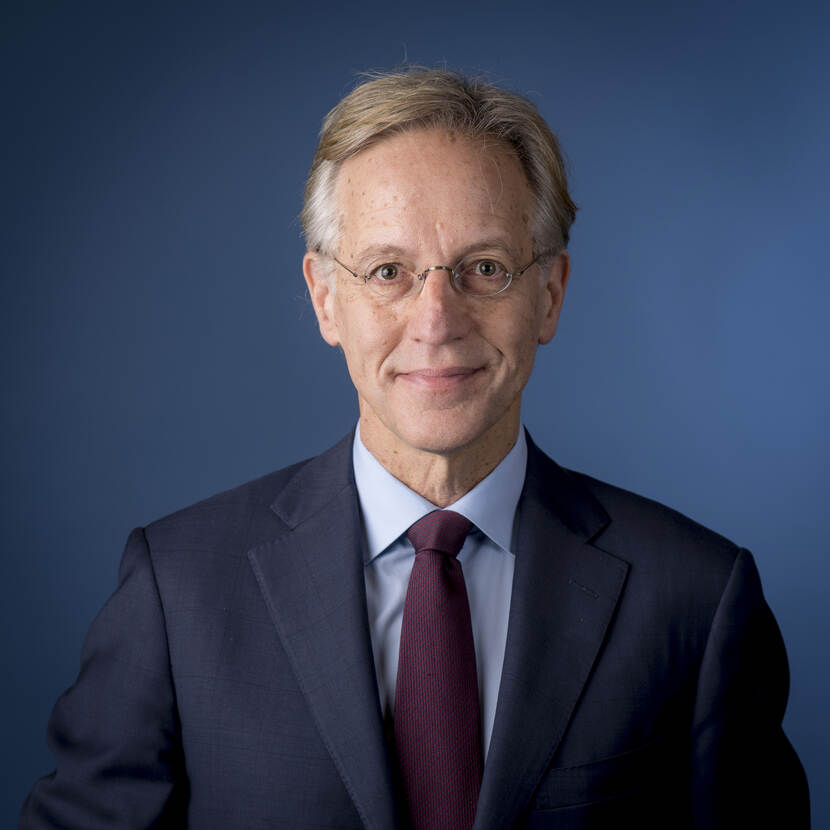
Robbert Dijkgraaf
Theoretical physicist and former Minister of Education, Culture and Science of Netherlands
3
APPEARANCES
3
PODCASTS
Jul 29, 2026


Robbert DijkgraafGUEST
Yeah, so I think this is one of the most serious challenges in science is that this kind of gap there is between the scientific community and the rest of society.
Robbert DijkgraafGUEST
And of course, scientists are part of society, but it's growing almost by definition because science and technology proceeds.
Robbert DijkgraafGUEST
who knows what's happening exactly in your smartphone or what is the process by which vaccines are developed or new technology in general.
28 MINS LATER

Andrew DubberHOST
right well you mentioned in your talk uh quite a lot about interdisciplinarity and transdisciplinarity um and and it is an idea i'm very interested in um how do you get that happening how do you make people collaborate with people that they have no other reason to share oxygen with

Robbert DijkgraafGUEST
Well, I think one thing we do really well in the Netherlands is, uh, to take vocational and technical training very seriously.
Robbert DijkgraafGUEST
Um, you know, we have had also big campaign to value it as much as academic training, but there's a whole system behind it.
Robbert DijkgraafGUEST
We have, uh, more than 250,000 licensed, what we call learning companies, so they, they together with the vocational and technical colleges, set the, uh, curricula.
Robbert DijkgraafGUEST
And, uh, so there's a whole system in place that, uh, take young people and give them the working experience and build this connection between schools and companies that allows both, I think, the schools and the companies to be updated and, and adapt to that, that rapid change.
Robbert DijkgraafGUEST
And, and, and a second important element is, is that we po- put a responsibility to bring young people who, like, drop out of school or are about to drop off out of school to local authorities.
Robbert DijkgraafGUEST
So we have experienced that what you need is communities of schools, companies, uh, government, but m- mostly at the local level.

Robbert DijkgraafGUEST
Ja, het had heel veel implicaties, want het vertelde gewoon natuurlijk dat we een heel ander wereldbeeld moeten hebben.
Robbert DijkgraafGUEST
Uhm, dat, uh, we na moeten denken welke vragen we wel en niet kunnen beantwoorden.
Robbert DijkgraafGUEST
Uhm, dat dingen, uh, misschien vanuit verschillende perspectieven kunnen bekeken worden.
Robbert DijkgraafGUEST
Dus het, een soort winst zit erin dat je meerdere gezichtspunten niet met elkaar in tegenspraak zijn.
23:35

Uhm, wat je ook zegt is dat quantum net als misschien wel, uh, de algemene relativiteitstheorie, uh, ook wel, ja, een soort filosofisch vraagstuk opwerpt van: waar-waarom zijn we hier eigenlijk allemaal en waarom werkt het zoals het werkt? Uh, het is bijna religieus, hè, hoe, hoe je ernaar moet kijken.