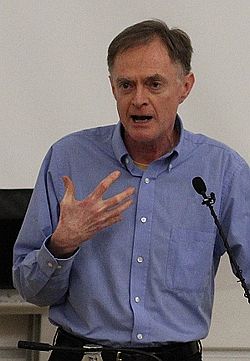
Richard Heinberg
American journalist and educator
3
APPEARANCES
3
PODCASTS
Oct 13, 2026


Richard HeinbergGUEST
Well, you know, I, I think the only way we're going to get through this bottleneck, which is what I think climate change is imposing on our species, is, uh, is through, uh, reconnection with and restoration of natural systems.
Richard HeinbergGUEST
There are ways of growing food that restore soils, that, that, uh, store carbon back in topsoil, and that's what we need to be doing.

CoreyHOST
But, uh, first I just wanna ask, so for you, what is it that brought collapse awareness into your life? At what point in life did this click for you?
Richard HeinbergGUEST
Uh, you know, it's been a long process, and it started when I was, uh, 21 years old, and I read a book called The Limits to Growth.
Richard HeinbergGUEST
And, uh, for those who are not familiar with the book, it was written almost exactly 50 years ago, and it was written by a team of scientists at Massachusetts Institute of Technology, MIT.
Richard HeinbergGUEST
These were systems scientists, and, uh, they were using this new gizmo called a computer to try to model scenarios of the future, looking at data on things like resources, pollution, population, industrial production, and, and food, and to see how these, these trends in these areas might influence each other over time.
Richard HeinbergGUEST
They did a dozen scenarios, right? You know, jiggling with the data and government policies and all the, all the inputs they could reasonably do, you know, within the boundaries of the experiment.
Richard HeinbergGUEST
And their, their standard run, uh, scenario where, you know, it was basically business as usual.
21 MINS LATER
KellanHOST
On the overaccumulation side, how, how do you know when you have too much power? What, what does it look like? Or what's the right amount of power to avoid-

SebastianHOST
So for people who are not familiar with your body of work, um, how would you, if you could, describe it? Uh, how would you summarize it?
Richard HeinbergGUEST
Well, um, my perspective, I guess I would say, is that of a, a human ecologist.
Richard HeinbergGUEST
Uh, ecology, of course, is the study of the relationships between organisms and their environments, so human ecology is the study of the relationship between humans and our environment, which of course includes lots of other organisms.
Richard HeinbergGUEST
So it's, to a large extent, the relationship between human beings and other organisms.
Richard HeinbergGUEST
Um, so that, that, that's a huge subject, and the, the, the part of that that's interested me most is, uh, human social evolution and its relationship to energy.
6 MINS LATER