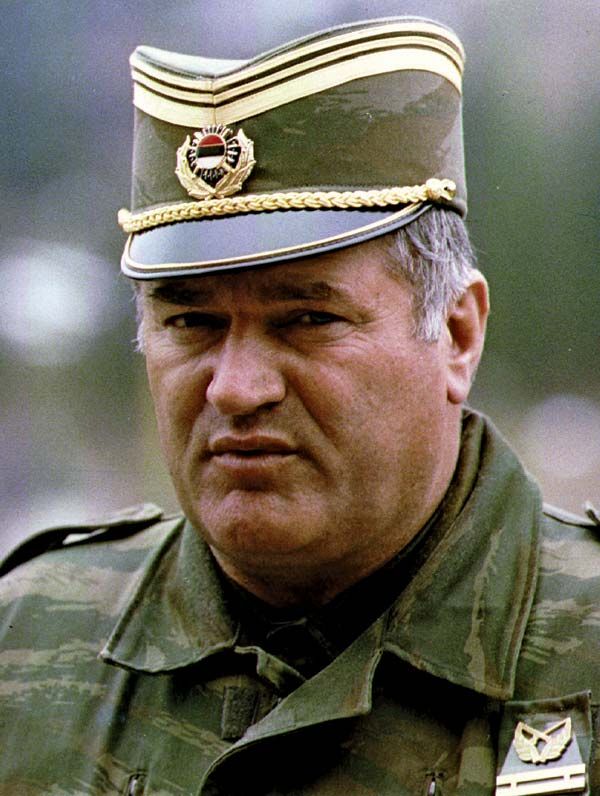
Ratko Mladić
Bosnian military officerWikipedia
40
MENTIONS
26
EPISODES
23
PODCASTS
Search complete. 40 mentions across 26 episodes found for "Ratko Mladić".
Oct 29, 2026

Marko PrelecGUEST
The first is that the student movement themselves were all over the map.
Marko PrelecGUEST
They covered the full spectrum of views about Ratko Mladic and the war, from full-on nationalists who deny there were any war crimes to people who are supportive of the ICTY and reconciliation and everything in between.
Marko PrelecGUEST
So it really is a very heterogeneous opposition movement that was focused on the things that they agreed on rather than what they disagreed on.
Marko PrelecGUEST
The other thing that is interesting is that this is really ancient history for a lot of the people in the student movement.

Srdja PopovicGUEST
So I will look at the accession process as a real test of... geopolitics and neighborhood stabilization process as far more important about who we are in Balkans and whom would we live in Balkans because the The night when Vucic admitted defeat, they were doing one of these resistance thing and they were applauding and say, we are going to the opposition and we are not going to surrender.
Srdja PopovicGUEST
And they sang the hymn to Ratko Mladic, the war criminal from Bosnian war.
Srdja PopovicGUEST
This is where I would be looking carefully.
Srdja PopovicGUEST
And this is like my first test is, are we going to surrender? be on a good side of the neighborhood or we are going to celebrate the disgusting past of Milosevic's 90s.

Rory StewartHOST
He was somebody from the right who had made the most disgusting statements ever.
Rory StewartHOST
as Milosevic, his propaganda chief, and the guy that was almost working as your opposite number during the Kosovo campaign, who was on record saying that he thought that, I think it was that 100 Bosnians should die for every Serb, which he later said was just a figure of speech, whose government, although he kept a little distance, but not much distance from it, essentially took back Ratko Mladic, the war criminal who was responsible for the Srebrenica genocide to something pretty close to a state funeral when he returned a few weeks ago.
Rory StewartHOST
A man who dominated the media so that when we were in Serbia doing that election, someone from the British embassy had basically got themselves caught up in a horrible situation in a provincial town.
Rory StewartHOST
And the control that Vucic's team seemed to be able to have over the media and the way that they were able to replay the bits of our interview that seemed positive to him right across the national media were unbelievable.

Tommy VietorGUEST
been around forever.
Jane CoastonHOST
Been around forever, had the support of the worst people alive, Serbian ultranationalists who would show up at soccer games and display a TIFO of, for example, a convicted war criminal and dead man, Ratko Mladic, during a Superliga game in September.
Jane CoastonHOST
Mladic, who oversaw the massacre at Srebrenica, the worst European post-war mass murder case.
Tommy VietorGUEST
Genocide.

George SzamuelyGUEST
They started handing over the leaders of the Serbs in the 1990s, the people who had actually defended and protected the Serbs.
George SzamuelyGUEST
They surrendered Slobodan Milosevic, then they surrendered Radovan Karadzic, they surrendered Ratko Mladic, they allowed Mladic, Milosevic to die in prison.
George SzamuelyGUEST
Karadzic will probably be next.
George SzamuelyGUEST
And then even when Kosovo declared independence, the new leadership had made clear to the European Union, to NATO, that we wouldn't do anything to stop you.

MariaSOUNDBITE_SPEAKER
First of all, with the fall of the canopy, the focus was the corruption and the responsibility of the people in power who dealt with this project, who killed practically the 16 people under this canopy.
MariaSOUNDBITE_SPEAKER
This, from the beginning, I think that the students understood that this is not the question, do we want socialism or we want something else, or we want Ratko Mladic.
MariaSOUNDBITE_SPEAKER
This was simply the matter that all our lives are suddenly under this canopy.
MariaSOUNDBITE_SPEAKER
I think that the oppositional leaders, even though some of them are good in general, were largely damaged by the manipulation of the pro-regime media, so they really, really had a bad reputation, and it was simply not possible to have them with the student movement.

Florian BieberGUEST
They've received political and economic support.
Florian BieberGUEST
Also, the Serbian media sphere is very much present in those countries and amplifies their kind of nationalist, also the denial of war crimes, the glorification of war criminals like when Ratko Mladic, for example, died and received state honors in Serbia.
Florian BieberGUEST
So these are the kind of measures in which Serbia amplifies, let's say, the more negative effects.
Florian BieberGUEST
Now, of course, many Serbs might see this as a positive role, although I think, you know, there are also Serbs which are maybe disillusioned in the Republika Srpska.

Randal WallaceHOST
You're listening to Randal Wallace Presents, formerly Bridging the Political Gap, the number one American history podcast of 2024 by feedspot.com.
speaker_1NARRATOR
[metal door closing] On July 11th, 1995, Bosnian Serb forces led by General Ratko Mladić began a systematic killing of nearly 10,000 Bosnian Muslim, sometimes referred to as Bosniaks, men and boys in the area of Srebrenica, a small town located about halfway between the Bosnian capital of Sarajevo and the Serbian capital of Belgrade.
speaker_1NARRATOR
Widespread ethnic violence in what had been Yugoslavia led to the outbreak of the largest armed conflict in Europe since the end of World War II, since eclipsed by Russia's invasion of Ukraine in 2022.
speaker_1NARRATOR
The horrific images beamed worldwide on news programs, newspapers, and magazines shocked the world, bringing back memories of the Holocaust and the outbreak of World War I in 1914, which began in the same region.
speaker_2NARRATOR
Little did they know this decision would ignite a powder keg of ethnic tensions.
speaker_2NARRATOR
The response was swift and violent.
speaker_2NARRATOR
Bosnian Serb forces, backed by the JNA and led by the controversial duo of Radovan Karadžić and General Ratko Mladić, seized key territories.
speaker_2NARRATOR
Their ultimate goal, the creation of a greater Serbia by annexing predominantly Serb areas in Bosnia and Herzegovina and linking them to Serbia proper.
Theo GattererHOST
Mm
Jasmin MujanovićGUEST
... position is on, you know, the recent funeral of the genocidaire Ratko Mladić.
Jasmin MujanovićGUEST
What their position is on the broader sort of question of Bosnia and Herzegovina and the origins of the RS and the context of the aggression and genocide of Bosnia.
Jasmin MujanovićGUEST
So this is, I think this is in many ways indicative of, of a, of a much bigger problem that you're gesturing at, which is that Serbia has not gone through the kind of catharsis that other societies which have had, shall we say, similar trajectories in their histories have gone through.
40 MINS LATER
Christian NotaHOST
Um, in this framework, the funeral of, uh, of Mladić, which is, uh, uh, confirmed, uh, genocidal with the Srebrenica massacre, is already sending a message that violence can return and is justified in the region.
Jasmin MujanovićGUEST
Yeah, I mean, look, um, I think what we saw in the context of the Mladić funeral in Serbia is deeply troubling for a number of reasons.
Jasmin MujanovićGUEST
The first, uh, and the one that's sort of directly related to what we've been speaking about here, is that the Serbian state remains institutionally wedded to the political project of Ratko Mladić, of Radovan Karadžić, of Slobodan Milošević, right? This goes back to what I was saying as Vučić, the ultra-nationalist.
Jasmin MujanovićGUEST
This is, this is the same cabal.

John BradshawHOST
War crimes were committed.
John BradshawHOST
Ratko Mladic became known as the Butcher of Bosnia for his role in the Bosnian War.
John BradshawHOST
Mass murder, torture, mutilation, rape.
John BradshawHOST
It was after the Bosnian War that mass rape was acknowledged as a war crime.
16 more episodes mention Ratko Mladić.
Create an account to see the whole feed, search across every transcript, and follow the entities you care about.