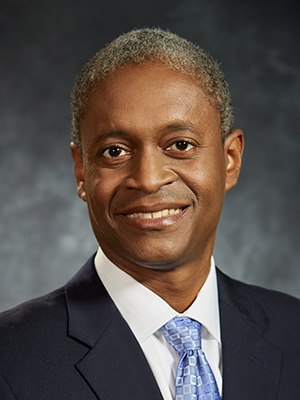
Raphael Bostic
President and CEO of the Federal Reserve Bank of Atlanta
6
APPEARANCES
5
PODCASTS
Sep 17, 2026


Sara EisenHOST
But can they actually affect it if a lot of it is being driven by higher oil prices from the war?

Raphael BosticGUEST
And if the Fed has not positioned itself so that people believe that at some point down the future we're going to get to 2%, then you could see the pricing environment more out of control.
Raphael BosticGUEST
By and large, that has not happened, but it has not happened because the Fed has stayed focused on that.
Raphael BosticGUEST
One question that I've been wrestling with for several years now is how should we think about supply shock? No, the textbook story is that supply shocks are not things that the Fed can deal with.

Raphael BosticGUEST
Like, if it looks like we stopped doing whatever it takes, then people might start worrying about our credibility.
Raphael BosticGUEST
Like, do, do, do they have the, the stick-to-it-iveness that, that we need them to have to have that longer run potential? Uh, and that's a problem.
Raphael BosticGUEST
So the inflation side has been a big concern for me for a long time, and, um, and so that's that.
Raphael BosticGUEST
Now you go to the labor market, and, um, there, I think it's actually very complicated.
Raphael BosticGUEST
And it's complicated because I do think there are some structural changes happening that are making it difficult for, for me and, and anybody really, to have a good sig- sense of what the implications are for where the economy is moving forward.
speaker_12UNKNOWN
[laughing]


Michael McKeeHOST
I want to ask you, as you travel around your district for the past year, what's the mood like among companies and consumers? We've seen the surveys show that people are getting very, very pessimistic.
Raphael BosticGUEST
So first of all, what has been true throughout the last year is a tremendous amount of resilience on the part of both businesses and consumers.
Raphael BosticGUEST
April 2nd, when the tariffs were announced at very high levels, that put everyone back on their heels and there was a lot of uncertainty.
Raphael BosticGUEST
And what's happened through the year is people have figured out ways to deal with that uncertainty.
Raphael BosticGUEST
So as for today, I think most businesses and most households are not thinking that the worst of the possible outcomes are going to happen.
Raphael BosticGUEST
They're not sure they can get to the best ones, but everyone's trying to find a steady state where they can get through.
Michael McKeeHOST
Does any of that, you don't have another meeting to vote at, but does any of that give you pause about the Fed pausing at this point?


Raphael BosticGUEST
So there's a lot of stuff that we do, and we've, we've historically had a leadership role in that, and we continue to play an important factor there.
Raphael BosticGUEST
And then in monetary policy, we have a few distinctive characteristics that I think are also quite helpful for me in terms of trying to figure out, you know, how the economy works.
Raphael BosticGUEST
One, we have a survey center that runs a series of surveys like the Survey of Business Uncertainty, the se- Survey of Business, inflation expectations.
Raphael BosticGUEST
We do a survey of CFOs, and we do a whole host of other things to try to get real-time information.
Raphael BosticGUEST
And one of the things that's interesting, like the surveys really built up...
6 MINS LATER


Raphael BosticGUEST
Because for many of these things, if you wait for them to show up in the national data, you're two months behind, a quarter behind, sometimes a couple weeks behind, and then there's more of a scramble.
Raphael BosticGUEST
We learned...... and the great financial crisis that we needed to be asking much more front forward and prospective questions about what businesses are seeing, what they's feeling, and how they're gonna respond.
Raphael BosticGUEST
So that even the, even if the revelation happens at different speeds, the impulses and the drivers will be more contemporaneous.
Raphael BosticGUEST
And if you can discern those, then you might be able to get a head start on where things are going.
Raphael BosticGUEST
What I would say today is, and it gets back to the, what we were just talking about, I think many firms will probably try to pass through costs to the extent they see them.
Raphael BosticGUEST
They will learn pretty quickly whether those cost increases are being t- taken on by customers or being rejected by them.
15 MINS LATER

Joe WeisenthalHOST
Do you think it's fair to say that the chances of having a lot of wage growth alongside higher goods prices is lower than it was post-pandemic? And if that's the case, does it perhaps give the Fed more room to look through higher goods prices if you're not worried about, you know, a big self-reinforcing inflationary spiral?

Raphael BosticGUEST
So, you know, one of the things that we are trying to do is figure out how everyone else is doing this.
Raphael BosticGUEST
We're talking to businesses, we're talking to consumers to figure out how they're dealing with this unprecedented level of uncertainty and volatility.
Raphael BosticGUEST
You know, as things are changing on a day-to-day basis, folks don't really know what they should be planning on or what they should be planning for.
Raphael BosticGUEST
And so the question that we've been asking is, "Well, what are you doing in that context? How are you thinking about responding to this?" And what we're hearing from most is that they're gonna wait and see, and hope that this thing clears up so that there's more certainty at some point in the future.
Raphael BosticGUEST
Uh, but we'll see how long they can hold on, and I think that's one of the questions that will be... that we will be watching very closely.