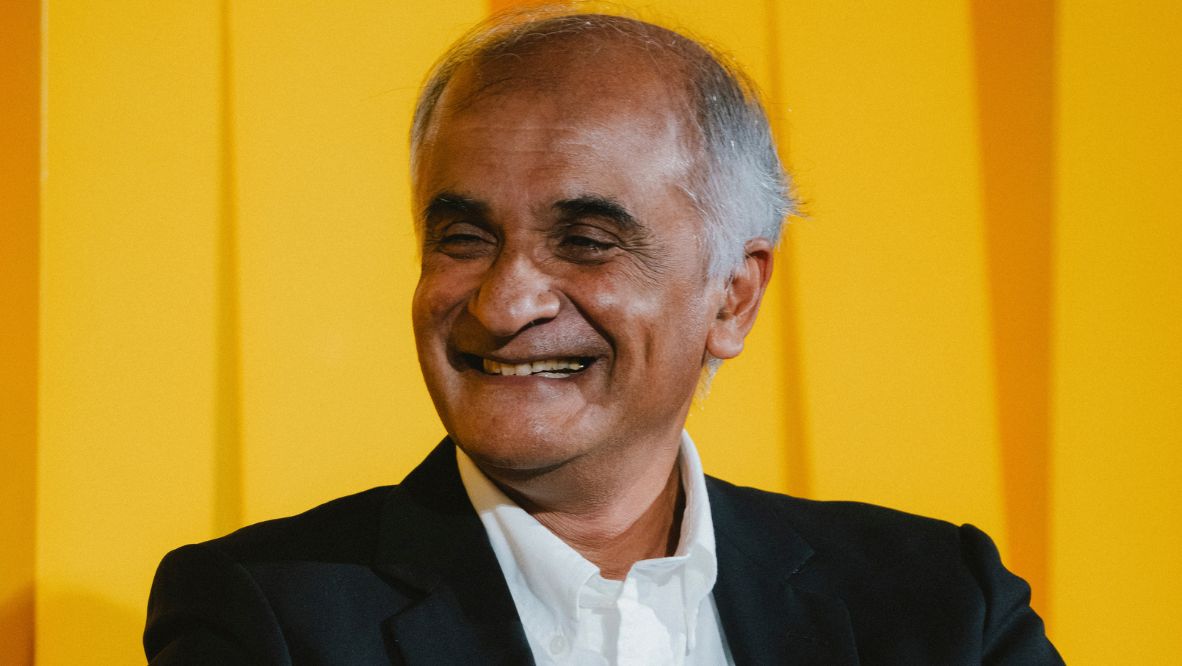
Pico Iyer
Essayist and novelist
15
APPEARANCES
11
PODCASTS
Oct 20, 2026


Pico IyerGUEST
So like so many people in Santa Barbara, I, many years ago, lost my house in a wildfire, lost everything in the world, was reduced to sleeping on a friend's floor for many months.
Pico IyerGUEST
And then another friend who taught at a local school came and he saw me on the floor and said, come on, Pico, you can do better.
Pico IyerGUEST
And he told me how he took his high school classes every spring to this quiet retreat house four hours up the coast in Big South California.
Pico IyerGUEST
And I thought, well, at least if I go there, I'll have a bed to sleep in, a desk, nice garden overlooking the Pacific Ocean, all the food I could eat in those days for $30 a night.
Pico IyerGUEST
So I found myself driving up to the last place I would ever expect to go otherwise, which is a Catholic monastery.
19 MINS LATER


Pico IyerGUEST
And, um, so in some ways, I thought, "I'm liberated from a lot of things," even from my dream of being a writer.
Pico IyerGUEST
Because those were pre-computer days, so my next probably seven years were all in my handwritten notes, and I lost my past, but in some ways, I lost my future, and it seemed to me a way, a challenge, one of those challenges life gives us, of think about what is really important and what do you want to do, and your writing is a great diversion, but what's more essential than that? Um, and this really confirmed my sense that living a rather stripped-down life in Japan was what, um, was right for me all along.
Pico IyerGUEST
And it was one of those cases where I'd been to Japan, wanted to live a simpler life without possessions.
Pico IyerGUEST
I came back here, and two years later, my house burnt down, and it's like, be careful what you wish for.
19 MINS LATER

speaker_0ADVERTISER
Ready for hair so soft and hydrated, it makes every move hit? Shop Matrix Food for Soft Oil now.
Pico IyerGUEST
If somebody suddenly asks me, "Where's your home?" I think about my sweetheart or my closest friends or the songs that travel with me wherever I happen to be.
Pico IyerGUEST
And I'd always felt this way, but [laughs] it really, uh, came home to me, as it were, some years ago when I was climbing up the stairs in my parents' house in California.
Pico IyerGUEST
And I looked through the living room windows, and I saw that we were encircled by 70-foot flames.
Pico IyerGUEST
One of those wildfires that regularly tear through the hills of California and many other such places.
Pico IyerGUEST
And three hours later, that fire had reduced my home and every last thing in it, except for me, to ash.
7 MINS LATER
speaker_4ADVERTISER
Ready for hair so soft and hydrated it makes every move hit? Shop Matrix Food For Soft Oil now.

Pico IyerGUEST
And I remember when I was in my 20s, I flew through the day and through the night, and I arrived in Bali, and I woke up and, uh, there was this golden morning all around me, and there were these smiling, kind people bringing me fresh fruit and, and tea to, uh, enjoy on the terrace of my bungalow.
Pico IyerGUEST
And apart from anything, I thought, "Even if this is paradise for me, it's probably not for the locals.
6 MINS LATER

Manoush ZomorodiHOST
This driver took Pico through busy streets to a mosque in the heart of Mashhad, which is actually the largest mosque in the world, with seven huge marble courtyards, and at the center, a shrine to Imam Reza, the saint that was being celebrated.


Pico IyerGUEST
Well, the, so the bus drove me for about 20 minutes through this very post-war, concrete, unappealing suburban landscape of convenience stores and apartment blocks, nothing exceptional.
Pico IyerGUEST
And then it stopped and let me off, and I went across a bridge, and suddenly I was in this much more intimate, ancient quarter.
Pico IyerGUEST
Uh, there were shoes ta- tidily laid out in front of the entrance to each wooden house or restaurant.
28 MINS LATER

Pico IyerGUEST
Yes, and of course, there are 11 or 12 years between the trip to India and my being 29.
Pico IyerGUEST
And I'll just say briefly that I quickly realized that travel was the one thing that I'd been born to, second nature.
Pico IyerGUEST
And if I were to see the advantages I'd had growing up, maybe the most important was that I was so used to living in planes and crisscrossing continents.
Pico IyerGUEST
So while I was in graduate school, each summer, my summer job was to write a guidebook to parts of Europe.
Pico IyerGUEST
And so I'd spend three months, the first summer in England and France, the second in France, Italy and Greece, writing guidebooks.
Pico IyerGUEST
And partly as a result of that, I got a job writing on world affairs for Time magazine.
8 MINS LATER

Michelle NeelingHOST
Can you tell us how that was and what sort of impact you think that had on who you are as a person?

Eric WeinerHOST
Tell me the difference between reading about North Korea, hearing about North Korea, and actually going there.
Pico IyerGUEST
I think people are very different from us until we meet them in the flesh, and that's true even of that most foreign of planets, North Korea.
Pico IyerGUEST
And even though as a traveler you can't see very much, every moment is scripted, and [laughs] every step is shadowed by your guide, nonetheless, just to meet it in three dimensions, just to see people looking after their kids, going shopping, riding the subway, all of that suddenly gives it a depth and a dimension that it doesn't have when we're just watching online images of this kind of Potemkin city.
Pico IyerGUEST
And also, of course, one of the beauties of going is that suddenly they realize that North America is not just an image on a screen, often hostile, this small bewildered person walking towards them in the street, and they gain from the interaction, too.
Pico IyerGUEST
I think wherever you're going, when I sit here in my apartment and think about Syria or Iran or Cuba, I mostly think about all the ways they're very different politically and historically and culturally.
Pico IyerGUEST
As soon as I get off the plane in any one of those places, get into a cab, the cab driver's worried about his kids, and he's fretting about the economy.
Eric WeinerHOST
Like North Korea, it is a much more complex, nuanced place than comes across in the latest news bulletin.

Pico IyerGUEST
You know, anyone who's read your previous book, Why Religion, is, is never going to forget it and the power of it.
Pico IyerGUEST
And one thing that I wanted to ask, if I may, was I remember, you know, you'd faced some terrible tragedies.
Pico IyerGUEST
And near here at Snowmass, I remember you said Father Thomas Keating gave you great solace in a time of im- immense loss.
6 MINS LATER


Pico IyerGUEST
One evening, I was fast asleep in our tiny two-room apartment when suddenly the phone began to ring.
Pico IyerGUEST
So I stumbled across the darkened space, and I picked up the receiver, and I heard a strange voice telling me that my father had been rushed into the hospital.
Pico IyerGUEST
But one quiet Sunday morning, the zigzagging line on the screen next to his bed flattened out, and two men in black came to carry my father away.
Pico IyerGUEST
And I suddenly realized, as my parents' only child, it was now all up to me to console my grieving mother, to organize the memorial service and the obituary, to notify friends, to alert the banks.
18 MINS LATER


Eric WeinerHOST
Tell me the difference between reading about North Korea, hearing about North Korea, and actually going there.
Pico IyerGUEST
I think people are very different from us until we meet them in the flesh, and that's true even of that most foreign of planets, North Korea.
Pico IyerGUEST
And even though, as a traveler, you can't see very much, every moment is scripted, and [laughs] every step is shadowed by your guide, nonetheless, just to meet it in three dimensions, just to see people looking after their kids-Going shopping, riding the subway.
Pico IyerGUEST
All of that suddenly gives it a depth and a dimension that it doesn't have when we're just watching online images of this kind of Potemkin city.
Pico IyerGUEST
And also, of course, one of the beauties of going is that suddenly they realize that North America is not just an image on a screen, often hostile.
Pico IyerGUEST
This small bewildered person walking towards them in the street, and they gain from the interaction too.
Eric WeinerHOST
Like North Korea, it is a much more complex, nuanced place than comes across in the latest news bulletin.
Pico IyerGUEST
And what I gradually learnt was that the whole point of this exercise is to ensure that there are no losers and everybody feels like a winner.
Pico IyerGUEST
And so every night, I was playing last night, when I come home and my wife says, "How was it?" I say, "Fantastic." I have no idea whether I've won or lost.
Pico IyerGUEST
I just know I've had a good time, and everybody else in the club would come up with the same answer.
Pico IyerGUEST
So it's exactly the opposite of the furious winner-takes-all individualism that Marty represents in the film.
6 MINS LATER

Pico IyerGUEST
So actually I see the silence I'm describing as a way to step out of the world so as better to remember connections and community and compassion, and then come back into the world with a clearer sense of where to go.
Pico IyerGUEST
'Cause I find when I'm driving from the bank to the supermarket to the pharmacy, 1,000 things are going on in my head, but they're actually keeping a- me away from what's important and the people I really care about.
Pico IyerGUEST
And so I have to actually separate myself from that noise, partly in my head and partly in the culture, in order to hear my mother, to hear my wife, and to remember what I need to be doing.
Pico IyerGUEST
It's almost like there are a thousand things at any point on a desk or in my head, and so many of them are trivial and some are essential, but in the rush of the world, you can't sift the trivial from the essential.

Elise HuHOST
We chat more about his work, the through line that connects his five TED Talks, and more.
Pico IyerGUEST
One evening, I was fast asleep in our tiny two-room apartment when suddenly the phone began to ring.
Pico IyerGUEST
So I stumbled across the darkened space, and I picked up the receiver, and I heard a strange voice telling me that my father had been rushed into the hospital.
Pico IyerGUEST
Naturally, I went to be by his side, and for fourteen days and nights, my mother and I sat right next to him, urging him on.
Pico IyerGUEST
But one quiet Sunday morning, the zigzagging line on the screen next to his bed flattened out, and two men in black came to carry my father away.
Pico IyerGUEST
And I suddenly realized, as my parents' only child, it was now all up to me to console my grieving mother, to organize the memorial service and the obituary, to notify friends, to alert the banks.
10 MINS LATER


Pico IyerGUEST
For me, it's such an honor to be here because it's really a sumptuous feast every time we come.
Pico IyerGUEST
The only trouble with this sumptuous feast is that, as you can see, I've been asked to contribute to it, and I don't even know how to cook.
Pico IyerGUEST
And besides that, most of me wishes I were listening to Patricia Clarkson right now.
Pico IyerGUEST
But I thought, rather in desperation, that I would address one of the central themes in this year's festival, the good life.
39 MINS LATER
speaker_2UNKNOWN
How do you know how to take the next step? How do you know what the next step will look like? What will be your guidelines for all of us on that? Thank you.
Manoush ZomorodiHOST
Pico got into his car and drove north for several hours, up the coast to Big Sur and this monastery, which sits high on a hilltop, surrounded by acres of forest on one side and looking out over the Pacific Ocean on the other.
Pico IyerGUEST
And I do remember very vividly the minute I got out of my car in this monastery, the silence was pulsing.
Pico IyerGUEST
It was a, a kind of active presence, maybe of everything I sleepwalk past in my regular life.
Pico IyerGUEST
And I walked into this small but comfortable room looking out on the Pacific, and instantly I felt I had come home.
Pico IyerGUEST
And so in an odd way, I had been well prepared for the monastery by being stripped of everything, and even stripped of the way I define myself.
8 MINS LATER
Manoush ZomorodiHOST
I wonder how you see it on a daily basis, whether there is a way to find this, this comfort without having to leave your life, which many people can't do.