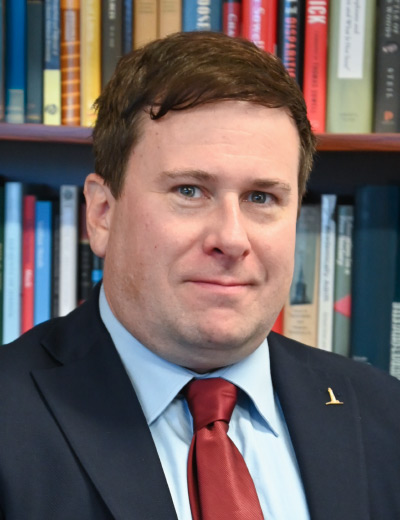
Phil Magness
12
APPEARANCES
11
PODCASTS
Oct 27, 2026


Phil MagnessGUEST
So the thing to note here is that President Trump started his second term by pushing a very aggressive tariff agenda under the International Emergency Economic Powers Act, or IEPA.
Phil MagnessGUEST
It had never been used under IEPA before, and the statute didn't even mention the word tariff, but he claimed it.
Phil MagnessGUEST
that it authorized the enacting of basically a sweeping revision to the entire tariff schedule of the United States by executive order.
Phil MagnessGUEST
And that's where that famous chart everyone was waving around on Liberation Day was.
15 MINS LATER


Phil MagnessGUEST
I view that as kind of like the first salvo that was fired from the new right, the post-liberal right.
Phil MagnessGUEST
And then a few weeks later, Yarvin posts on his own personal blog, basically a lockdown manifesto.
Phil MagnessGUEST
So you read this manifesto, and it basically says the United States, to defeat COVID, needs to adopt a Chinese-style Wuhan, weld people in their apartment buildings and lock the doors, authoritarian lockdown, and even go beyond that.
Phil MagnessGUEST
It basically calls for the permanent social ostracization of anyone that questions lockdowns.
42 MINS LATER


David LinHOST
The topping-up process will begin very shortly, and as a gift from Venezuela to the people of the United States." How are you interpreting this?
Phil MagnessGUEST
Well, this is confirming what I think were our worst fears when, uh, Trump toppled the Maduro regime in Venezuela.
Phil MagnessGUEST
Uh, it was a horrendous, undemocratic, totalitarian regime that had wrecked that country's economy.
Phil MagnessGUEST
But in the aftermath, rather than seeking a democratic transition, uh, to the opposition leader, to the people that actually won the last election and had that stolen from them through, uh, ballot fraud, uh, Trump has instead struck a deal with Delcy Rodriguez, who was Nicolás Maduro's number two.
Phil MagnessGUEST
Uh, and she turns out to be a very corrupt politician, and decided, you know, she's going to, uh, cut a deal with the United States to maintain her position in power.
Phil MagnessGUEST
And the one thing that she had in leverage that she offered was access to Venezuela's oil reserves.
10 MINS LATER

Jeremiah JohnsonHOST
But does it actually work? When the Trump administration has put all these tariffs on all these countries in this wide variety of ways they tried to do it, is it even working to increase GDP, to shoot up manufacturing, to increase welfare?
Phil MagnessGUEST
Well, there's the great complication that Vance and Trump and people that are protectionists have because, you know, they espouse tariffs.
Phil MagnessGUEST
The idea there is if we cut off trade, we cut off imports and therefore we eliminate our trade imbalance.
Phil MagnessGUEST
You know, they've been championing this line basically since Liberation Day last year.
Phil MagnessGUEST
When you put a tax on imports, you have basically a factor that plays out that we refer to as the Lerner symmetry theorem or symmetry effects.
15 MINS LATER


Phil MagnessGUEST
But you see this ulterior agenda, this, this supposed economic multipolarity, it relates to that economic isolationism.
Phil MagnessGUEST
Uh, they don't like the dollar's position in the world, uh, because they s- they think that consumption itself is sinful.


Austin PetersenHOST
So what part of that do you actually reject? The mechanism, the size of the effect, or Vance's conclusion about what government should do about it?
Phil MagnessGUEST
Well, in the Myron paper, and this is the famous Mar-a-Lago Accord paper it's sometimes referred to.
Phil MagnessGUEST
This was Trump's former chair of the Council of Economic Advisors put this out right before he took office for the second term.
Phil MagnessGUEST
And it was basically an argument that we need to rebalance the entire international trade system.
Phil MagnessGUEST
It was a sophisticated dress up of the case for trade protectionism and tariffs.
Phil MagnessGUEST
And the issue with Myron's paper is he mistakes some very basic fundamentals of how trade policy works.
Phil MagnessGUEST
One of the cores of that is that when we put tariffs on goods, goods coming in from abroad, the question is who pays for those tariffs.
13 MINS LATER
Austin PetersenHOST
What keeps Phil Magness up at night more? Vance questioning the trade-offs of reserve status or the debt, deficits, inflation, and bad governance that could make foreigners stop wanting our money without anybody in Washington attending it?

speaker_2HOST
But what did he mean? Historian and senior fellow with the Independence Institute, Phil Magnus, explains it this way.
Phil MagnusGUEST
Well, it is a very clear expression of an ideal, but it's an ideal rooted in an individual right, that all human beings have a basic dignity and that dignity is not something that government can step in and just take away from them by arbitrary whim.
Phil MagnusGUEST
The reason that we establish governments is not to extract power from other people, but to protect and preserve our rights.
23 MINS LATER
speaker_2HOST
Should courts simply reflect the beliefs of their own time, or should they sometimes resist them? When, if ever, is it okay to sacrifice equality for the greater good? And do our values become meaningless just because we temporarily wander away from them? To the last question, Phil says no.

Phil MagnessGUEST
And part of this vanguard theory is one of the tasks that the vanguard representative agent has is to educate the masses, to break them out of their false consciousness – And to do that, you have to teach them Marx.
Phil MagnessGUEST
This is a really interesting insight because it was happened upon by a Marxist historian that's done some of the best work documenting it, Eric Hobsbawm.
24 MINS LATER

Lars LarsonHOST
And yet they made a lot of fabricated claims to support that 1619 project, didn't they?
Phil MagnusGUEST
And they made this economic claim that, like, if you use Microsoft Excel in the present day, you are repeating the practices of the slave plantation.
Lars LarsonHOST
You know, even having said that, the New York Times was just quietly deleting things that it had originally said without telling its audience we goofed on this?

Phil MagnessGUEST
happened? This is Leslie Harris, who's another well-known historian of the American Revolution at Northwestern University.
Phil MagnessGUEST
She had been asked by The New York Times because when they run journalism, they do fact checkers.
Phil MagnessGUEST
So they got her as the outside expert, as the fact checker, to read Nicole Hannah-Jones' essay.
Phil MagnessGUEST
And she did, and apparently her feedback was, you cannot make this claim that the American Revolution was fought to protect slavery.
29 MINS LATER


Ryan BourneHOST
Why do they argue against those? What is their argument against those constraints?
Phil MagnessGUEST
He first emerged on the law professor legal academic scene in about the mid 2000s.
Phil MagnessGUEST
And he starts putting out a series of books on executive power in times of emergency.
11 MINS LATER

Phil MagnessGUEST
S- so Marx is a legend in his own mind and a legend in the mind of a- a very small number of people around him.
Phil MagnessGUEST
He's a, uh, um, marginally employed, uh, self-styled intellectual who is writing these bromides against, uh, all of society and the rest of society's not even paying attention to him.
54 MINS LATER

Jonah GoldbergHOST
How would you describe, um, Marx's approach to history without being able to use the word Marxists- Marxist to describe it, right? I mean...