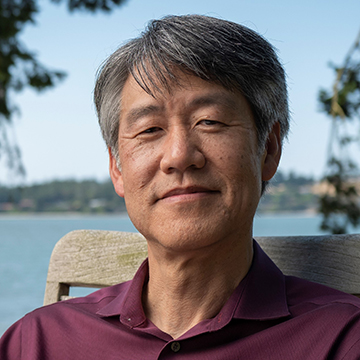
Peter Lee
President of Microsoft Research
7
APPEARANCES
6
PODCASTS
Aug 21, 2026


Peter LeeGUEST
And I think, um, I, I saw Katharine Birbalsingh post on X yesterday, a really important point, that in kind of two thousand and nine, about forty percent of the cohort didn't pass, whereas it's now around about thirty to thirty-five percent.
Peter LeeGUEST
They made exams harder Um, they, they, they removed the kind of the, the gaming of, uh, resits.
Peter LeeGUEST
Um, you know, back in sort of two thousand and nine I was an assistant headteacher, uh, and, and we were putting children in four, five, six, seven times to, uh, resit maths and English.
Peter LeeGUEST
And actually, the exams have got harder since then, um, you know, but they're more focused on kind of knowledge rich, um, which has delivered these results.
speaker_51UNKNOWN
Pickup fees may apply.

Greg BartalosHOST
John, I'd like to, uh, hear a little about you, and then, uh, we'll unpack things.
Peter LeeGUEST
Um, so yeah, personally, quick background, I grew up in downtown Chicago, um, went up to University of Wisconsin for undergrad, uh, on a football scholarship to play football at Wisconsin.
Peter LeeGUEST
My quarterback coach that recruited me ended up leaving to go to the NFL, and that led, uh, me to transferring out to Yale University, where I played three years at Yale.
Peter LeeGUEST
And my senior year, I was economics major, and, uh, we had to do a seminar within our major, so I ended up doing my seminar, um, working for and studying under a gentleman named David Swensen, who ran Yale's endowment.
Peter LeeGUEST
And, um, you know, David was a dear friend and mentor of mine, and for me, that was kind of my first taste of the investment world.
12 MINS LATER
Greg BartalosHOST
What would be some advice that you might have for people in similar situation who are, you know, embarking on this and maybe things that you can't read an article and know that you learned through experience? Like, you know what? Be sure you do A, B, and C for either of you gentlemen.


Peter LeeGUEST
And, um, and, and I think that the impact on food, I think, to your point, is going to be really, really profound in the coming years.
Peter LeeGUEST
Um, but, um, you know, on the materials, uh, design, uh, I, I think many of your followers are probably familiar with the idea that AI, besides carrying out a conversation, uh, AI systems also can generate images and videos.
Peter LeeGUEST
People might have used DALL-E or Sora to generate, you know, nice images just from a English description or, uh, or a video or something like that.
Peter LeeGUEST
And the fundamental AI, uh, that's powering those things is something called a, a diffusion model.
Peter LeeGUEST
And diffusion models, uh, again, are a wonderfully elegant idea in computer science, um, where you start with a completely noisy image.

Peter LeeGUEST
So you'll have the frontier model companies, you'll have the systems developers, you'll then have the companies that might be deploying them, and then you'll have the users themselves.
Peter LeeGUEST
And so trying to work out when something goes wrong, who is accountable, is very complex, and it's also made more complicated by the fact that these different actors are often in different jurisdictions which have different approaches to AI law.
Peter LeeGUEST
I think the common law jurisdictions will, in time, start to give us some more clarity around this.


Peter LeeGUEST
For, for launch, uh, another term you'll hear is it's launched on rails, so it can be on a, off the back of the truck or, or on the ground.
Peter LeeGUEST
And initially, what the drone needs is to get enough speed to maintain airborne flight.
Peter LeeGUEST
The small petrol engine that drives it does not give it that initial speed, so it needs a, a short burst of something like rocket fuel, s- something more explosive just to get it moving.
Peter LeeGUEST
Then once it's on an upward trajectory with the engine running, that is sufficient to keep it airborne.
Peter LeeGUEST
And because of its shape with its basically a very wide flying wing, it has a very large surface area for the air to compress underneath and continue with lift.
12 MINS LATER

Peter LeeGUEST
... we can't-- If we lose our customers in the winter, it's very difficult to regain them again in the summer.
Peter LeeGUEST
So, um, you know, when I'm following [coughs] different podcasts from the States and stuff, and I see, you know, that, you know, markets stop at Thanksgiving and don't start again maybe till April.