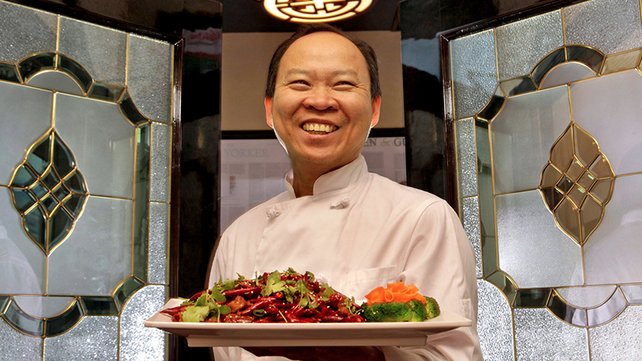
Peter Chang
Chef
5
APPEARANCES
3
PODCASTS
Nov 20, 2026


Tu YunHOST
Then, Peter, what do you think are the most urgent gaps that ASEAN needs to address right now?

Peter ChangGUEST
So we've got to make sure that even as we speed ahead with this digitalization and AI-driven economy there, the rest of us are not left behind.
Peter ChangGUEST
And it's crucial that we have this conscientious and deliberate effort to make sure that this gap doesn't become bigger.
12 MINS LATER


Ding HengHOST
So in the present day, how should China's younger generation seek to serve the greater good for the people when chasing after their own dreams and their individual ambitions and aspirations?
Peter ChangGUEST
Yes, I think President Xi's people-centered approach has been proven very, very effective as well.
15 MINS LATER
Ding HengHOST
So in your opinion, what are the areas where you think China and India need to and should cooperate more deeply in order to empower the BRICS?
Peter ChangGUEST
As Professor Chou Pu has already mentioned earlier, and also Professor Nalapath, both India and China represent two of the biggest economies in the region, if not in the world.
Peter ChangGUEST
And if there is even greater synergy between China and India in terms of economic cooperation, at the moment is still hampered by certain trade barriers and others, the energy that comes up from the synergy between these two Asian giants will be enormous.
Peter ChangGUEST
And it will have a lot of downstream effect on the rest of the region, BRICS, and for us here in Southeast Asia as well.
Peter ChangGUEST
If the two Asian giant economies come together, work together, there will be enormous good, I think, certainly at the general level.
Peter ChangGUEST
But then I think more specifically, India and China could really work together to counter the kind of weaponization of the trade system or specifically the US dollar currency system that we are seeing right now.
Peter ChangGUEST
We are seeing the fallout from the war between Ukraine and Russia, how America uses its trade to fully sanctions Russia, Russia's economy on its knees, how vulnerable we are when the financial system and trade system is monopolized by one country.
17 MINS LATER
Ding HengHOST
How can this concern be addressed, in your opinion, within the framework of the BRICS cooperation mechanism? Can China and India find a way to address this particular concern?


Liu XinHOST
Peter Chen in Malaysia, do you think the creation or the centralization of Japan's central intelligence structure will bring back some pretty dark memory in the minds of people in China and in Southeast Asia as well?
Peter ChangGUEST
As both Warwick and Chang-Yun has mentioned, because of Japan's World War II history, and that is the single central reason why this trajectory that Japan, the Takashi administration is taking, including centralizing the military agency, is causing a lot of unease in Southeast Asia.
Peter ChangGUEST
In Southeast Asia, we do not have the Toku police, but we have the Japanese military police during the Second World War.
6 MINS LATER
Liu XinHOST
Peter, what is your take? Do you think this is just another step in Japan's dream and effort of becoming a normal country or a very alarming move, especially to Japan's Asian neighbors about the expansionist ambitions that have been revived in Japan?
Peter ChangGUEST
From what I've read is that, uh, I think there's both a domestic and international dimension to it.
Peter ChangGUEST
I got a feeling that there are factions within the Philippines government themselves.
Peter ChangGUEST
There are some who would like to take a much more confrontational approach, and others would prefer a more diplomatic, but in this case, appears that the confrontational faction has, has, has had the upper hand that caused the skirmishes that we, we saw.
Peter ChangGUEST
The other factor that, the other quote, unquote, "certain forces," I think is being read as forces that are extra-regional powers that are not the stakeholders in the well-being of, of South China Sea, per se.
13 MINS LATER

Ge AnnaHOST
Dr. Chung, what are your expectations? Can the code of conduct really help reduce tensions and keep outside interference from dominating the agenda in the region?