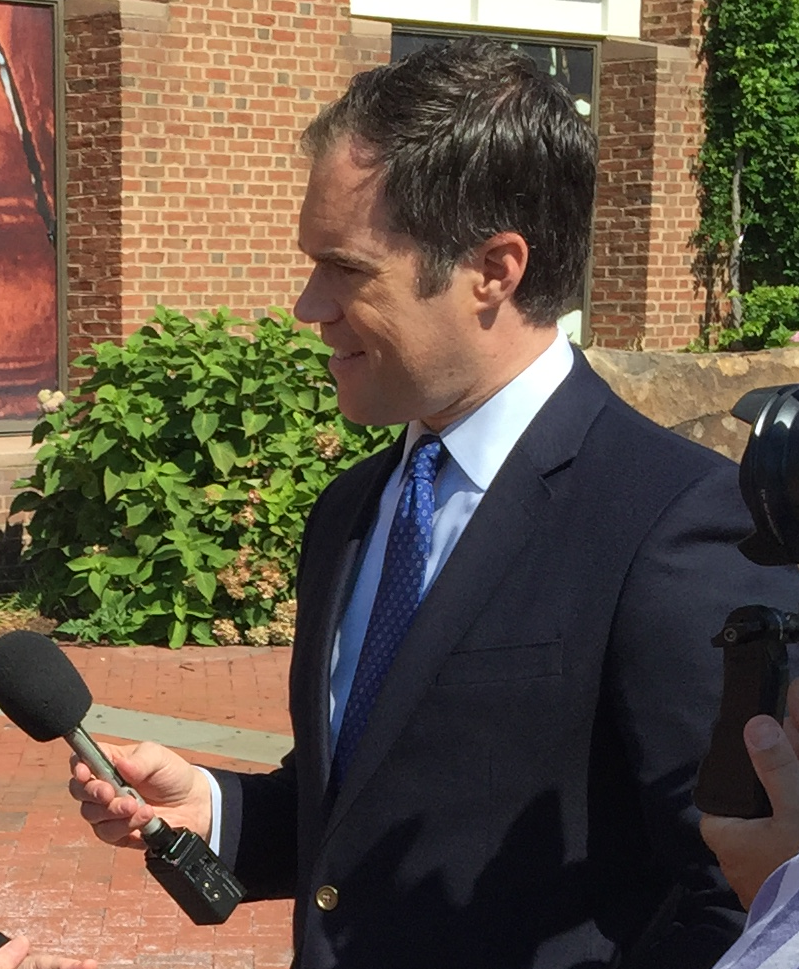
Peter Alexander
American journalist and TV show host
27
APPEARANCES
15
PODCASTS
Oct 30, 2026
Brandon WeichertHOST
We've talked about this before, but what is going on in China's economy, and is this the end of China's economic miracle?
18 MINS LATER


Elliot SegalHOST
You know what, Peter? Hearing you say that about the preciousness of time, I would wonder, and maybe you've asked Rebecca this, would it have almost been easier to just lose it all at once other than kind of waking up, maybe not every day, but going like, is today the day it gets smaller? All of a sudden, it becomes a pinhole that goes away.

Peter AlexanderGUEST
Everyone always says, would you rather have your hearing or your vision? And she has often said that it's the hearing that she misses often.
Peter AlexanderGUEST
The vision, though... is so challenging because the thing that I can't get over is when she takes her cochlear implants out at night, she hears nothing.


Peter AlexanderGUEST
I think at the end of the day, this says as much about Hegseth's leadership as it does about the president's, right? Not the first time that's come under question.
Peter AlexanderGUEST
The president does, it is required that he approve a firing squad being used for a US military execution like this.
Peter AlexanderGUEST
Was he, was he freelancing or not? I can't tell you, but it's clear that Pete Hegseth has been able to do a lot of things that have had to d- required corrective action.
Peter AlexanderGUEST
We're gonna talk about leakers, I'm guessing, in this conversation at some point-


Peter AlexanderGUEST
I think we watch that and think, like, this is like so many other cases, misrepresentation, exaggeration, or an outright lie.
Peter AlexanderGUEST
If you go online, I don't encourage you to do this, the only example of her passing the bar, according to her critics, is her walking past a bar on the side of the road right now.
Peter AlexanderGUEST
That's the sort of skeptical view of this, okay? The, but the gist is for the President, all he cares about is that you are delivering his message, doing it well.
Peter AlexanderGUEST
And what he loved about Caroline Leavitt is that her mouth moved like a machine gun.
Peter AlexanderGUEST
Meaning that, you know, whenever there's uncertainty within either certain blocs, whether it's AUKUS or the Quad or G7 even, you know, China's going to use that to its advantage to be able to try and not necessarily peel off certain partners, but to be able to sort of position itself to gain from the uncertainty, if you will, of whatever partners China, or the US is trying to team up with, and be able to try and, you know, essentially just say, "Look," you know, "Are they going to be there for you in the long term?" and whatever.
Peter AlexanderGUEST
So China's real goal is to continue to build and grow its various bilateral re- relationships, um, you know, to your sort of...
39 MINS LATER
Peter AlexanderGUEST
They're in the process of a massive infrastructure build-out that's centrally driven by Beijing to figure things out that is the power grid, water grid, including what you were just saying about the US.
Peter AlexanderGUEST
So they're continuing to move, but this time they're, as they're building out more and more solar farms, wind farms, you know, they've got the battery technology as well.


Peter AlexanderGUEST
$300,000 she'd been paid to do speaking engagements in the past for him related to his concerns about COVID-19 mandates.
Peter AlexanderGUEST
And as he noted, as Eric Dieters said to me in our conversation today, he said that this isn't just her who's doing it.


Peter AlexanderGUEST
I got to tell you all the times I'd be in the front row at the White House with the president.
Peter AlexanderGUEST
I'd ask a question or and he would try to brush me off or insult me or attack me.
9 MINS LATER
Erielle ReshefHOST
Peter, what would it look like to you if you were still sitting at the White House and you were not, you know, an MSNOW employee, you were still there representing your previous network, and you see the Chinese media file in and you know that your colleagues from the American press are outside?


Peter AlexanderGUEST
So let me try to give folks a, a better understanding by lifting the hood on this a little bit.
Peter AlexanderGUEST
So what happened today is the organizations MS now, CNN, and Politico were allowed back onto the grounds, which is a very basic step.
Peter AlexanderGUEST
The grounds are good because it allows for these independent outlets, MS now among them, to use our eyes and ears to sort of see what's happening there, to have access perhaps to a member of the cabinet or a press secretary, there isn't one right now, when they come out and use one of the cameras along what we call Pebble Beach, the green tents that line, um, the side of the White House so all the camera positions look at the same shot directed back at the White House.
Peter AlexanderGUEST
It allows you to be in the briefing room and to have a position, whether you have a seat or not, to ask questions if a briefing takes place.
Peter AlexanderGUEST
And in the past, it allowed you to walk into what was referred to as upper press inside the West Wing to ask your questions.
Peter AlexanderGUEST
So the point around Taiwan is just your typical talking point that every Chinese president has made, especially when they come to the White House.
Peter AlexanderGUEST
And the issue around Taiwan, as I've always viewed it, is one, rhetorical, the rhetoric, the politics, and then the geopolitical reality of it all.
Peter AlexanderGUEST
And what you're seeing from the Wall Street Journal is nothing more than just the rhetoric of it.
Peter AlexanderGUEST
You know, are the fishing boats going to Taiwan and creating some big giant line? Is there a deterrence issue with regard to Beijing on what Taiwan is doing? Is Xi Jinping going to come in and press with regard to the third communique and the six assurances and all of this stuff? And in reality, the vast majority, and again, having conversations not just with mainland Chinese, but also with Taiwanese, granted business executives, but all anybody wants is the status quo.
41 MINS LATER

Peter AlexanderGUEST
So just to give the audience a bit of background, and again, you know, if, if you have the attention span and the interest, you can, you can read this in a bit more detail in that essay.
Peter AlexanderGUEST
One was Bill Clinton coming out publicly and saying, "We are going to move NATO, um, we're gonna expand it." A, a big issue and, you know, there's a lot of debate over whether or not there was an agreement that NATO after, um, the unification of Germany, you know, we will not go one each, one inch eastward.
Peter AlexanderGUEST
Well, supposedly what was the conversation and theoretically, or at least the argument being made is that Bill Clinton went against that.
5 MINS LATER

Peter AlexanderGUEST
He didn't identify any inaccuracy, no grievance, no particular report that frustrated him.
Peter AlexanderGUEST
It was just the, quote, fake news in his words, which is a frustration he has had from the very beginning.
Peter AlexanderGUEST
My view, having covered this president and having covered presidents for most of the last 14 years, is that he identifies fake news as facts that he doesn't like.
Peter AlexanderGUEST
And the facts have been piling up in a way that he and members of his administration acknowledge has been problematic right now.
Peter AlexanderGUEST
There are real concerns about what's happening as we head toward the midterms, barely 40 days from right now.
6 MINS LATER

Antonia HyltonHOST
You know, should anyone go inside the White House right now until their colleagues access is restored? Are these things that people are actively talking about, considering debating right now?

Brandon WeichertHOST
they moved on because the government was sitting there telling them that, oh, no, this is just a ripoff of what we've already done.
Peter AlexanderGUEST
It drives me truly insane that it's like all of a sudden there was a new narrative.
Peter AlexanderGUEST
But my response when Kimmy K3 came out with everybody was, okay, stop for a minute, learn the lesson, and do not let this example... end up going the same way, being forgotten in 48 hours.
Brandon WeichertHOST
Does that mean China moves in and replaces us? What does that mean for the global economy? What's the power dynamic? Because in my view, and we might've talked about this before, there is a shift going on and the middle East is sort of now the epicenter of that shift from West to East.

Adam TaggartHOST
the big world powers playing here, and China's role in it, um, give us your latest assessment and maybe, maybe explain it through the lens of the Cat Theory.
Peter AlexanderGUEST
So the, you used the word mission, and I think this is critical when anybody is, is consuming any content they see from myself, whether it's on a podcast or, you know, reading anything that I might write, is, as I mentioned on our, on our last podcast when we talked six months ago, the truth when it comes to China is always in the middle.
Peter AlexanderGUEST
Um, again, just to reiterate the point, China is not on the precipice of collapse, nor is China on the verge of assuming hegemonic, you know, global power.
Peter AlexanderGUEST
The, the process that is underway is a, a, a, a shift, if you will, where we've heard Chinese leaders, particularly Xi Jinping, coming out talking about changes not seen in a millennium, and there is a lot of that that's in play.
Peter AlexanderGUEST
So when you're assuming, or I guess when you're looking at and talking or basically reading anything about China, there is a level of projection that gets used whereby, you know, whether it's think tank, um, analysts in the Beltway or, you know, other people that are weighing in that are geopolit- uh, geopolitically focused, what you're gonna find is there is an American or a, what I refer to as sort of a post-1945 mindset-


Peter AlexanderGUEST
At the moment, I read the Wall Street Journal and New York Times every day, and Mr. Trump is getting twitchy with the bond market, just like Mrs. Truss did.
Peter AlexanderGUEST
and moment it starts rising it will in it'll flow onto all interest rates so in one way it's a credit it's a plus but in another way it's hard on every business at the moment it's the bond market in the uk in france in italy In Germany, it's all starting to react.
Brandon WeichertHOST
How much of a significant threat is this to the US dollar, the choke point of the US dollar, uh, going forward?
Peter AlexanderGUEST
I mean, the US, again, and, and this, this is an area where I, I'm trying my best to, to, to get this message out, which is, first and foremost, you have a reserve currency and you have a reserve asset.
Peter AlexanderGUEST
The reserve currency is the US dollar, it's the medium of exchange, and there is a massive infrastructure built around it, uh, that people are going to use.
Peter AlexanderGUEST
And I don't anticipate whether it's the BRICS Bank, whether it's the AIIB, or whether it's the SCO Development Bank.
Peter AlexanderGUEST
These bodies, um, are not being created as a replacement to the US dollar system.
7 MINS LATER
Emanuel CleaverSOUNDBITE_SPEAKER
Look, blaming others will not make Missouri great again.
Peter AlexanderGUEST
So obviously, though, Alicia, this does raise a lot of other questions, right? Which is, how is this all going to play out? We're just two months, 60 days away from the midterm election there.
Peter AlexanderGUEST
Some of the people for whom you voted for in the primary, you may not be voting for in the general election because of all the rejiggering that's just now taken place.
Peter AlexanderGUEST
And broadly, it raises a lot of the questions that we're grappling with right now as they relate to other issues in other states or even nationally.
Peter AlexanderGUEST
with the president's efforts to try to undermine mail-in voting right now, given we're within two months.


Peter AlexanderGUEST
It really raises what was a very big contrast yesterday and the day before that we were witnessing.
Peter AlexanderGUEST
You had this set of meetings between the sort of economic leaders of the West and the rest of the world.
5 MINS LATER

Mike BarniclePANELIST
But the anger is out there because people realize that the country is being stolen from them.
Peter AlexanderGUEST
I've been playing, I, I get home every day this week and just said, "Alexa, play Dolly." It has been nonstop in the Alexander house.
Peter AlexanderGUEST
So what a nice tribute to her, and, and let's be honest, Kenny Rogers, the two of them together, Islands in the Stream, like it doesn't get any better.

Stephanie RuhleHOST
So get ready, because the next time we're having a sign-off, Peter, I'm gonna think a lot about how you see me, and I'm gonna have a new name for you.
Peter AlexanderGUEST
One, I dress in the dark, so if everything matches without a tie, that's just a matter of good fortune here.
Peter AlexanderGUEST
But Suze Orman, Dr. Ruth, I mean, like we respect both of those powerful, strong, impressive women.
Peter AlexanderGUEST
But the more important element is this has been a process that has been specifically driven by the need to, again, as I said, mitigate the risks.
Peter AlexanderGUEST
And then in 2014, and this goes to the whole debate about reserve currency status.
18 MINS LATER
Brandon WeichertHOST
Um, what do you think the Russia's role, uh, with, um, Russia's role with North Korea, how is that impacting the China-North Korean relationship? Is it helping? Is it hindering? What do you think that amounts to?

Vaughn HilliardCORRESPONDENT
You said that sort of this has been his message here, him dismissing the idea that affordability is an issue in America.
6 MINS LATER
Antonia HyltonHOST
Uh, give us a little inside scoop what we can expect, because for 15 years on the White House beat, you have been running from major national global story to story, and now starting in just a few minutes, you're gonna have a whole hour to yourself.
Peter AlexanderGUEST
First of all, thank you for this warm welcome here, but thank you to you for all the months that you were sitting in this chair at this hour.
Peter AlexanderGUEST
You are fantastic, a total star, and I'm just proud to be on the same team with you.
Peter AlexanderGUEST
We share the same goal, which is to focus on the facts, to always be pushing it forward, trying to have more voices in here that are the ones making news as it happens.
Peter AlexanderGUEST
And the reason for that is if you just look at the oil imports over the course of the last year, they've gone above trend, which is around 10 million barrels a day or thereabouts.
Peter AlexanderGUEST
I mean, after last year, um, you saw the United States and Iran so-called mow the lawn in the summer of '25, right? So there's been a shift now, I think, where you're seeing greater attention on the refinery side of the business.
Peter AlexanderGUEST
And one of the elements I think has been missed is China right now has the largest capacity for petroleum refinery in the world, more than the United States.
Peter AlexanderGUEST
It's not exactly the same in terms of the types of oil that's being refined, like light sweet versus heavy and what have you, but you're talking close to nine million barrels a day.
10 MINS LATER
Stephanie RuhleHOST
It's 330 million people in this country, and, uh, people are allowed to have a lot of opinions and fit under one tent.
Peter AlexanderGUEST
The Republicans, Donald Trump world, is gonna do everything in its power to try to exploit the differences that were, uh, revealed in dramatic fashion over the course of the last several months during what was a heated, as Rachel Maddow described it at times, spicy campaign between Haley Stevens and Abdul El-Sayed right now.
Peter AlexanderGUEST
I've been speaking, uh, to folks inside the White House who say, among other things, that they are looking to exploit that difference.
Peter AlexanderGUEST
They have already, the president himself doing it, as we previewed first here on MSNBC now already saying that this is just more evidence that the Democrats are who we told you they were.
16 MINS LATER


Peter AlexanderGUEST
There was, there's this, uh, uh, video going around from Jordan Peterson where he talks about, you know, if you jaywalk, you're gonna get money taken out of your bank account, your face is...
9 MINS LATER

6:10
But the Green Revolution is really thousands of farmers, scientists, business, and governments doing all kinds of things.
Peter AlexanderGUEST
It's the breeding of the crops, it's inorganic fertilizer, it's pesticides, it's management practices.
Peter AlexanderGUEST
It's kind of a whole suite of different things that have been continually allowing us to produce more from less land.
6:41
Peter says there obviously are environmental downsides to high-intensity agriculture, but in terms of feeding the world's population, it seems to have done the trick.
Peter AlexanderGUEST
If you think about it in terms of calories produced, I did a very quick calculation, and between 1961 and 2024, which is the most recent data I've got, per capita, we produce 34% more cereals than we did then.
Scroll for more appearances