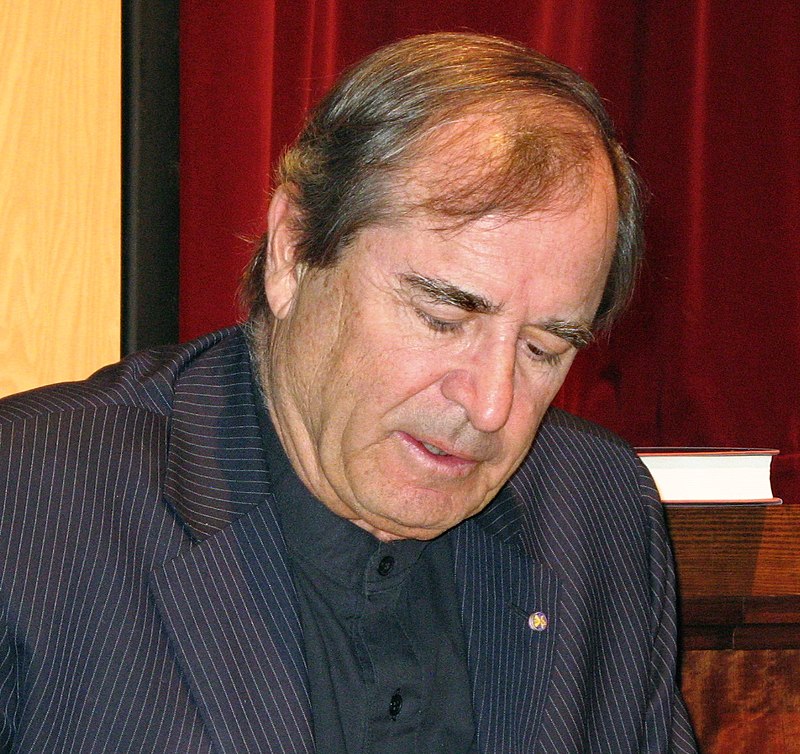
Paul Theroux
American novelist and travel writer
8
APPEARANCES
8
PODCASTS
Oct 28, 2026


Paul TherouxGUEST
But prior to that, I lived in Africa, and one of the thrills of my reading life was reading Enderby.
Paul TherouxGUEST
It wasn't the first Burgess book I read, but it was one that thrilled me to the point that I then got Enderby Outside, and then later, so I had that.
26 MINS LATER

Paul TherouxGUEST
They get a lot from the government, they give a lot to the government, but they're not Until Trump, they never waved the maple leaf flag.
Paul TherouxGUEST
Trump unified Canada and forced Canadians to consider their allegiances, their loyalties.
5 MINS LATER

Ryan MurdockHOST
So give us a sense of where he came from and the Canada that he inhabited before it was even Canada.

Paul TherouxGUEST
So where is this population of 42 million in a country that is bigger than China? They're on little islands, not actual islands, but island-like places, Winnipeg, Toronto, Calgary, Edmonton, uh, way up in [laughs] Corner Brook in Newfoundland.
Paul TherouxGUEST
So the archipelago is these little populous islands, and then in between, there's little, of course, there are settlements all over Canada, but that 42 million people is very widely distributed but concentrated in specific places.
Paul TherouxGUEST
The other thing which is amazing to me visually is when you're traveling across the prairie in a car, there's nothing.
11 MINS LATER


Daniel SchefflerHOST
So with a subject in mind and both hands on the wheel, Paul crossed the border into Quebec, Canada's largest province, with a language, culture, and identity distinctly all its own.


Ollie WilliamsHOST
What were you hoping to understand? Give us a sense of where this book goes, both geographically and beyond.
Paul TherouxGUEST
The answer is my ancestor, Antoine Theroux, left France, Gascony actually, in 1693.
9 MINS LATER
Ollie WilliamsHOST
Is there going to need to be some sort of national reckoning with a sense of self here that actually the country isn't so special after all, and it can fall under the same spells?

4:58

Now, can you tell us in brief, what is True North? Are you looking at all of Canada? Are you focusing on specific stories? What is the book about?
8:39
And it's such a shame because it's a wonderful country and there's so much to do.


Rolf PottsHOST
What would you say characterizes in, in, especially, uh, successful travel writing, especially in an age when, when local people are, are, are connected to, to, uh, the World Wide Web and can comment upon and even write their own accounts of place?
Paul TherouxGUEST
It's, if you can find out in a, in a, in a travel book, the human element, the, um, the, the human factor, the, the flesh and blood of a place, anatomizing or, um, or, or describing the people who actually live in a place, what their lives are like, what their stories are like, what their past has been like, then if you can get at that, it, it's who lives in this place, not-- Take Hong Kong.
Paul TherouxGUEST
Uh, uh, I mean, you go to Hong Kong, it's, it's a, it seems like an impenetrable city, very vertical, very tall, very dense.
Paul TherouxGUEST
I mean, it, it, it's one of the most, uh, densely populated, uh, uh, cities on Earth.
6 MINS LATER
Rolf PottsHOST
What are some other essential nuisances that draw you closer into the travel experience and away from the passive convenience that might be characterized by internet smartphone life in the twenty-first century?


Deborah TreismanHOST
Well, we'll talk some more after the reading, and now here's Paul Theroux reading The Necklace by V.S. Pritchett.
Paul TherouxGUEST
The Necklace"Just checking up on a necklace your wife brought in this afternoon," the older of the two detectives said to me when we got to the police station.
Paul TherouxGUEST
The younger one kept his hands in his raincoat pockets and didn't say a word, and neither did I.
46 MINS LATER