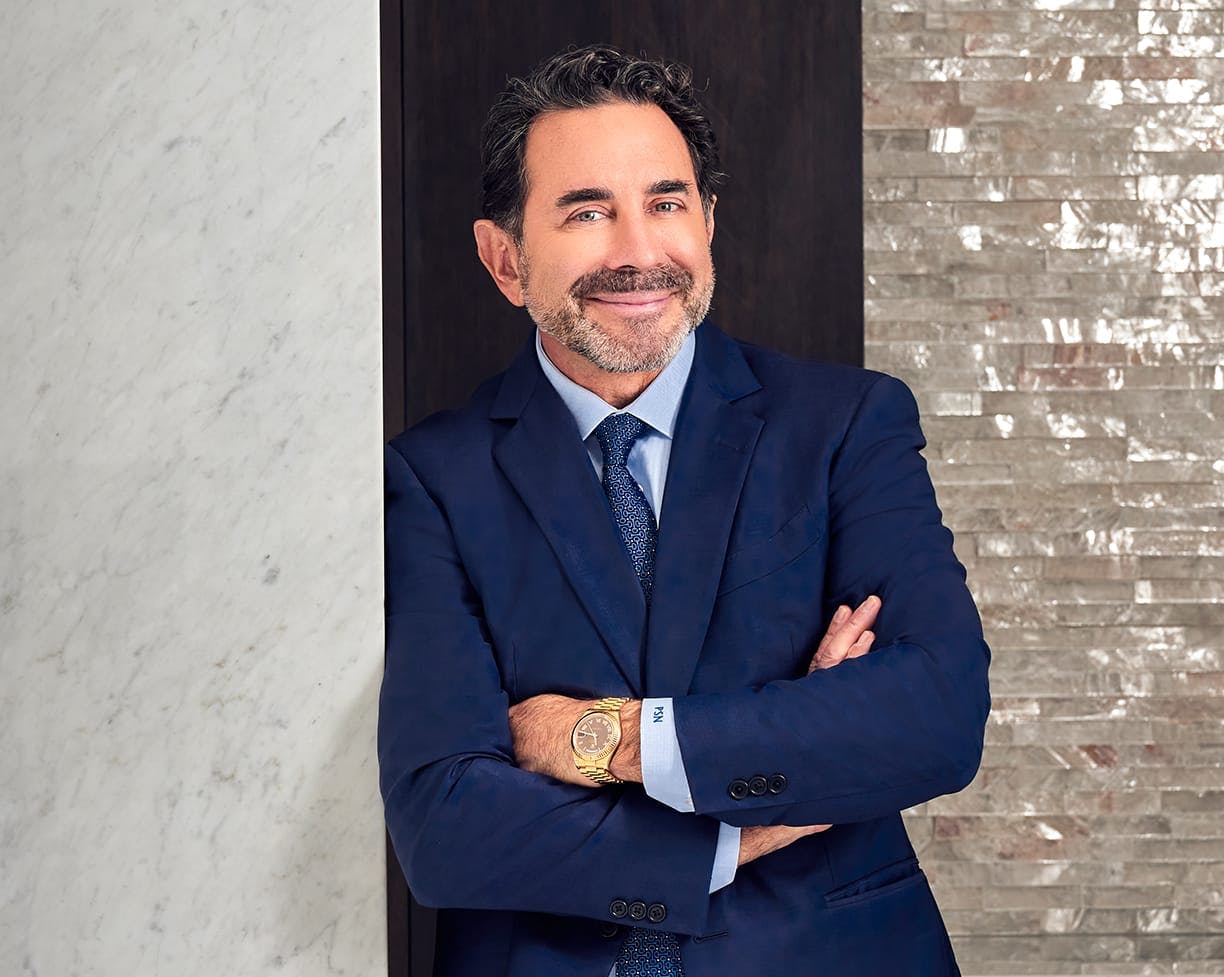
Paul Nassif
American plastic surgeon and TV personality
10
APPEARANCES
6
PODCASTS
Nov 16, 2026


Terry DubrowGUEST
Some of them we actually still do, but one of the original operations was to make someone's To make someone a nose, you would make a tube from their arm skin, and they'd walk around like this for a number of weeks, get blood supply, and then you would detach it.

Paul NassifGUEST
What's the most common botch? Since the number one procedure that plastic surgeons perform is breast augmentation, It's going to be revision of breast work, especially because you're putting a foreign body, a breast implant, into the body.
Paul NassifGUEST
Now, I'm a facial plastic surgeon, so what I do is I do the number one thing for me.
Paul NassifGUEST
About 25% of someone who has a rhinoplasty, a nose job, need to come back and have some type of a touch-up, whether it's minimal or a very severe touch-up.
8 MINS LATER

Larry KingHOST
You each have your own expertise so you don't conflict, right? All right, what do you make of social media putting a different kind of pressure on people, forcing them to look better, bringing more business to you? What's the effect of Instagram and all the rest on you?
Terry DubrowGUEST
For me, it gave us so much experience doing operations that plastic surgeons only do maybe once or twice in their careers that has allowed us to be really good at fixing incredibly difficult problems, actually very easily most of the time now.
Paul NassifGUEST
We had a patient unbotched who we diagnosed, incidentally, some aneurysms in her brain.
Paul NassifGUEST
And if that weren't diagnosed, she probably would have died within the first couple of months.
Larry KingHOST
All right, what do you make of social media putting a different kind of pressure on people, forcing them to look better, bringing more business to you? What's the effect of Instagram and all the rest on you?
Paul NassifGUEST
I remember three years ago when doctors were starting doing before and afters on social media, for example.
Paul NassifGUEST
But in a way now what we're seeing is something that we both coined the term selfie dysmorphia.
Paul NassifGUEST
And when we would look at some of the patients before to say, can you fix this? It was usually no, no, no, no, yes.
Paul NassifGUEST
But throughout the years, we've been so lucky that our talents have been increasing because of the complexity.
7 MINS LATER
speaker_1ADVERTISER
Watch Steps, now playing only on Netflix.

Randi BoyetteHOST
Are there any other trends that your patients are asking about right now that you think are worth the hype?
Paul NassifGUEST
In regards to surgery, for example, you might have seen on my Instagram or someone else's Instagram like hemostatic nets.
Paul NassifGUEST
We just did a deep plane facelift yesterday and we're putting in a hemostatic net, which are visible stitches.
Paul NassifGUEST
So if I'm doing, you know, a newer thing is called a gliding lateral corner jowl marionette lip lift through a small incision here, or a gliding brow lift just underneath the skin, where we're using for about three days the surgical mat.
Paul NassifGUEST
So that's one thing to me that's more informational to the viewers in case you see it so you know what it is.
Randi BoyetteHOST
Do you think there's some solid evidence behind them? And I guess also on the flip side, where do you think that the promises are getting ahead of the science?


Paul NassifGUEST
And they, first of all, they're exfoliators, cleansers, and it does about 20 different things to your skin.


Kris FadeHOST
So you know with the paralysis possibly of kidding a nerve, whatever, when you're in the face, when you're cutting in or doing whatever you do, do you see the nerves?
22 MINS LATER
Kris FadeHOST
You've always been that family guy? You've always been the man that you are now? Or do you feel like you've changed over the years and focused more on that?


Paul NassifGUEST
Let's say you're someone who's lost a lot of weight, and even by your knee, k- knees, you know, side your knees, you don't have any fat, and you are gaunt.


Paul NassifGUEST
And this is gonna be, you're gonna put that on before you put on the brand new Advanced Firm and Restore Oil.
