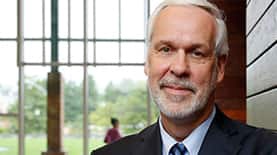
Paul LeBlanc
Former president of Southern New Hampshire University
5
APPEARANCES
5
PODCASTS
Sep 21, 2026

Troy BurnettHOST
What foundational policy frameworks do you think are most critical? And the way I want to frame this is in the absence thereof, it becomes a public trust issue because when we ensure that a university degree retains its inherent value in the eyes of the public, in the eyes of the workforce, what does that policy framework look like? What's the most critical elements of that to maintain public trust? Yeah.

Paul LeBlancGUEST
So in the end, it's the question of how do you know? so in our in in the best of circumstances any institution any program any course even would be very very clear about the claims it makes for what students know and can do with what they know and in an ai world where we increasingly can know all kind know all kinds of things we have access to enormous amounts of knowledge um it's what we can do with that knowledge and that's a question of assessment that's a question of performance And it used to be, and this is before AI, 30, 40 years ago, a college degree was a pretty reliable signal to the labor market that you knew things, that you could comport yourself, show up in the ways that employers expected, that you had good communication skills, you had good quant skills and so on.
Paul LeBlancGUEST
But what AI has done is it's held up a very, very harsh mirror to our assessment practices.
Paul LeBlancGUEST
So to go to your question about policy, I think the policies we have to think about and frame is like they have to be relevant, they have to be rigorous, and they have to be reliable.
Paul LeBlancGUEST
That is, are students learning what I need them to learn? Is this what we would expect them to, you know, is it relevant? Is it relevant to the jobs they'll be asked to do? Is it relevant to the way they want them to be in the world? Is it rigorous? Can I trust this assessment? How do I know? And there are lots of ways and we should talk a little bit about that.
10 MINS LATER
Troy BurnettHOST
And then we have sort of at the faculty layer, what strategies are being put in place or what do you think are required to guide faculty through this major transition that we're all undergoing?

Michael KovnatHOST
Download the Quince app for app-exclusive offers or go to quince.com slash NBID.
Paul LeBlancGUEST
I'm Paul LeBlanc, author of Broken, How Our Social Systems Are Failing Us and How We Can Fix Them.
Paul LeBlancGUEST
I'm also the president of Southern New Hampshire University, the largest university in the United States, with a mission to improve the lives of those increasingly left behind in an increasingly inequitable world.
Paul LeBlancGUEST
We often say that we serve the 45% of Americans who would struggle to come up with $400 for an unexpected car repair or medical bill.
Paul LeBlancGUEST
That includes working people, New Americans, military students and veterans, homeless youth, and tens of thousands of students of color, Native American, and refugee learners.
Paul LeBlancGUEST
The impetus for Broken came when I was writing a higher education book, but found myself asking, why do so many of the scaled social systems meant to lift people up so often come to dehumanize the very people they are meant to serve? This happens all the time in K-12 education, healthcare, criminal justice, mental health, substance abuse treatment, and yes, higher education.

Paul LeBlancGUEST
So one, can we take them in reverse because I was sort of saying stage after stage.
Paul LeBlancGUEST
Universities are the only entities in this culture that I trust to get this right in terms of trying to think through how do we get to a healthy for the planet, healthy for people, healthy for society uses of AI.
Paul LeBlancGUEST
The frontier models in the end of the day, they're driven by corporate profit.
24 MINS LATER

Sara CusterHOST
So my question is, can institutions start doing this work and are some already doing it? And what's your advice to get started?

Paul LeBlancGUEST
So let me frame it as Carlotta does, kind of generally what one sees, and then talk about this specifically.
Paul LeBlancGUEST
So in her book, Technological Revolutions and Capital Markets, I think is the title, Very boring sounding title, utterly worth reading.
Paul LeBlancGUEST
But what she would say is these transitions are typically, they're displacing, right? Like people lose their footing.
Paul LeBlancGUEST
And the things you typically see, what characterizes them historically, massive wealth inequity, rise of monopolies, rise of strongmen, dictators, leaders, because people start to want someone who says they can make America great again, right? Fourth would be rise of populism.
29 MINS LATER

Matthew RascoffHOST
But if you were going to write it today with this current technology, what is the line that should not be crossed in terms of the right to be forgotten, in terms of deletion, collection, surveillance? What is that limit and what's the protection you would want for kids and young people? That's a great question,


Paul LeBlancGUEST
But what he says is that AI is going to take very expensive, hard-to-get knowledge and understanding, the kinds of stuff we think about doctors.
17 MINS LATER