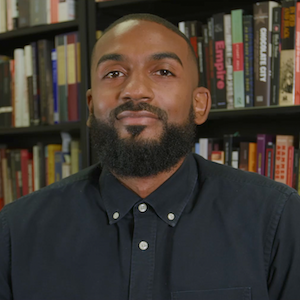
Orisanmi Burton
Anthropologist
4
APPEARANCES
4
PODCASTS
Sep 21, 2026


Orisanmi BurtonGUEST
no thank you i mean you're exactly right and and you know i don't treat this topic at length in tip of the spear but i am working on um some some work that does extend this but that kind of triad of war prisons and slavery is exactly kind of where some of my work is headed.
Orisanmi BurtonGUEST
And you're right that it becomes very difficult when you think about these things, it becomes very difficult to disaggregate these things, both at a historical level And at a theoretical level, really, in terms of the ontology, like what is war? What is slavery? What is prison? And where do they overlap? And where are they different? It becomes quite difficult to do that.
Orisanmi BurtonGUEST
And so, you know, within the context of the Black liberation struggle, which is, you know, what my research focuses on, enslaved Africans were captured as prisoners of war and held in barracoons, transported on slave ships.
19 MINS LATER
Adnan HusainHOST
And so what do you make of the revolutionary potential of this struggle in terms of changing how people looked at the world and reframing it out of the conventional historiography or liberal reformist tradition that is identified even by this political prisoner as one of the options that needs to be thought through carefully?

Adnan HusainHOST
And I think what your study does is really historicize how these deeper connections and dynamics of war are related to you know kind of the both the political conditions but also you might say the socioeconomic realities of what's possible And so I'm wondering if maybe you have other thoughts about the development of this kind of system that is often looked at as an extension of you know, techniques of control and so forth after emancipation, you know, and the way that that has been talked about typically from this legal perspective and how your, you know, analysis really departs from that or adds to that with a different level of analysis.
Orisanmi BurtonGUEST
And, you know, I don't treat this topic at length in Tip of the Spear, but I am working on some work that does extend this.
Orisanmi BurtonGUEST
But that kind of triad of war, prisons and slavery is exactly where some of my work is headed.
Orisanmi BurtonGUEST
You're right that it becomes very difficult when you think about these things, it becomes very difficult to disaggregate these things, both at a historical level, And at a theoretical level, really, in terms of the ontology, like what is war? What is slavery? What is prison? And where do they overlap? And where are they different? It becomes quite difficult to do that.
20 MINS LATER
Adnan HusainHOST
And so what do you make of the revolutionary potential of this struggle in terms of changing how people looked at the world and reframing it out of the conventional historiography or liberal reformist tradition that is identified even by this political prisoner as one of the options that needs to be thought through carefully?


Orisanmi BurtonGUEST
No, Toussaint, I love what you've put on the table, um, especially uplifting, um, new African identity and these other traditions and, um, urging us to think about how, um, other notions of th- thinking about time were at work here, um, which is something that I've always...
Orisanmi BurtonGUEST
I've never been able to articulate it in quite the way that you just did, but it's something that I've always thought about when, especially as the commemoration of Black August has extended beyond the prison and we're continuing to unearth s- particular kinds of, um, Black revolutionary moments that developed in August.
Orisanmi BurtonGUEST
You know, this idea that, um, in, in some ways I feel like, okay, this is actually fascinating.
Orisanmi BurtonGUEST
And in other ways I'm like, "Okay, well, are, might there be other ways that we might think about time that don't require us, um, to just sort of keep creating, creating this list of what happens in August?" For instance, I would put, I would put Attica in Black August, right, for a lot of reasons, one of which is, you know, the day after George was assassinated, the brothers in Attica, um, engaged in a fast to commemorate, um, his death.
Orisanmi BurtonGUEST
And obviously the, um, the, the rebellion emerges shortly thereafter in part as a continuity.
19 MINS LATER


Juan GonzálezHOST
You went back in time, of course, the Attica Revolt being one of the biggest in American history and its impact on reforms within the prison system.
Orisanmi BurtonGUEST
And Jose was exactly right in talking about the role of solitary confinement, all of this.
Orisanmi BurtonGUEST
Of course, a repeal of the HALT Act is really the primary demand of the guards.
Orisanmi BurtonGUEST
So, in the wake of the Attica Rebellion, we saw nationally the proliferation of solitary confinement and the extension of the lengths of time to which people were subjected to solitary confinement.
