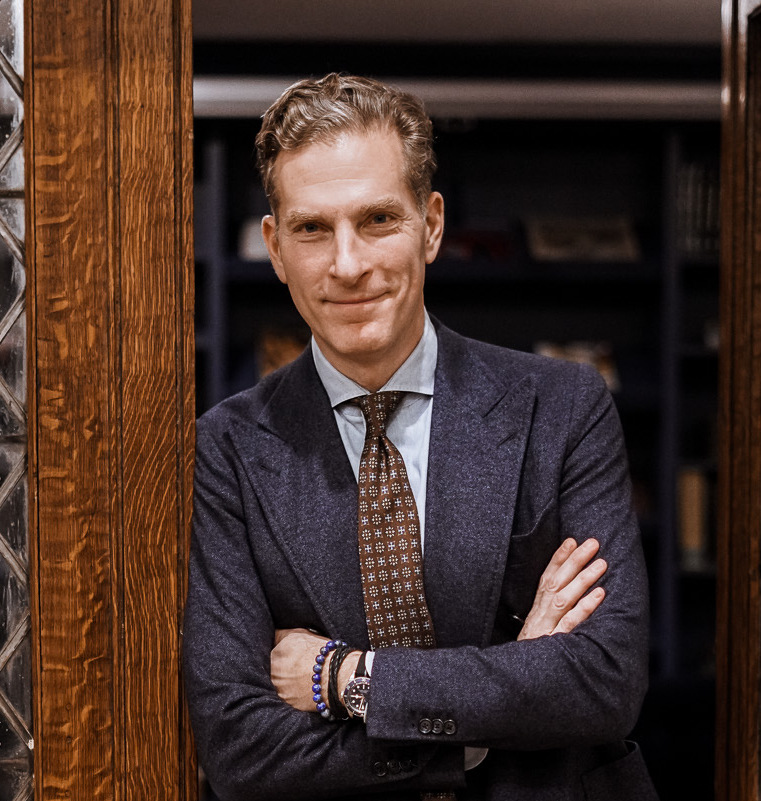
Noah Feldman
American legal scholar
11
APPEARANCES
11
PODCASTS
Nov 10, 2026

Noah FeldmanGUEST
There are basically three different things that people are talking about when they say they want to reform the Supreme Court.
Noah FeldmanGUEST
The first one is one that I think is pretty non-problematic, which is some kind of an ethics code that Congress would pass that would claim to bind the justices.
Noah FeldmanGUEST
But the unfortunate reality is that it will be up to, you guessed it, the Supreme Court justices to decide if Congress has the constitutional power to bind them.
Noah FeldmanGUEST
So I think some kind of ethics reform bill makes sense and will almost certainly be passed by Congress.
Noah FeldmanGUEST
And then they kind of put the onus on the justices to say, oh, you can't do this to us, which I think the justices, frankly, would be glad to bite the bullet.
9 MINS LATER

David GuraHOST
Looking ahead, as you see the president, Democrats in Congress kind of locking horns here, what kind of fights do you expect will reach the Supreme Court?

38:02
How did you come to start this program? And what, if any, role has your work on Islamic law and Islam and the state played in how you think about Jewish and Israeli law?
Noah FeldmanGUEST
You know, until I did start this program a few years before it, I tried to, and I think I said this in my introduction to my Jewish book, you know, my Jewish book is my 10th book.
Noah FeldmanGUEST
And of the previous books, you know, four of them had been about Islam in one way or another.
Noah FeldmanGUEST
You know, I think I felt I was too close to it and that it was too locally contentious in some way.
Noah FeldmanGUEST
And a few years before this program was started— I moderated an event, a really weird event at Harvard Law School, which was a conversation between Rabbi Lord Jonathan Sachs, who was the chief rabbi of the UK and had been put in the House of Lords, who was a kind of relatively moderate figure, at least in my view, certainly within the Jewish spectrum, and Alan Dershowitz, about whom the less said the better.
12 MINS LATER

speaker_2HOST
Here's Noah.

Noah FeldmanGUEST
He had fought in the American Civil War and he fought for the Massachusetts side.
Noah FeldmanGUEST
He was the first Massachusetts man to be injured in the war, luckily not killed, luckily for him shot in the front, not in the back, injured badly enough that it sent him back to Massachusetts where he became an instant hero.
Noah FeldmanGUEST
And it didn't hurt that his father was also a well-known professor at Harvard Medical School and a very well-known journalist on the side.
Noah FeldmanGUEST
So his father was a bit of a celebrity, and he immediately became a big celebrity himself.
Noah FeldmanGUEST
He later came to believe that his experience in the war, though, and where he was injured again and where he lost his closest friend had been kind of a mistake.
speaker_2HOST
Anyway.

speaker_2NARRATOR
Here's Noah.
Noah FeldmanGUEST
He had fought in the American Civil War and he fought for the Massachusetts side.
Noah FeldmanGUEST
He was the first Massachusetts man to be injured in the war, luckily not killed, luckily for him shot in the front, not in the back, injured badly enough that it sent him back to Massachusetts where he became an instant hero.
Noah FeldmanGUEST
And it didn't hurt that his father was also a well-known professor at Harvard Medical School and a very well-known journalist on the side.
Noah FeldmanGUEST
So his father was a bit of a celebrity, and he immediately became a big celebrity himself.
Noah FeldmanGUEST
He later came to believe that his experience in the war, though, and where he was injured again and where he lost his closest friend had been kind of a mistake.
speaker_2NARRATOR
Anyway.


Abbas MilaniGUEST
The regime has gone on killing sprees on almost every major, uh, demonstration.
Noah FeldmanGUEST
demonstration.In terms of the popularity, uh, uh, uh, the crown prince has, by the most credible poll I have seen, uh, about at least 30% of the population.
Noah FeldmanGUEST
Uh, so, uh, my sense is, uh, and I wrote a piece in The New York Times, uh, two days ago.
Noah FeldmanGUEST
I said, "What is important is what the people of Iran seem to clearly want, and that's a secular democratic society, an end to this regime." And a secular democratic society means to me that the future of Iran has to be determined by the people of Iran.

Hari SreenivasanCORRESPONDENT
So if you could refresh our audience, how did we get to this point where the president, a president of the United States, can launch a military attack on another country without having to let Congress know or get permission?


Ian BremmerHOST
Do you agree with that? And where do you think criticism should be levied and why?
Noah FeldmanGUEST
Well, I think that runs together two different challenges, each of which is important to take seriously.
Noah FeldmanGUEST
One is, are we in universities doing a good job of teaching young people? And I think we all agree that we want from young people is to not accept the truths that we teach, but to think hard for themselves.
Noah FeldmanGUEST
We need to teach them to think hard for themselves, to learn how to get facts, and especially in today's world, to distinguish made-up stuff from real stuff.
Noah FeldmanGUEST
And of course, an argument can be made that the universities haven't always successfully done that.
Noah FeldmanGUEST
But, you know, we're fighting against some really powerful forces out there in the world.
Noah FeldmanGUEST
Ideology, sources from social media, polarization, populism, all of which tend to undercut the idea that, you know, maybe we can get better answers to questions.
Ian BremmerHOST
I'm not talking about, you know, sort of the former president of Harvard and her presentation to Congress, but the issue itself, how has Harvard done? How are they doing at addressing antisemitism?

Anthony BrooksHOST
I began by asking him to explain the importance of foreign students to a university like Harvard.
Noah FeldmanGUEST
They matter to the life of the university because they provide perspectives from all over the world that you can't get otherwise.
Noah FeldmanGUEST
So, it's a very different experience to teach the First Amendment to students with some Chinese students in the classroom than it is to teach it without them there, because they live in a country that's succeeding economically and militarily and many other ways, but doesn't have free speech, and they're able to offer their perspective in a way that's profoundly illuminating.
Noah FeldmanGUEST
It's also really great because, especially in the sciences, some of the smartest students from all over the world come to study at Harvard, and if they perform well, they are offered fellowships and eventually job opportunities in the United States, often to do research themselves, and a very meaningful number of them choose to move to the United States and even become Americans.
5 MINS LATER


Terry GrossHOST
The Trump administration wants to prevent foreign students from enrolling in Harvard, and my understanding is that includes already enrolled students.
Noah FeldmanGUEST
The Trump administration issued an order, quickly blocked by a federal district court judge here in Boston, but the original order said that Harvard could not participate in the program run by the government that basically processes student visas for international students, and everyone in that program was supposed to be, at Harvard, was supposed to be booted out of it and no new ones were supposed to be permitted.
Noah FeldmanGUEST
So yes, that would, in theory, have included currently enrolled students who wouldn't have been able to come back to school, uh, in September when school starts again.
Noah FeldmanGUEST
Again, there are procedures that the government can use by law and regulation if it wants to say that some university has done something wrong that would disqualify it from admitting international students.
Noah FeldmanGUEST
The administration, the Trump administration fully ignored those procedures, said nothing about them, didn't even allege in its letter to Harvard that Harvard had violated those procedures, or didn't say why they were doing it in terms of the rules that exist.
15 MINS LATER
Terry GrossHOST
Um, and I'd like you j- to explain what definition, uh, Harvard is using to define antisemitism and what definition the Trump administration is using, if they have one, to define it.


William BranghamCORRESPONDENT
And because of it, he inspired a Republican rally cry, "No more Souters." He grew up in a small New Hampshire town and carried that Yankee upbringing with him to Washington, according to a former law clerk, Noah Feldman.
Noah FeldmanGUEST
He never wore a coat in Washington DC because as a New Englander, he took the view that it was never cold enough to need a coat, and that included at the memorial service for Justice Harry Blackmun when the justices had to stand outside for more than two hours in pelting snow, and he absolutely refused to wear a coat.
William BranghamCORRESPONDENT
And in one notable dissent, in the controversial 2000 election case, Bush v. Gore, Souter argued Florida should continue its recount.
Noah FeldmanGUEST
The biggest mistake that people made about David Souter was thinking that somehow he was a conservative when he went onto the court and then magically became a liberal.
Noah FeldmanGUEST
He believed that the Constitution was not a dead document that should be interpreted according to what people thought 200 and some years ago, but rather was a document that needed to be interpreted in the light of our changing needs and circumstances.


Ilya MarritzCORRESPONDENT
This is the moment when Harvard moved to an admission system that looks more like what we know today, with interviews for applicants, an emphasis on character, and an effort to recruit from all over the nation, tools that enabled the school to have more of a say in its own student body.
Noah FeldmanGUEST
The point of this plan, the diversity plan, was to say, by making it a national school, we'll draw in people from Nebraska and Iowa.
Noah FeldmanGUEST
And the idea was that the university would then be more diverse nationally, and by magic, it would also have very many fewer Jews because it wouldn't have urban ethnic Jews.
9 MINS LATER
Noah FeldmanGUEST
To my mind, not at all a coincidence that the Supreme Court strikes down the diversity rationale, and then almost immediately, the attacks on Claudine Gay start to depict her as, quote-unquote, "A diversity candidate," with the intent of undermining her.
Noah FeldmanGUEST
For critics of diversity, depicting a president who was already in a lot of trouble as a diversity candidate was a way of weakening diversity as a cultural category that can be used positively for anybody else in the future.


Fareed ZakariaHOST
This gets to the sort of central question that in some ways was part of that hearing with the university presidents, right? Which is, does a university have the right to combat anti-Semitism, or are those views protected by the First Amendment?
Noah FeldmanGUEST
If you explain your views in the classroom or in a conversation, you are protected under the First Amendment, and you're allowed to say them, and that means the government can't punish you, and if you're at a private university, most private universities have rules of academic freedom that also protect your expression of your view.
Noah FeldmanGUEST
However, according to university rules, and according to federal law as it's been interpreted by various relevant actors, if you discriminate or harass or bully somebody as part of an act of discrimination, then you can be punished for expressing anti-Semitic or racist views as part of that harassment.
Fareed ZakariaHOST
Do you, do you worry about the fact that this could be interpreted as an attack on the First Amendment?
Noah FeldmanGUEST
It's not close to an attack because the US Supreme Court has held all the way back to World War II, so for 80-plus years, that if you're a non-citizen who's present here lawfully and you're living in the United States, as Khalil was on a green card, you have full First Amendment rights.
Noah FeldmanGUEST
So for the administration to deport him, if it's the case that they're doing so solely because of his expression of views that are protected by the First Amendment, then that is an attack on his First Amendment rights.
Noah FeldmanGUEST
And so by extension, it's an attack on everybody's First Amendment rights because there's no difference constitutionally between a citizen and a non-citizen with respect to free speech.