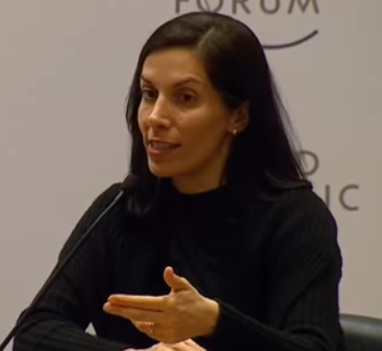
Nita A. Farahany
American author
12
APPEARANCES
11
PODCASTS
Oct 10, 2026


Nita A. FarahanyGUEST
you say my most recent book, do you mean the one that's coming out, which is Cognitive Extinction? Yeah.
Nita A. FarahanyGUEST
To get there, I have to explain a little bit about my last book, which is my last book, The Battle for Your Brain, focuses on the kind of coming age of widespread use of neurotechnology.
Nita A. FarahanyGUEST
And by that, I don't mean if you've heard of like what Elon Musk is working on, which is to put chips inside of a person's brain who has lost the ability to speak or to move.
Nita A. FarahanyGUEST
And then those chips together with AI can read brain signals and decode what a person is thinking.
11 MINS LATER
Yael PotterHOST
So from a legal perspective, what's the difference between freedom of expression and freedom of thought? And can we be possibly prosecuted based off of things that we're thinking? Is that something that can be used against us as evidence? Like, what are your thoughts?


Nita FarahanyGUEST
pick up on it for a second, Dan, which is- First, I'd never heard prompt jockey like that.
Nita FarahanyGUEST
And then, you know, second or I think you're right, which is all of these norms are going to evolve.
11 MINS LATER


Nita FarahanyGUEST
The guy comes in and he seems a little uncomfortable, like this was not pleasant for him.
Nita FarahanyGUEST
He said, you know, your baby's probably coming in 24 to 48 hours, and we know how hard you worked to have this baby, and we know how much you want this baby, and we assume that you want everything done.
Nita FarahanyGUEST
And he said, you know, there's about a 53% chance that the baby will die no matter what we do.

speaker_1ADVERTISER
Joue de façon responsable.
Nita FarahanyGUEST
They're partnering with a major headphone maker, and the idea is to just pack the, you know, soft, cushiony earpieces that you would ordinarily use with sensors that can detect brain activity.
Nita FarahanyGUEST
So some of the beta software that we're gonna look at enables me to do some tasks to see how well I switch between tasks, but also to see how attention can actually be tracked and monitored through headsets that you would use to listen to music or do a conference call.
Nita FarahanyGUEST
What we're seeing here is we're seeing my focus levels while I was doing the task.
speaker_1ADVERTISER
Joue de façon responsable.


David RothkopfHOST
Uh, another example you give is, is track your response to, um, s- for example, s- series of numbers to identify what your passwords might be.
Nita FarahanyGUEST
They, uh, you know, put into a gaming platform because a lot of, uh, the early applications of neurotechnology has been for gamers to be able to interact with the screen, you know, by thinking about shooting or moving left or right.
Nita FarahanyGUEST
And they wanted to see if in an environment where somebody's gaming and they don't even, uh, realize that it's happening, if it was possible to probe recognition of different numbers and to be able to come up with their PIN numbers to bank accounts and even their address, and they were able to successfully do that, just embedded into the environment without you realizing it's happening because your brain, before you're even consciously aware of something, processes recognition of numbers or sequence of numbers or words or images.
Nita FarahanyGUEST
Um, and that's not hard for governments or for nefarious actors to take advantage of.
Nita FarahanyGUEST
So it's happening already, and it brings back the original question, which is, you know, is there a world in which we need to more explicitly recognize a right to mental privacy, and is that already here? And I've been arguing yes, we've already arrived there, and we can look at it from a neurotechnology perspective and say, okay, obviously in that circumstance, we need to have some mental privacy.
17 MINS LATER


Henry BlodgetHOST
Give us some other examples of where this might actually come into play for, for most of us.
Nita FarahanyGUEST
Yeah, and what I try to do in, in the book, The Battle for Your Brain, is, you know, in part because both people didn't necessarily know what was happening, but also, um, people wouldn't necessarily believe, like, this is where we're going.
Nita FarahanyGUEST
I try to ground it as much in examples of what's already happening rather than where it might be used in the future.
Nita FarahanyGUEST
Um, and so I'm going to give some of the examples of where it's already being used and misused, because I think that helps people really understand the stakes even more so than how it could be misused.
Nita FarahanyGUEST
And so, you know, one, uh, kind of important area, a- and this is a little bit ironic, which is probably starting in 2010, um, I started to experiment with these technologies and think about, you know, kind of where were we going with it.
Nita FarahanyGUEST
And one, uh, kind of area that I thought would be interesting is early applications of these technologies allowed attention to be tracked, so you could tell if somebody was paying attention or their mind was wandering.
Nita FarahanyGUEST
And I thought, wouldn't that be interesting in the classroom setting? Like, I'm a professor, uh, wouldn't it be great, you know, to be able to look across the classroom and say, like: "Oh, that person's paying attention," or, "Their mind is wandering," or, you know, empower the students to have that information themselves, like track their brain activity during the class, see when their mind is wandering and when they're paying attention, and see if they can improve it over time.
27 MINS LATER


Sinead BovellHOST
So what is actually happening that's going to make this possible or that is already making it possible?
Nita FarahanyGUEST
Yeah, so we don't know when and if Apple will launch a BCI device, but I'm going to answer the Apple ecosystem first and then how exactly it works because I think it matters, which is Apple in May of 2025 announced, along with a whole bunch of other things, something really important that a lot of people didn't notice, which is a new accessibility feature.
Nita FarahanyGUEST
What that is is that it treats brain signals as a native signal for Apple devices.
Nita FarahanyGUEST
So it's like switch control, your ability to turn on and off things or be able to move a cursor.
Nita FarahanyGUEST
Instead of you needing to use your hand on a cursor, it allows brain signals to be the direct input.
22 MINS LATER
Sinead BovellHOST
So could you make the case for both, a world where it's actually a net benefit to society to have these devices, and then one where it could go too far and be used against us?


Jon HamiltonCORRESPONDENT
But she says things could get kinda weird when some of these functions come to consumer devices like, say, a headset that lets you play a video game or post on social media using just your thoughts.
Nita FarahanyGUEST
The more we push this research forward, the more transparent our brains become, and that's a double-edged sword, and we have to recognize that this era of brain transparency really is an entirely new frontier for us that we haven't even begun to grapple with.


Manoush ZomorodiHOST
I mean, what's your biggest fear here, Nita? What is the worst case scenario if we don't start to put some legal safeguards around this tech?
Nita FarahanyGUEST
So for me, you know, what I've been talking about is, is our right to cognitive liberty, our right to self-determination over our brain and our mental experiences.
Nita FarahanyGUEST
And what I mean by that is, like, fundamentally, your right to develop your own identity, your own thoughts, like, to have a space where you're able to reflect, to think, to...
Nita FarahanyGUEST
I have a, um, a third grader, so an almost nine-year-old, and watching her, you know, more and more come into her own and trying to figure out who she is, all of that happens in this safe space, this safe space of mental reprieve.


Joyce VanceHOST
But what do you wish policymakers would take into account as they begin to think about AI and, and AI-related regulation?
Nita FarahanyGUEST
Last fall, I taught, for the first time at Duke Law School, a class on AI law and policy.
Nita FarahanyGUEST
Like, trying to figure out, like, if it, what are the fundamentals of this? Like, breaking it down to the components.
Nita FarahanyGUEST
And I broke it down into looking across all of the ways in which AI has been governed so far.
Nita FarahanyGUEST
How do we think about the foundations of that? And the foundations would be things like compute power, or weights behind the models, or training data and bias issues and manipulation, copyright issues.


Nita FarahanyGUEST
Think about the way in which large language models are trained, huge amounts of speech, but they're able to predict, like, what comes next in a sentence.
Nita FarahanyGUEST
And so one of the things from a speech communication perspective that has been slow in decoding is that if you're trying to decode one letter at a time or one word at a time, that's a very slow decoding signal.
Nita FarahanyGUEST
But if you understand that when humans say, "Open the," the most likely next word they're gonna say is door or window or, in context, bottle of wine, it allows for a much faster decoding and correlation between brain states and what they mean.
Nita FarahanyGUEST
Like, if somebody's in a functional magnetic resonance imaging machine, they're looking at images, you're training the model to say, "Here's what the images look like," and it has this huge database of what images look like, it's able to do that much faster.
7 MINS LATER
13:37
How has your thinking about the framework we need changed, and what exactly are you advocating for now?
Nita FarahanySOUNDBITE_SPEAKER
This new category of technology presents unprecedented possibility, both good and bad.
Nita FarahanySOUNDBITE_SPEAKER
Consider how our physical health and well-being are increasing while neurological disease and suffering continue to rise.
Nita FarahanySOUNDBITE_SPEAKER
Fifty-five million people around the world are struggling with dementia, with more than sixty to seventy percent of them suffering from Alzheimer's disease.
Nita FarahanySOUNDBITE_SPEAKER
Nearly a billion people struggle with mental health and drug use disorders.
Nita FarahanySOUNDBITE_SPEAKER
Consumer neurotech devices can finally enable us to treat our brain health and wellness as seriously as we treat the rest of our physical well-being.
9 MINS LATER