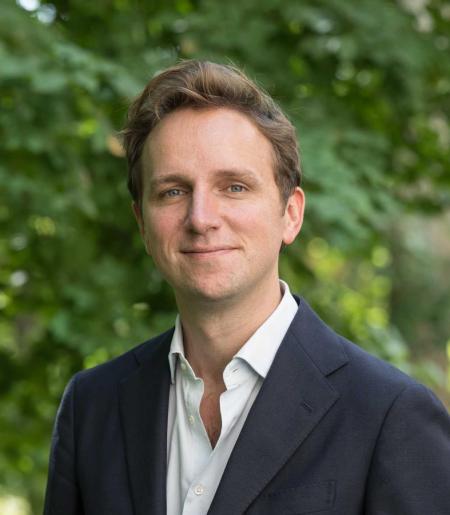
Nicholas Mulder
Historian
6
APPEARANCES
6
PODCASTS
Aug 25, 2026


Anjali KamatHOST
Your response to this announcement yesterday, there's not a lot of details on enforcement, and what does this mean for China? China is Iran's largest economic trading partner, buys over eighty percent of its oil, um, and President Trump is set to meet with the Chinese premier next month.

Nicholas MulderGUEST
I think that this announcement really shows that the United States is trying to increase the pressure on Iran, but is primarily doing so at the moment by rhetorical means and a kind of psychological warfare.
Nicholas MulderGUEST
Of course, Iran has been under a naval blockade imposed by the United States since June.
Nicholas MulderGUEST
Um, and the announcement yesterday was very short, as you mentioned, no details.
Nicholas MulderGUEST
There was a hint that a major global financial institution might be designated under the sanctions soon, but that too was left very vague.

Juan GonzálezHOST
So, uh, what would be the impact of any attempt to sanction, for instance, a major Chinese, uh, uh, bank or institution?

Nicholas MulderGUEST
I think that this announcement really shows that the United States is trying to increase the pressure on Iran, but is primarily doing so at the moment by rhetorical means and a kind of psychological warfare.
Nicholas MulderGUEST
Of course, Iran has been under a naval blockade imposed by the United States since June.
Nicholas MulderGUEST
And the announcement yesterday was very short, as you mentioned, no details.
Nicholas MulderGUEST
There was a hint that a major global financial institution might be designated under the sanctions soon.
Juan GonzálezHOST
So what would be the impact of any attempt to sanction, for instance, a major Chinese bank or institution? So

Anjali KamatHOST
And what does this mean for China? China is Iran's largest economic trading partner, buys over 80 percent of its oil, and President Trump is set to meet with the Chinese premier next month.
Nicholas MulderGUEST
I think that this announcement really shows that the United States is trying to increase the pressure on Iran, but is primarily doing so at the moment by rhetorical means and a kind of psychological warfare.
Nicholas MulderGUEST
Of course, Iran has been under a naval blockade imposed by the United States since June.
Nicholas MulderGUEST
And the announcement yesterday was very short, as you mentioned, no details.
Nicholas MulderGUEST
There was a hint that a major global financial institution might be designated under the sanctions soon, but that too was left very vague.
Juan GonzalezHOST
So, what would be the impact of any attempt to sanction, for instance, a major Chinese bank or institution? So

Anjali KamatHOST
Nicholas Mulder, welcome to Democracy Now! Your response to this announcement yesterday, there's not a lot of details on enforcement, and what does this mean for China? China is Iran's largest economic trading partner, buys over eighty percent of its oil, um, and President Trump is set to meet with the Chinese premier next month.
Nicholas MulderGUEST
I think that this announcement really shows that the United States is trying to increase the pressure on Iran, but is primarily doing so at the moment by rhetorical means and a kind of psychological warfare.
Nicholas MulderGUEST
Of course, Iran has been under a naval blockade imposed by the United States since June.
Nicholas MulderGUEST
Um, and the announcement yesterday was very short, as you mentioned, no details.
Nicholas MulderGUEST
There was a hint that a major global financial institution might be designated under the sanctions soon, but that too was left very vague.
Juan GonzalezHOST
So, uh, what would be the impact of any attempt to sanction, for instance, a major Chinese, uh, uh, bank or institution?


Rhoda MetcalfCORRESPONDENT
That said, I mean, state-run enterprises have been heavily criticized in the past for good reasons, right? I mean, can you talk about why they haven't worked well in many cases?
Nicholas MulderGUEST
In others, there are industries that are much more conducive to state ownership because there are more natural monopolies.
Nicholas MulderGUEST
And part of the reason that we have these waves of nationalization and privatization is that one or the other perspective dominates.
Rhoda MetcalfCORRESPONDENT
And that was the beginning of the debt crisis, essentially, for those developing countries.


Krystal BallHOST
Well, you have a number of insights here, but another significant insight in this piece is just how consequential it will be if Iran maintains control and there's a new status quo with regard to the Strait of Hormuz because that effectively gives them sanction, a powerful sanction ability as well.

Nicholas MulderGUEST
And it'll be very interesting to see in the next few weeks if a regime for the control of the Strait of Hormuz emerges.
Nicholas MulderGUEST
There are some indications now in the last few days that Iran has begun to levy tolls on ships that can pass, and moreover, that it is implementing a kind of tiered system of egress, so of being able to leave the Strait of Hormuz.
Nicholas MulderGUEST
Friendly countries that are friendly to Iran, so we've, have confirmations that Pakistan, but also the Philippines and China have been able to send tankers and ships through the Strait of Hormuz, can, uh, go through it without any problem.
Nicholas MulderGUEST
And here, the question is really whether Iran imposes a very heavy toll or if it's going to be a light one.
Krystal BallHOST
So how impactful do you see those developments as being in terms of sort of, um, you know, creating an alternative financial infrastructure that allows people to evade sanctions, and also in demonstrating that there are severe limits to the ability of the US to really extract, you know, effective pain or force some sort of regime overthrow with our sanctions?