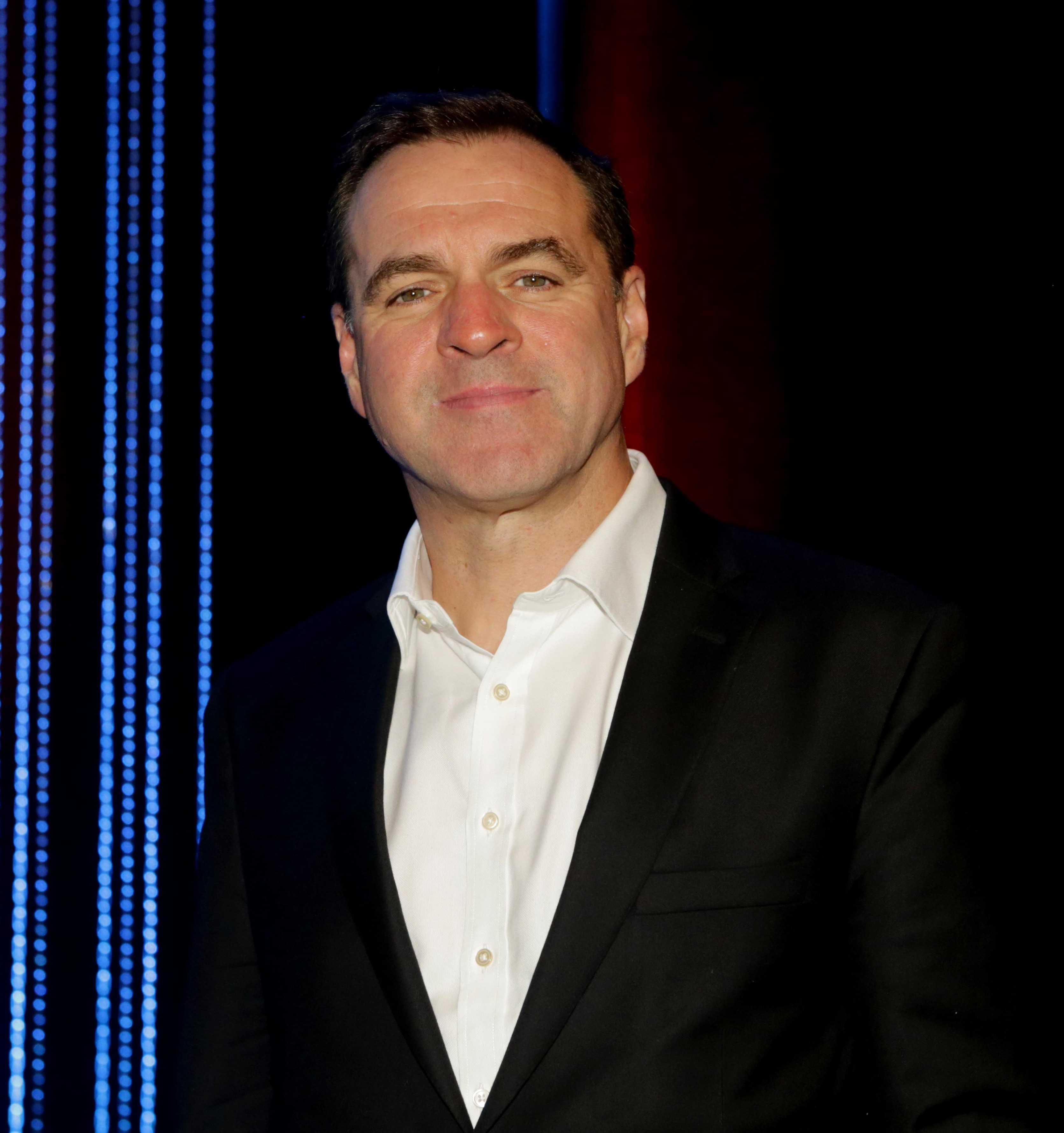
Niall Ferguson
British historian
24
APPEARANCES
17
PODCASTS
Oct 1, 2026


Niall FergusonGUEST
if you add those two things together, and then the rest of it has to do with inventories.
Niall FergusonGUEST
The recession is technically over, but I will be very surprised if the next quarter's numbers are as good because, uh, these programs are expiring or have expired.
Niall FergusonGUEST
The global recovery's more interesting because China, and not only China, also India and Brazil, plus a whole bunch of other mainly Asian economies, are growing much faster than I think anybody would have predicted six months ago.
Niall FergusonGUEST
Uh, not many people back, uh, in the dark days of the spring thought that even China would bounce back this strongly.

Consuelo MackHOST
Are we really in that much danger of our worldwide credibility, the inability or the unwillingness of people to buy our debt? Are we even close to that?
Niall FergusonGUEST
Well, obviously, Greece and Ireland are small economies, and they have no monetary sovereignty because they're part of a monetary union.
Niall FergusonGUEST
On the other hand, when you look at, for example, the ratio of public debt to tax revenue, The federal government's position is actually worse than that of any of the so-called pigs, worse than Greece.
Niall FergusonGUEST
And that's very interesting because it means that the United States, although it's much bigger than these small European countries and although it has monetary sovereignty, it is still on the same planet and it is still bound by the same economic rules that say at some point there's a ceiling.
Niall FergusonGUEST
And we don't know where that ceiling is, but there is a point at which the government is clearly borrowing too much, clearly owes too much.
Niall FergusonGUEST
And at that point, investors are going to ask for some kind of compensation for the risk.
5 MINS LATER
Niall FergusonGUEST
You can't actually ask questions in a Muslim empire about the will of God because that's inscrutable and it's sacrilegious to try to work out the laws of motion that govern the movements of the planets.
Niall FergusonGUEST
In Europe, the church tried to restrain Galileo when he observed, for example, that the planets are not ordered as the church had taught and the world is not at the center of the universe.
Niall FergusonGUEST
But the church wasn't powerful enough where it actually was possible for the clergy to silence those who wanted to explore optics and the laws of astronomy in the Eastern world.
Niall FergusonGUEST
It's a killer application literally because once you understand the laws of motion, your artillery becomes accurate.
Consuelo MackHOST
So what's changed? And does it mean the West decline and the East ascendancy? Or does it mean that we just slow down and the East is just growing faster?
Unknown podcast
Ep.568 ~ What Did Oppenheimer Do Wrong ~ Jordan B Peterson
Aug 18 · 4m

Niall FergusonGUEST
I, I should be clear, I haven't watched the movie, but I read the, the book American Prometheus.
Niall FergusonGUEST
And the book, uh, makes it clear that what Oppenheimer got wrong was, uh, to flirt with communism.
Niall FergusonGUEST
And, and that was wrong because, uh, it was the moment when he set aside, uh, his scientific judgment and, uh, and drank at least some of the snake oil, uh, that the Soviet regime was successfully exporting, uh, in the 1930s.
Niall FergusonGUEST
This was a terrible mistake that ultimately undermined his credibility and limited his power to, to steer the course of, uh, of the nuclear race.
Niall FergusonGUEST
Uh, what he got right was to, to develop a bomb that could end World War II without the need for a large-scale conventional forces invasion of Japan, which would have cost untold numbers of American, uh, soldiers' lives.
Unknown podcast
Ep.567 ~ The German Problem ~ Jordan B Peterson
Aug 18 · 15m
Niall FergusonGUEST
Uh, the problem, uh, with purely economic explanations or socioeconomic explanations is that they, they can't explain why the United States, which has an equally bad depression to Germany, that the two major industrial economies suffer almost as big a shock, why the United States does not abandon democracy and does not abandon the rule of law and does not embrace the demonic ideas of, of, of racialism, which were available to all societies.
Niall FergusonGUEST
One must remember that the ideas that, that Hitler came to believe, eugenics, for example, or antisemitism, were, they were, they were open source.
Niall FergusonGUEST
Anybody could believe these things because they had been very respectable, uh, in intellectual circles from really the turn of the century.
Niall FergusonGUEST
So it's very hard to say that Germany had a much worse economic expli-- uh, experience than any other countries, because countries all around the world experienced the, the Great Depression, and countries all around the world were exposed to the kind of ideas that Hitler had embraced.
8 MINS LATER


Larry KotlikoffHOST
What do you see going on here? do you see you know i have thought of this as world war iii too and i think you've referred to this as world war iii in many ways i think this is as dangerous a situation as the the advent of the nazis and that unless we i mean the nazis do not have nuclear capacity the iranians are seeking that they're also seeking a delivery system that could plant those nuclear weapons anywhere in europe already they can reach with their ballistic missiles apparently any pretty much any place in europe except for spain which is being very friendly to them maybe not maybe they can get madrid at this point but then in a few years the projection is they'll be able to hit new york and washington dc and boston so i do really think this is a existential war for the us but i'm not here to speak you are here to convey your opinion
Niall FergusonGUEST
Well, I was asked right at the beginning of Operation Epic Fury, February 28th, was this World War III? I wrote a column for the Free Press saying not quite.
Niall FergusonGUEST
After all, World War II started as a series of regional conflicts that coalesced into a single global war in 1942, really.
Niall FergusonGUEST
And so one has to think of world wars as perhaps arising from multiple regional conflicts.
Niall FergusonGUEST
One, obviously, in Ukraine, which has been going on for four and a half years.
Niall FergusonGUEST
The other between the US and Iran, not forgetting Israel's somewhat different conflict with Iran and its proxies.
12 MINS LATER


Dan SenorHOST
If you were to describe the scale of the problem, which you and John Clark get into in the free press piece, tell us, like, what are we looking at?
Niall FergusonGUEST
Well, I think the first thing that one has to do to understand what's going on is just look at the sheer volume of toxic content there is online.
Niall FergusonGUEST
Most of the people watching this will have heard of Nick Fuentes, might have heard of Darrell Cooper.
Niall FergusonGUEST
But I'm doubtful that they'll be familiar with some of the even lower life people online who are peddling anti-Semitic content.
Niall FergusonGUEST
there is just a huge network of people who appear on what we used to call social media but what we should really call algorithmic media with names like delano or lost who posts short clips or memes which are clearly immediately recognizably antisemitic.
Niall FergusonGUEST
There's a vast volume of this stuff, and it has been proliferating in ways that I think most people aren't aware of.
Dan SenorHOST
Do you think all that was missing is that they didn't have access to today's algorithms? And had they, could they have gone farther?

Dan SenorHOST
If you were to describe the scale of the problem, which you and Jon Clark get into in the Free Press piece, tell us like, what are we looking at?
Niall FergusonGUEST
Well, I think the first thing that one has to do to understand what's going on is just look at the sheer volume of toxic content there is online.
Niall FergusonGUEST
Most of the people watching this will have heard of Nick Fuentes, might have heard of Darryl Cooper, the phony pseudo historian promoted by Tucker Carlson.
Niall FergusonGUEST
But I'm doubtful that they'll be familiar with some of the even lower life people online who are peddling antisemitic content.
Niall FergusonGUEST
There is just a huge network of people who appear on what we used to call social media, but what we should really call algorithmic media, with names like Delano or Lost, who posts short clips or memes which are clearly immediately recognizably antisemitic.
Niall FergusonGUEST
There's a vast volume of this stuff, and it has been proliferating in ways that I think most people aren't aware of.
Niall FergusonGUEST
Jon Clark Levin, who co-authored the piece with me, has a great example of the way on TikTok, if you show interest in right-leaning content with amazing speed these days, he ran this experiment, TikTok's algorithm will serve you up videos of Hitler.
13 MINS LATER
Dan SenorHOST
How real is the engagement? At what point do these algorithmically enhanced fringes move to the mainstream?


Aaron MacLeanHOST
What do you think? Uh, is this, is this a period similar to, say, 1911, 1912? Or, um, help us, help us think about how to think about these questions.
Niall FergusonGUEST
Well, first of all, uh, it's a great pleasure to be with you all this evening and to be with, uh, Aaron, who's doing such a good job of reawakening public interest in military history.
Niall FergusonGUEST
That's important because it was more or less abolished at university some time ago.
Niall FergusonGUEST
In fact, most of the leading universities' history departments, if you look at the course catalogs, offer no courses in military history, which is a, a lamentable failure, uh, whi- which will have consequences.
Niall FergusonGUEST
So this is a great opportunity to, to take a step back and do the kind of toggling between past and present, uh, that I've made my life's work.
Niall FergusonGUEST
One of the very first things that I wrote about was the First World War, as the Brits call it, and I wrote about it 'cause my grandfather fought in it.
Niall FergusonGUEST
And the first question I ever asked myself of, of an historical nature as a, as a boy was: How on earth did my grandad, at the age of 17, end up on the Western Front fighting the Germans? And, and he fought in that war for three years.
1 HR LATER
speaker_12UNKNOWN
Is there a historical context to lean on or to, to, um, view this against, uh, where there was a good reversal of the kind of revisionism that we're seeing right now?

Gail MarkiewiczCORRESPONDENT
How do you interpret that trend? Do you think it's, do you think it's fundamentally new or a resurgence of older fault lines?
Niall FergusonGUEST
I don't think it's entirely newTo see ideological polarization because after all, the United States had a civil war back in the 19th century.
Niall FergusonGUEST
If you look at American politics in the 1950s at the time of McCarthy or in the 1960s and the late '60s when assassination almost became a, a too familiar feature of American politics, those were very polarized times too.
Niall FergusonGUEST
I think I've argued since The Square and the Tower, which was published back in 2017, that the advent of network platforms as the dominant organizing forces on the internet was bound to lead to more polarization because of the business model.
Niall FergusonGUEST
If you're selling ads to generate cash flow, whether you're Facebook or Google or YouTube, you, you are going to, to promote more inflammatory content, and the, the center is going to just get hollowed out 'cause they're just...
Niall FergusonGUEST
So I think that's playing out in a way that was quite predictable some years ago.
12 MINS LATER
Gail MarkiewiczCORRESPONDENT
Is there anything that we should be hopeful for in the future? Is there something that we could feel happy about and optimistic about?
Dan SenorHOST
The second question is, therefore, if the administration is going to strike, what's the goal?
Niall FergusonGUEST
There's a tendency amongst Western commentators to kind of be excited by revolutions.
Niall FergusonGUEST
This is a, an American problem because Americans have this very positive view of their own revolution.
Niall FergusonGUEST
They're always looking for a new 1776 to get excited about, especially this year on the two hundred and fiftieth anniversary of the Declaration of Independence.
Niall FergusonGUEST
But you have to keep reminding Americans that most revolutions don't have the happy ending that theirs did.
Niall FergusonGUEST
They hardly ever produce constitutional, liberal, representative government that endures.
41 MINS LATER
Dan SenorHOST
But that said, if you had to step back and explain what is the coherence to this foreign policy, what is it?
Dan SenorHOST
The second question is, therefore, if the administration is going to strike, what's the goal?
Niall FergusonGUEST
There's a tendency amongst Western commentators to kind of be excited by revolutions.
Niall FergusonGUEST
This is an American problem because Americans have this very positive view of their own revolution.
Niall FergusonGUEST
They're always looking for a new 1776 to get excited about, especially this year on the 250th anniversary of the Declaration of Independence.
Niall FergusonGUEST
But you have to keep reminding Americans that most revolutions don't have the happy ending that theirs did.
Niall FergusonGUEST
They hardly ever produce constitutional, liberal, representative government that endures.
41 MINS LATER
Dan SenorHOST
But that said, if you had to step back and explain what is the coherence to this foreign policy, what is it?


Niall FergusonGUEST
The rhetoric of the Trump administration, particularly Trump 2.0, is quite consciously borrowed from McKinley and Roosevelt.
Niall FergusonGUEST
I don't know who gives Trump this stuff, 'cause for sure he's not sitting there reading biographies of [chuckles] Theodore Roosevelt.
Niall FergusonGUEST
Somebody thinks it's a good idea, maybe it's JD, I don't know, somebody thinks it's a good idea to make these allusions to a, an America before the New Deal, an America, uh, which was an America still-... on the rise as a, as a power, not even really regarded as a great power by the rest of the world.
Niall FergusonGUEST
So this rhetoric has clearly some appeal, uh, in, uh, to members of the administration, maybe to voters.
Niall FergusonGUEST
I don't know how many voters have heard of the Roosevelt Corollary, not many, I suspect.
14 MINS LATER

Niall FergusonGUEST
And one must remember that in the 1950s, the Persian Gulf was really an area of continuing British influence.
Niall FergusonGUEST
And the British didn't really wrap up their dominance of the Gulf until they went more or less bust in the 1970s.
Niall FergusonGUEST
It's as recently as 71, 72 that the Americans are having to decide to take over what had been British responsibilities in that region.
17 MINS LATER

Coleman HughesHOST
So the question is, in what ways is Iraq a good comparison for Americans to have in their mind for what could happen in Iran if the regime fell? And in what ways is it a bad comparison?


Niall FergusonGUEST
... because it's really the only possible antidote to the, uh, the antisemitic myths.
Niall FergusonGUEST
The myth says that, in a somewhat illicit way, the Rothschilds, uh, make money from the outcome of the Battle of Waterloo.
Niall FergusonGUEST
Uh, while heroic Frenchmen and, uh, Britons, uh, not to mention Germans, are perishing in the, in the battle, uh, they're profiting.
Niall FergusonGUEST
Uh, so what really was going on? What was going on was that Britain, uh, uh, o-other European countries, uh, fought recurrent wars with France from the 1790s, from the period after the French Revolution, right up un- until the Battle of, of Waterloo in 1815.
Niall FergusonGUEST
Uh, and, uh, a variety of different instruments were used to finance, uh, these wars, including bonds, which the British government was able to issue in substantial quantities, and bankers.
Niall FergusonGUEST
And the Rothschilds were one of a very significant number of bankers, uh, who contributed to financing the war effort against revolutionary and then Napoleonic France.
32 MINS LATER


Niall FergusonGUEST
Well, the first thing is, uh, to acknowledge that, uh, major success was achieved by US diplomacy.
Niall FergusonGUEST
Uh, and I think that owed quite a bit to the involvement of the president's son-in-law, Jared Kushner, who, when he joined forces with Steve Witkoff, uh, brought to bear his whole, I guess, network plus his experience in the region.
Niall FergusonGUEST
The remaining surviving hostages that were still held captive by Hamas were released and a, a kind of peace, I say kind of peace because, uh, it's not exactly tranquil there, but a kind of peace was achieved, uh, in, in Gaza, leaving Hamas in control of parts of Gaza, but not all of it, because in effect, Gaza has been divided and a substantial part of it is actually under, well, in practice, Israeli control.
Niall FergusonGUEST
Uh, the problem with Hamas is it's very difficult entirely to annihilate it.
Niall FergusonGUEST
The Israeli Defense Forces had a pretty good go at this and certainly inflicted very serious damage on the organization.
7 MINS LATER
Niall FergusonGUEST
Uh, that was the s- And that's still, by the way, a kind of default assumption in, in Europe, which is why you've got this bizarre phenomenon of recognition of the Palestinian state at a time when i- its non-existence is one of the most striking features of the region and, and its total loss of legitimacy in the eyes of Israelis.
Niall FergusonGUEST
I, I've never m- I haven't met since October 7th two years ago any Israeli who really believes in a two-state solution.
Niall FergusonGUEST
So, I think the conventional view was completely wrong and I remember having, uh, a meeting with Jared Kushner early on in this process where he explained his vision, which was, "Let's try and make the Palestinians less central.
Niall FergusonGUEST
Let's try to address their, their concerns, but, but not make them the central issue.
21 MINS LATER

Niall FergusonGUEST
We, and I'm sure Dexter would confirm this, uh, uh, know that this has been Bibi Netanyahu's raison d'etre for years, that Iran is the great enemy, that the Palestinian question is a sideshow, that Iran poses a, an existential threat, and ultimately the nuclear program cannot be allowed to be completed.
Niall FergusonGUEST
And the striking thing was how reluctant Trump was, and it became clear, uh, to the Israeli government that Trump 2.0 was different, fundamentally different from Trump 1.0.
Niall FergusonGUEST
In the first Trump administration, there had been considerable sympathy for Israel.
27 MINS LATER

Bari WeissHOST
How do you see that playing out? What, what faction there is going to prevail, and where does someone like Steve Witkoff fall? Because I'm hearing lots of mixed reporting on him.


Niall FergusonGUEST
And the argument back then was China and the United States are in a symbiotic relationship, but it's not symmetrical.
Niall FergusonGUEST
The U.S. does the importing, China does the exporting, the U.S. does the consuming, and China does the saving.
Niall FergusonGUEST
And the argument that I made back in 2007 was that this was not really sustainable.
Niall FergusonGUEST
It actually took longer than I expected to turn sour, but certainly by 2017-18, we had the beginnings of Cold War II, when the rise of China finally elicited a response from the United States.


Fareed ZakariaHOST
Uh, Niall you point out in a piece you wrote on Substack that while there is a lot of flurry and some of these executive orders have big effects, on something like the core fiscal issues, um, there actually hasn't been very much done.
Niall FergusonGUEST
done.Well, the- the key problem, uh, that Donald Trump faces in his second term is that the debt is much larger than it was eight years ago.
Niall FergusonGUEST
It's like the debt at the end of World War II and interest payments are absorbing a rising share, uh, of government spending and of- of GDP.
Niall FergusonGUEST
In fact, they exceed the, uh, defense budget at this point for the first time in a- in a long, long time.
Niall FergusonGUEST
The other problem, which is closely related, is that although Donald Trump is radical on certain issues, notably trade, he long ago committed to keep his hands off, uh, Social Security and Medicare.
Niall FergusonGUEST
And as those are the two biggest line items in the federal budget, that means it's not really full repeal of the New Deal in the way that- that John has just said.
Fareed ZakariaHOST
And you have a- a- a wonderful line in, I think, your Substack, uh, column where you say, "The negotiations that Steve Witkof is undertaking, uh, resemble those between the first little pig and, uh- and the- the big bad wolf." How do you think it's going now?


Azeem AzharHOST
So this is a company that is not really present at all in the US, but is really substantial, both in terms of its scale numbers of cars sold, but also how good those vehicles actually are.
Niall FergusonGUEST
when Chinese automobile companies seemed like the Wild West of the Chinese economy and people didn't take it seriously in the West.
Niall FergusonGUEST
Well, they're taking it seriously now because unless you erect your tariff barriers double quick, your domestic market is going to be overrun by Chinese competitively priced and pretty impressive technologically vehicles.
Niall FergusonGUEST
I really was struck by the change in mood over 12 months because 12 months ago, you know, Chinese investors, Chinese tech companies were still pretty down in the mouth.
18 MINS LATER
Bari WeissHOST
They're a necessary reckoning for wealth and equality in this country, for a system that was inevitably going to lead to a disastrous outcome domestically in this country." Is there anything to that argument in your view?
Niall FergusonGUEST
Well, there's a, a little bit to that argument, but not enough to justify this policy.
Niall FergusonGUEST
Globalization has been a kind of post-Cold War phenomenon in which the entry into the global market of Chinese labor, as well as Chinese savings, had enormous consequences, not just for the US but for everybody.
Niall FergusonGUEST
It greatly lowered the cost of, of labor, it made a great deal of capital available, and the- the benefits unquestionably went to two groups: the elite of the United States and the Chinese middle class.
Niall FergusonGUEST
And it is clear that really from the 1990s until around 2016, the median American household saw barely any change in inflation-adjusted disposable income.
9 MINS LATER
Bari WeissHOST
So what is your message, Niall, to someone living in a de-industrialized, hollowed-out town in the Rust Belt who looks at the history, economically speaking, of the past 30 years and thinks, "This didn't work for me, and I need something to work for me." Which, what is the message to those people if the message is not, "Manufacturing's coming back," you know, and you're saying that's a nostalgia trip? What is the message?


Niall FergusonGUEST
First of all, it's to try to put this in some kind of broader perspective using analogies to help us get a better sense of where we are.
Niall FergusonGUEST
You can't do history in real time and always be right, and some of the things that are especially difficult about this moment will not prove to be right or wrong for years.
Niall FergusonGUEST
But let me, let me try to make sense of what we're seeing, and also to answer the specific question you asked, how do they see this in Moscow? How do they see it in Beijing? I think in Moscow they're feeling good.But not completely relaxed because they have, to some extent, handed the initiative to the President of the United States.
8 MINS LATER


Preet BhararaHOST
So the question is, if you believe in free speech, and there is the possibility and allowance for free speech, and there was in your mind and in your assessment also in these universities until about 10 years ago, if you believe in the marketplace of ideas, why isn't the contrary view, or maybe it is, why isn't whatever you think the contrary view is to enforcing speech orthodoxy gaining traction? And what, if anything, should anybody do about it given that you have very, very smart, intelligent, educated, decently paid and housed people at these elite universities?
Niall FergusonGUEST
My observation at Harvard, but I go to multiple universities to give lectures, so I had a sense of what was going on elsewhere, in addition to which we have a lot of survey data now.
Niall FergusonGUEST
So my impression, backed up by data, is that over a 10-year period, there was an increase in cancellations, disinvitations, disciplinary actions taken against professors as well as students, and a shift in sentiment amongst not only students, but also professors, administrators, and university presidents.
Niall FergusonGUEST
And these things cumulatively changed the climate so that in 2014, I felt that I could speak quite freely in my classes at Harvard, make jokes, even risque jokes.
6 MINS LATER
Preet BhararaHOST
who's the bad faith on the part of? Is the bad faith on the part of the administrators? Yeah.