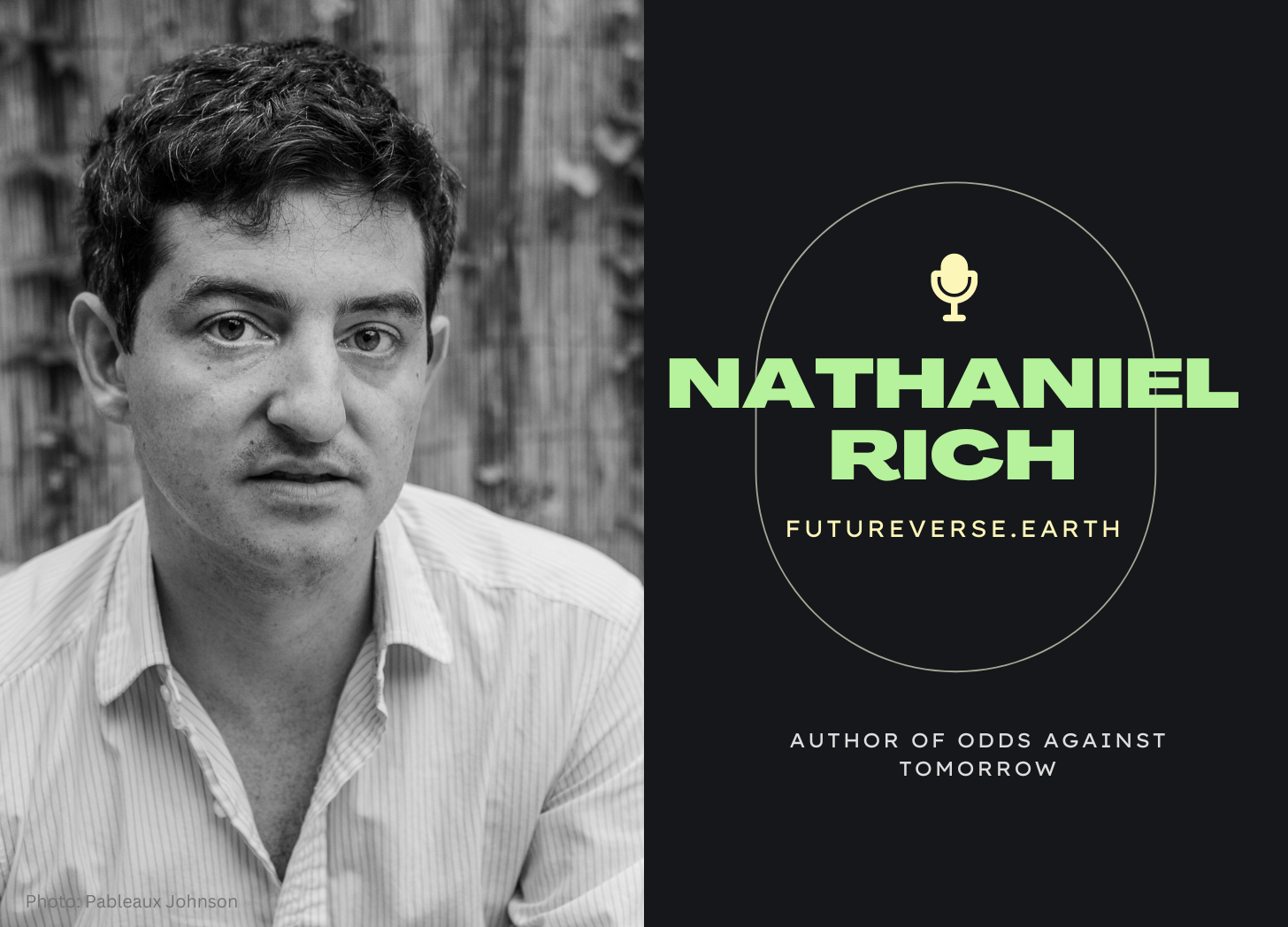
Nathaniel Rich
American novelist and essayist
8
APPEARANCES
8
PODCASTS
Oct 19, 2026

2:54

It's the whole idea of a heist and a plan and a coming together of something for a common goal, isn't it?
Nathaniel RichGUEST
Yeah, I mean, I've spent a lot of time reflecting on the form and particularly its relation to the rest of, you know, the other kind of subgenres in crime fiction.
Nathaniel RichGUEST
And it strikes me, I'd be curious to know your... your thoughts, cause you're certainly an expert on this, this and your, as are your listeners, I'm sure.
Nathaniel RichGUEST
But my theory of the case is that the, the heist novel is fundamentally a comic form, you know, it's about, and I guess the closest analog in that way within crime fiction might be the whodunit, you know, or certain, certain versions of that, that story where, you know, you have the satisfaction of essentially solving a puzzle.
Nathaniel RichGUEST
Instead of figuring out who committed a crime, it's how can the criminals figure out how to pull off a great crime.
11 MINS LATER

Justin ChangMODERATOR
What was your response when you heard that Tom was interested in making this film and what did your input go from there?

Nathaniel RichGUEST
I see it as a human story, a story about people flawed in many ways who are trying to basically save the world, but have to deal with their own failings.
Nathaniel RichGUEST
And I felt like given his work, He was an ideal director to bring out the human element of the story, which I think is so crucial in writing about this subject.
20 MINS LATER
Justin ChangMODERATOR
I'm just curious, given how hopeless things can seem, and given that the film does not exactly flood us with hope, what do you hope that the film might accomplish as people get to see it next year?

Nathaniel RichGUEST
Yeah, she reminds him of a real-life character named Veronique Le Guin, who I think I first encountered in a great book by Michael Finkel, A Stranger in the Woods, about a kind of hermit who lived in the Maine woods for decades, undetected.
Nathaniel RichGUEST
And one is Veronique Le Guin, who is a French shop girl who essentially, I think, was talked into... by her boyfriend at the time, who was a speleologist, he would climb in caves and spend a lot of time in caves doing science there, to take part in a crazily unethical experiment, which was essentially to live underground in a cave as long as possible, essentially until she went insane.
Nathaniel RichGUEST
She lived underground, monitored by scientists to see what would happen to her when she was cut off from her circadian rhythms, did not see sunlight, and essentially was left to her own devices.
Nathaniel RichGUEST
And she chronicles what happens in this incredible diary that was published in France that I was able to get a copy of.

Susan LarsonHOST
You know what I mean? And this description just spoke to me, spoke to the young me at that time.

Nathaniel RichGUEST
It's this incredible story of the heist of a data center in the center of London about 20 years ago.
Nathaniel RichGUEST
Um, and I came to it, uh, and I should say that the headline is, uh, five professional thieves and a professional, um, fake police dog that they hired, um, dressed up as police officers, went into this Verizon data center in, in the middle of King's Cross and stole 80 servers.
Nathaniel RichGUEST
Um, they claim they were hired by, uh, some kind of banking conglomerate through a, through a fixer, professional fixer, classic, you know, Ocean's 11 scenario.
Nathaniel RichGUEST
And, um, that on those servers was information, um, that would incriminate, um, the bankers.
Nathaniel RichGUEST
And this was a-- The Times actually made me cut this detail 'cause they didn't wanna get sued.
Nathaniel RichGUEST
But among the banks that were keeping their data in this, in this data center, um, was JPMorgan Chase, the s- the world's second biggest bank at the time, as well as another number of major international banks.

Tim MillerHOST
Um, uh, there hasn't been as much conversation around kind of this more whatever libertarian horseshoe angle, um, of, of it, like, which is what like what are we s- you know, what like what are the security implications of this? Like, what are my personal security implications of this? What are the risks of, of, about this to, on a more systemic level?


Indira LakshmananCORRESPONDENT
I began by asking him where he got the idea for the heist of a data center.
Nathaniel RichGUEST
I think it must have come from a piece I reported many years ago about a group of people who were connected to the WikiLeaks organization and Julian Assange who were extremely concerned about privacy, surveillance, and this sort of coming age that we've now entered of tech corporations controlling every aspect of our lives.
Nathaniel RichGUEST
And I remember a conversation with one of these activists who told me, "You know, Google is more powerful than any country in the world." And I said, "Because they're, you know, so rich?" He said, "No.
Nathaniel RichGUEST
No, in their servers, they have information that could compromise any political leader, any CEO, any, you know, news organization, any military.
Nathaniel RichGUEST
Everybody uses these servers, and they own all of it." And that kind of staggered me.
Indira LakshmananCORRESPONDENT
Was it a shock for you to research for this book just how much of our lives, from classified war plans at the Pentagon to cutting edge science trials, to emails that could implicate business leaders or politicians in crimes, is just sitting there in these warehouses without a ton of security?
Nathaniel RichGUEST
The focus has been on cybersecurity really in the last 20, 30 years, and I, I've sp- I've spoken with a bunch of security experts, and they, they feel like there's been a real disservice, uh, in focusing so much on cybercrime because as, as those defenses have been built up, there's much less concern about the prospect of physical security.

Nathaniel RichGUEST
The main impression one gets was of being inside the mind of an artist, of a sculptor.
Nathaniel RichGUEST
Completely filled with a chaotic mess of half-finished works of art, old furniture draped in various fabrics.
Jen LardasHOST
But first, we go to Round Pond, Maine, where author Nathaniel Rich returns to a secluded studio tucked in the woods that taught him that a house can shape not just who you are, but the work you'll spend a lifetime trying to create.


Michael SvobodaGUEST
I think you've already done much of this already, but whatever you would like to do to set up a reading in terms of background?
Nathaniel RichGUEST
Yeah, so the main character, I'll just read a couple sections for the two, two of the main characters.
Nathaniel RichGUEST
One is Tim, who's a journalist, a climate journalist, who's really down on his luck when the book begins, and you'll hear why.
Nathaniel RichGUEST
And he's with his buddy, Cess, who's a kind of conniver who's trying to convince him to rob It's a series of heists.
Nathaniel RichGUEST
The first heist, and again, the stakes kind of increase, but the first heist is a heist of a mini storage facility.
32 MINS LATER
speaker_5AUDIENCE
I'm wondering if you've noticed differences, either across these moments or across time, with your different books and the audience talks you've seen.


Brooke GladstoneHOST
So, they have to choose between saving their homes or saving their livelihoods, and they've picked their livelihoods.
Nathaniel RichGUEST
It's a very conservative parish, but they don't need to be convinced that the water is rising.
Nathaniel RichGUEST
However, they're not really concerned about what's going to happen, you know, to them 10 or 15 or 30 years from now.
5 MINS LATER
Brooke GladstoneHOST
I just wonder, is there a way that this message of cherishing the moment in which we actually spend our lives can be an impetus to change?