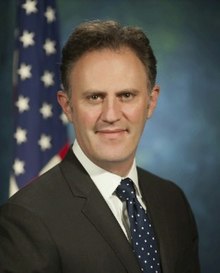
Nathan Sales
American lawyer
22
APPEARANCES
7
PODCASTS
Oct 17, 2026


Katie PavlichHOST
So for those who are not familiar with what the Moab is, the mother of all bombs, can you explain what it is and why the president would be considering using it?

Nathan SalesGUEST
So it's designed to destroy surface targets and targets just below the surface.
Nathan SalesGUEST
It's so big that we can't actually drop it from a bomber like a B-2 or a B-52.

Brian EntenHOST
Ambassador, the new information that the fly Dubai terror suspect planned to crash into an American base, and this just came out a little while ago, if the first Israeli target failed, do you think that increases the likelihood that Iran is involved in this?
Nathan SalesGUEST
I think the investigation is ongoing and more details will be coming out over the coming days.
Nathan SalesGUEST
But one thing that's obvious from today's news is that there was a complete breakdown in security that allowed this co-pilot to get anywhere near the controls of the 737.
Nathan SalesGUEST
Why was he hired by the airline in the first place after he had been flagged by the Omanis and denied an ability to fly for the Omani airline? Why was he allowed to fly to Israel? Israel has a policy that citizens of countries that do not maintain diplomatic relations with Israel aren't allowed to fly there.
Brian EntenHOST
If they're lying and the U.S. can show for sure that they were the ones plotting an attack, what options does President Trump have? What do you think we'll see happen? Would this lead to more serious strikes?


Mark LevinHOST
I mean, it's just a matter of time until we're going to be putting up with an awful lot of bad stuff, is it not?
Nathan SalesGUEST
Well, Mark, the terrorism threat that we face today in 2026 is very different from the one that we faced back in 2001 when 9-11 happened in our country.
Nathan SalesGUEST
The threat we were concerned about then and not concerned enough about but still concerned about was al-Qaeda, a centrally planned hierarchical terrorist organization that had a leader and a clear command structure and issued orders to operatives to go out and commit terror attacks.
Nathan SalesGUEST
But what we really have to worry about is independent terrorists, people who radicalize on their own and swear an oath of allegiance to some far-off terrorist group.
Mark LevinHOST
I don't think we're more than three, four, five, ten years max behind them, and they're going to have a hell of a big problem, aren't they?


Leland VittertHOST
But to that point, can something really go from the Iranians seemingly as in control as they are now to completely falling apart in two weeks?
Nathan SalesGUEST
I don't know what the timeline is, Leland, but the trajectory is not a good one for the Iranian regime.
Nathan SalesGUEST
So the other part of this, though, that also deserves attention, not just what kind of economic pressure is the United States putting on Iran, But what is the United States and what are our allies doing to limit Iran's leverage and ability to hold shipping in the Gulf hostage? The numbers that we're seeing in recent days, recent weeks suggest that the market is adjusting and we're getting close to pre-war levels of friendly oil shipments coming out, whether through the Gulf or through pipelines into the Strait of Oman or into the Red Sea.
Nathan SalesGUEST
Once we're able to restore something like or close to where we were prior to the war, the Iranian regime's leverage over the rest of the world is zero.
Leland VittertHOST
And is Trump, as you see it... steeled enough to not take the easy win if the Iranians offer it.
Leland VittertHOST
I think the Iranians may be scared more of Besant than they are of Pete Hegseth right now.
Nathan SalesGUEST
Well, we've definitely entered a new phase of this contest with the Iranian regime.
Nathan SalesGUEST
Administration went into it with the best of intentions, but it turns out the Iranians weren't prepared to negotiate good faith.
Leland VittertHOST
That means Russia and China are both watching and saying, well, the U.S. isn't willing to finish the job.

Nathan SalesGUEST
The first act was the military campaign that was incredibly successful at destroying Iran's conventional m- uh, uh, uh, army and navy, air force, don't exist anymore, as well as the nuclear program.
Nathan SalesGUEST
Phase two was the diplomatic phase, where we were trying to coax them into a deal.
Nathan SalesGUEST
The problem with diplomacy is the other side always gets a vote on whether to take it seriously, and it's obvious that the Iranians didn't.

Sean HannityHOST
He wrote The Satanic Verses of, I believe the, the name of the book was entitled.
Mark LevinHOST
And do we as a country really understand this enemy is not about deals or transactions and so forth?
Nathan SalesGUEST
We are returning to the default Donald Trump approach to Iran, which is make no concessions and impose our will on the regime via coercive force, economic sanctions, military force, diplomatic pressure, and isolation.
Nathan SalesGUEST
That has been the approach that Donald Trump has taken with respect to Iran, not just this term and the first term, but dating back to his life as a private citizen back in the 1980s.
Nathan SalesGUEST
So nobody should be surprised to see Donald Trump pivoting back to his, uh, i- instinctive approach to Iran.
Nathan SalesGUEST
So pressure on Iran, towards what end? Well, I think the most immediate goal here is to make sure that the strait is open, and what we're seeing is essentially a three-part strategy to open the strait on our terms and deny Iran any ability to threaten it or extort money from it.
11:51

How much of a blunder was this of Vice President J.D. Vance kind of revealing the cards? The Iranians, I'm sure, are listening.
Nathan SalesGUEST
Well, I think the Iranians are the ones who are making a strategic mistake here.
Nathan SalesGUEST
And actually, before that even, if you go back to the initial ceasefire that was announced several months ago, they were violating that before the ink was dry.
Nathan SalesGUEST
They basically are not interested in serious negotiations about their nuke program.
Nathan SalesGUEST
They're not serious about anything else right now except gaining control of the Strait of Hormuz.
15:50
What did you make of this? And what do you make of my analysis more generally about the economic side of this?


Nathan SalesGUEST
elections and transition the country from the Chavista era socialist dictatorship to a free market democracy.
Nathan SalesGUEST
But a lot has to happen between now and then for the policy and strategy to take effect.
Nathan SalesGUEST
I think when it comes to the private sector, rather than the administration issuing a blanket removal of sanctions, you're seeing a much more bespoke, customized, tailored approach.
Nathan SalesGUEST
And the reason for that, I think there are several, but one of the reasons for that, I think, is because Washington wants to maintain as much control as possible over the country's transition through those three stages of recovery.
Nathan SalesGUEST
Issuing general licenses for the energy sector creates great opportunities for certainly energy companies, but also for companies in adjacent industries, infrastructure companies, logistics companies, transportation companies, and so on.
18 MINS LATER

Beth ViolaGUEST
Venezuela is open for business and the administration, the White House in particular, is willing to help U.S. companies that are trying to advance their business priorities on the ground in any way they can.
Mark LevinHOST
And so Nathan Sales, my question to you is this: um, what does a great deal look like, and what about the enforcement features? Isn't that key to everything?
Nathan SalesGUEST
It's a great point, Mark, and let's start there because a parchment agreement isn't worth anything if it's not actually implemented, if it's not actually enforced.
Nathan SalesGUEST
And we know that the Iranian regime has cheated in the past, and they're gonna cheat in the future.
Nathan SalesGUEST
So the arrangements that are being, um, uh, adopted have to be enforced, um, in the future vigorously and robustly.
Nathan SalesGUEST
Um, so what does that mean in practice? It means we're gonna have to have, um, an incredibly robust inspections regime to make sure that they're not secretly trying to restart their nuclear weapons program.
Mark LevinHOST
What do you think about the need to absolutely focus on this and make absolutely certain that the Iranians can't use Hezbollah, that Israel can defend itself, and those missiles?
Nathan SalesGUEST
What they are doing is what they always do, which is use diplomacy as a smokescreen to run some clock and try and outlast the United States or get some sort of better arrangement for themselves.
Nathan SalesGUEST
American diplomacy is most effective when it is backed by the credible threat of military force.
Nathan SalesGUEST
That doesn't mean we have to start bombing today, but what it does mean is the Iranians are never gonna take us seriously if they think that we're unafraid, uh, if they think we're afraid of using military force.
Nathan SalesGUEST
They clearly are not afraid of using it, and they think they've got our number right now, and that's not a good situation for us to be in.
Leland VittertHOST
Ambassador, how does Netanyahu play this to his local audience, to h- his constituents in Israel, to the Middle East, and I think maybe even more importantly to the domestic political audience in America where, uh, Israel's influence in American politics, shall we say, is a topic of conversation?
Sean HannityHOST
Um, however, uh, I get a little nervous when American ships are escorting other ships through the Strait of Hormuz, knowing the short distance at its narrowest point is what, 20, 24 miles, something like that.
Nathan SalesGUEST
The, the US announced that we were going to be reopening the strait and working with commercial shipping companies, uh, to reduce the risk that their cargos and crews face.
Nathan SalesGUEST
Who in Iran? It's, it's actually not clear, um, who's responsible for making these decisions to attack ships in the, in the Gulf and to launch drones at the United Arab Emirates.
Nathan SalesGUEST
Are these rogue commanders on the front lines who have taken matters into their own hands, or is this a strategic decision that's made by leadership, such as it is, leadership that's remaining, uh, in Tehran? So we've gotta watch the situation very, very closely.
6 MINS LATER
Sean HannityHOST
Where's China in all of this? 'Cause they get a lot of their oil through that strait.
Sean HannityHOST
If they have all this 60% enriched uranium, that's gotta be a part of it, and I would imagine the president would insist on it.
Nathan SalesGUEST
The Iranian regime has proven itself over the years to be completely untrustworthy.
Nathan SalesGUEST
No matter what they promise, no matter what they put in writing, the key question is always going to be, is it actually going to be implemented? And they, you know, for years, they said, "We don't have a nuclear weapons program." And then Israel snuck into the country and stole their archive and brought it out for the world to see, oh, it looks like they do have a nuclear weapons program.
Nathan SalesGUEST
For years, they told us, "Our ballistic missiles can only ch- go 2,000 kilometers." Well, they just took a shot at Diego Garcia about 4,000 kilometers away, so clearly anything they commit to, anything they say, has to be taken with an entire shaker of salt.
Nathan SalesGUEST
So right now, I'm not surprised that the regime would be desperate for some sort of deal to preserve whatever is left of their ballistic missile capabilities or their nuclear capabilities.
Nathan SalesGUEST
If we're not going to, um, end the war militarily, but diplomatically right now, we have to make sure that the end game accomplishes all of our military objectives.
Sean HannityHOST
Uh, Ambassador, first your thoughts on Cuba before we get into the, the whole Iranian situation, where we are just a little over two weeks into this.
Nathan SalesGUEST
Um, things are looking better for the freedom-loving people of Cuba, uh, and pro-democracy elements in Cuba today than they have in recent memory.
Nathan SalesGUEST
That's not to say that the communist dictatorship is, is going to collapse inevitably.
Nathan SalesGUEST
Um, but the regime is weak, and it just needs a little bit of a push, uh, and maybe, uh, the, the long-suffering people of Cuba will, will find liberation at hand.
Sean HannityHOST
Uh, how important is this strategically? And, and does it in any way, you think, impact whoever is in charge of Iran, their thinking in terms of, of stopping the free flow of oil through the Strait of Hormuz?
No mention dialogue available.


Dave AnthonyHOST
With this threat, again, when he says they'll be blown away, does Hamas respond? Will it react to those threats from the president about that, you think?
Nathan SalesGUEST
They're not gonna do what's right for the world or the region, they're gonna do what's in their interest, and we saw that in the lead-up to the ceasefire several months ago.
Dave AnthonyHOST
So when you see this new Board of Peace, there are some who are worried that the president is trying to undermine what the United Nations does, and so we have some countries like France who say they're not willing to join.

Nathan SalesGUEST
Uh-... can bring together the Arab leaders and Muslim leaders on the one side and Israel on the other, to forge a ceasefire deal that's good for all parties.
Nathan SalesGUEST
Its chief benefactor, Iran, uh, its, its capabilities to threaten Israel are in tatters because of Israel's relentless campaign against Iran, and us finishing off the Iranian nuclear program over the summer under Trump's leadership.
Nathan SalesGUEST
So, this is, this is a great day for the hostage families, but let's also take a victory lap as Americans because it was American leadership that made this all possible.
Sean HannityHOST
And I think this now created a window of opportunity for the rest of the Middle East to side with the United States, and I think the president re-established America's role in the world as the leader of the free world.
Nathan SalesGUEST
The, the untold story of the past two years was how quietly many of the Arab states were still cooperating on security matters with their Israeli counterparts.
Sean HannityHOST
It's just war is hard, but they're, they're decimating every one of their enemies simultaneously and it's, it's complicated and it, it's expensive.
Nathan SalesGUEST
Um, Benjamin Netanyahu is actually taking some risks here, uh, for his political future in order to get this war ended on terms that are acceptable to everybody in the region.
Nathan SalesGUEST
You know, his coalition government is very fragile at home and he has some members of his coalition that are threatening to walk and, and, and throw the coalition into chaos if Netanyahu makes too many concessions.
8 MINS LATER
Nathan SalesGUEST
I, I think Vladimir Putin's approach to geopolitics is the same as Vladimir Lenin's.
Nathan SalesGUEST
If you encounter steel, you withdraw." And I think what Putin has been finding these past couple of months is that the United States is made of steel.
Nathan SalesGUEST
We have, through diplomacy, uh, encouraged, harangued, uh, twisted the arms of our European allies to spend more on their own defense.
Sean HannityHOST
He served in the first Trump administration as ambassador-at-large for counter-terrorism, acting under secretary of state-Uh, is there anything I'm saying here that you disagree with?
Nathan SalesGUEST
Sean, it sounds like, um, y- you're angling for an appointment at the State Department.
Nathan SalesGUEST
(laughs) I- I'd love to have what you just said, um, reflected among America's diplomatic corps.
Nathan SalesGUEST
Um, Iran is a threat, not just to Israel, not even just to the region, they're a threat to the United States and that has to be the guiding star of US policy over the next couple of weeks.
Nathan SalesGUEST
W- we're starting to see some of Israel's, um, on again, off again friends in the West starting to waver.
Nathan SalesGUEST
Um, there's some chatter as the G7 summit up in Canada kicks off today, um, that the G7 might call for deescalation.
Sean HannityHOST
I don't want uh, people to think, uh, that this is, you know, a cakewalk, because it's not, um, but it's a matter of do you act now or do you risk, you know, w- what they- what we- w- as a world might be facing later? And I'm not willing to take that risk for our children and grandchildren.
Sean HannityHOST
He served in the first Trump administration as ambassador-at-large for counterterrorism, acting under secretary of state.Uh, is there anything I'm saying here that you disagree with?
Nathan SalesGUEST
Sean, it sounds like, um, you're angling for an appointment at the State Department.
Nathan SalesGUEST
(laughs) I'd love to have what you just said, uh, reflected among America's diplomatic corps.
Nathan SalesGUEST
Um, Iran is a threat, not just to Israel, not even just to the region, they're a threat to the United States and that has to be the guiding star of US policy over the next couple of weeks.
Nathan SalesGUEST
We're starting to see some of Israel's, um, on-again, off-again friends in the West starting to waver.
Nathan SalesGUEST
Um, there's some chatter as the G7 Summit up in Canada kicks off today, um, that the G7 might call for deescalation.
Sean HannityHOST
Um, but it's a matter of do you act now or do you risk, you know, what they, what we as a world might be facing later? And I'm not willing to take that risk for our children and grandchildren.
Sean HannityHOST
Uh, uh, how, after everything that Israel's been able to accomplish by taking out the top leadership of Hamas and Hezbollah and all these other terror groups, why would they ever underestimate Israel's capabilities?
Nathan SalesGUEST
It- it's a great question, and I think it's just the arrogance of the Iranian regime.
Nathan SalesGUEST
They- they think that they are on a divinely ordained mission to destroy the state of Israel.
Nathan SalesGUEST
When- when they chant, "Death to Israel" and "Death to America," they actually mean it.
Nathan SalesGUEST
And it's clear that the people of Iran d- have not signed up for this, uh, revolutionary and genocidal agenda.