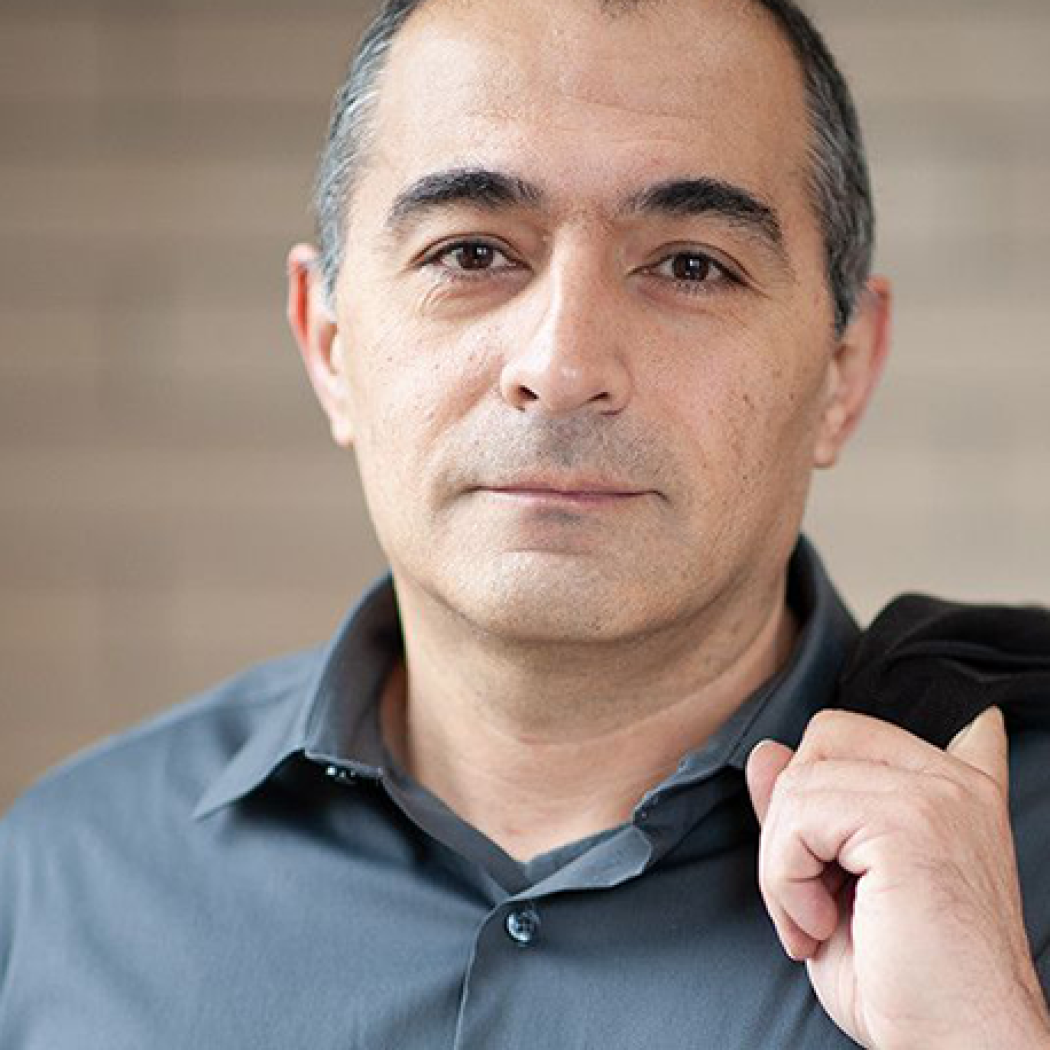
Nader Hashemi
Author
15
APPEARANCES
11
PODCASTS
Oct 2, 2026

Nader HashemiGUEST
Um, when that document was signed and, and written, there was overwhelmingly, um, celebrations in the street of s- streets of Iran, um, a- and, and strong support among Iran's human rights and pro-democracy community because they realized by, you know, by removing the threat of external war, uh, internal conditions for struggling against the authoritarian regime would, would open.
Nader HashemiGUEST
Uh, Trump imposed crippling sanctions, largely at the behest of, you know, um, um, uh, pro-Israel supporters in the United States, largely because, you know, also because he was just very jealous of, of Barack Obama.
6 MINS LATER

Peter BeinartHOST
Nadar, I'm curious what you think about this idea of [clears throat] that, that the war could have produced regime change in Iran and, and then, and, and maybe if, if U- the US had gone along with this Israeli plan of trying to arm insurgents inside Iran.


Ian MastersHOST
But I'm wondering whether or not this is more about Trump's personality and after the elections, he'll feel free to go ahead and bomb the hell out of Iran.
Nader HashemiGUEST
Well, Ian, I'm hearing similar things, although your sources are much more solid than mine.
Nader HashemiGUEST
I'm just interpreting what I'm seeing on the ground and what I'm hearing from both sides.
Nader HashemiGUEST
I think his policies, both domestically and internationally, are driven by his ego and by how he's perceived in the public domain.
Nader HashemiGUEST
All of this talk about his obsession with this ballroom at the White House, which seems to be something that he's much more interested in than solving domestic and international problems, speaks to the point that I'm making.
Nader HashemiGUEST
Recall just recently what Donald Trump said at the United Nations, where he threatened once again to obliterate Iran.

Omar ShakirMODERATOR
But Can you just flesh out a little bit more about what you argue in that piece and what you feel like U.S. pressure on Iran, how does it relate to domestic movements against the very real repression of the regime?
Nader HashemiGUEST
Yeah, so what I was trying to argue in that piece in Foreign Affairs was to reflect upon the domestic consequences for the internal struggle for democracy in Iran that this war is producing.
Nader HashemiGUEST
And if you study the academic literature on democratic transitions, internal struggles for democracy, Scholars agree that there are a set of internal preconditions for democracy that overlap with a certain level of modernization, a certain level of education level, sizable middle class, the existence of an administrative state, a suitable political culture where most of the participants agree to the rules and procedures of democracy.
Nader HashemiGUEST
And I argued in my piece that if you go through all of those preconditions internally, most of them are actually in place in Iraq.
21 MINS LATER
Omar ShakirMODERATOR
Who on the panel wants to take that one?
4:22

Is Tehran still using that pressure to get back to a deal or has prolonged confrontation become part of the strategy itself?
Nader HashemiGUEST
The official Iranian position is that they want to return to the June 17th Memorandum of Understanding that was signed between the United States and Iran.
Nader HashemiGUEST
And if you look at that document, Article 5 of the document, in fairly clear terms, explicitly says that Iran is supposed to manage shipping through the Strait of Hormuz.
Nader HashemiGUEST
The United States was not, even though they signed onto the document, I think they thought it meant something else.
Nader HashemiGUEST
There's different interpretations over the meaning of particularly that article.
8 MINS LATER
13:01
How much influence can countries outside the immediate conflict actually exert on Washington and Tehran?

Nader HashemiGUEST
We have had the usual ups and downs of the news cycle, from natural disasters to royal weddings, and I am deeply grateful to the many of you who have stayed with us through it all.
5 MINS LATER
Karen SciolinSOUNDBITE_SPEAKER
In your estimation, who moves first then?
Nader HashemiGUEST
Um, the one issue that's in the background here is the looming Israeli elections that are gonna happen in October.
Nader HashemiGUEST
Uh, Netanyahu has no chance of getting, uh, reelected if he's perceived to be soft on Hamas, uh, which is why since Trump made the announcement last week, um, close to three dozen Palestinians have been killed just in the last week, um, in Israeli attacks on Gaza.
Nader HashemiGUEST
So because of this election that's supposed to happen sometime in, let's say, October, um, I don't see the Israeli government under Benjamin Netanyahu, uh, making any concessions, um, uh, along the lines of respecting the terms of the ceasefire.

Caryn CeolinHOST
Do you think there is a world in which, you know, by accepting disarmament, Hamas is acknowledging that its strategy has failed?
Nader HashemiGUEST
Um, in fact, there was an interview just yesterday with Piers Morgan where a leading Hamas, uh, uh, official was asked that precise question.
Nader HashemiGUEST
Like, "Hasn't your strategy failed? Look what's happened to you." Um, and he refused, of course, to concede the point.
Nader HashemiGUEST
But I think objectively speaking, you know, the Palestinians, um, um, their, their national movement, both the secular version and the religious, uh, as- uh, uh, aspect of that national movement, find themselves in very tough conditions.
Nader HashemiGUEST
One, they're [clears throat] dealing with a formidable adversary that's one of the largest military powers in the world, backed by the superpower, uh, the lone-- one of the remaining superpowers in the world, backed by the West.
18 MINS LATER
Caryn CeolinHOST
Y- you know, i- is that tantamount to surrender, or do you think Hamas could still be strong enough to maintain its, its coercive power over Gaza in the future?
Nader HashemiGUEST
The end of time scenario that you hear sometimes coming out of the Islamic Republic of Iran is not a worldview that shapes national policy and security policy.
Nader HashemiGUEST
It's a line they feed to their most loyal and devout observers, which is a small percentage of the population to keep them on board.
Nader HashemiGUEST
This is very much a regime that wants to stay in political power because they're benefiting from a certain authoritarian system, and they don't want to give up power.
Nader HashemiGUEST
A regime doesn't last for 47 years if it's driven by irrational sort of end of time scenarios.


Rani SamtaniHOST
So then what are the options on the table? I mean, what does this mean for countries that have ships waiting to pass through?
Nader HashemiGUEST
Well, those countries are, um, gonna have to keep those ships in place because there's an active war going on, and Donald Trump has just announced that he's, um, you know, putting a blockade on Iranian ports, and Iran is gonna, um, um, a- assert its control over the Strait of Hormuz.
Nader HashemiGUEST
So those countries that have ships are stuck until this war is resolved, and it's not just those countries that have ships in the, uh, Persian Gulf.
Nader HashemiGUEST
Um, uh, global inflation is increasing, and of course, the price is being paid by the poor and the vulnerable people on this planet, who are, um, um, gonna pay the immediate price, um, because of costs of energy.
6 MINS LATER
Rani SamtaniHOST
W- what d- what leverage do both sides have to keep this war going? And how much longer can we keep it going? How much longer can both sides sustain?
Nader HashemiGUEST
I believe there is going to be a compromise, and it's going to be a compromise in Iran's favor.
Nader HashemiGUEST
Because the way this war ended, Iran was able to outlast not just the American and Israeli attempt at regime change, but when the United States put a blockade on Iranian ports, there was effectively a standoff, a game of chicken to see who would blink first.
Nader HashemiGUEST
There were political reasons related to the lack of support within the United States with respect to this war.
Nader HashemiGUEST
And so Iran believes it has a much stronger position to assert its will And to flex its muscle and from Iran's perspective, it's the Strait of Hormuz that gives it leverage over the United States and the talks that are slowly starting to take shape with respect to all of these outstanding issues that separate the United States and Iran.
5 MINS LATER
Ian MastersHOST
But Hezbollah is not going to agree to its own extinction, right? So how are they going to work that one out?

Peter BeinartHOST
And Nader, I wonder if I could just ask you kind of to talk at a broad level about how you think Iran's role in the Middle East may be different as a result of this war.
Nader HashemiGUEST
It's tough to make any definitive conclusions now because we're still in the early phases of this war.
Nader HashemiGUEST
One thing that has jumped out in my mind that appears pretty accurate as a significant development is that Iran has been able to increase its soft power influence in the region, particularly at the local level.
Nader HashemiGUEST
After the Arab Spring, Iran took a huge hit by virtue largely of its catastrophic intervention in Syria to bolster the regime of Bashar al-Assad and the previous sort of soft power influence that it had on the so-called Arab street as the leading voice of anti-imperialism, anti-Zionism.
36 MINS LATER
Peter BeinartHOST
I'm curious what you're hearing in terms of how people are making sense of this moment and how that scrambles the thinking of Iranians at home and abroad who wish for a different kind of leadership.


Nader HashemiGUEST
So Donald Trump, uh, at the encouragement of Netanyahu, sort of, uh, thought that this would be, uh, the time to bring Iran down into s-- break it down into size, weaken it.
Nader HashemiGUEST
I think the broad goal here that the United States and Israel and Western countries, uh, sort of share, um, is, uh, preventing Iran from, um, projecting power beyond its borders, weaken it, weakening, uh, Iran militarily, economically, so that Iran becomes something like Libya, Lebanon, or Syria, um, a weak state that can barely control its own borders, but critically cannot project power beyond its borders, thus allowing for an Israeli-centric and Arab dictatorial-centric sort of regional order to take shape in the Middle East along the lines of the Abraham Accords that were, you know, announced in 2020.
Nader HashemiGUEST
Um, and Donald Trump, of course, you know, thought in his great naivety and stupidity that Iran was like Venezuela.
Nader HashemiGUEST
You know, you just, you know, send an armada to Iran's shores, and the regime will collapse.
59 MINS LATER


Jen WhiteHOST
What stands out to you in what you heard Prime Minister Netanyahu say there and other rhetoric he's used around this war?
Nader HashemiGUEST
Uh, the, the, the religious references might be different, but the driving forces behind what Netanyahu is saying is not that dissimilar from what we're hearing and seeing in the United States.
Nader HashemiGUEST
In other words, the driver of these statements by Netanyahu and American politicians, the driver of it is, um, uh, geopolitics.
Nader HashemiGUEST
It's about a sense of a, a desire for, you know, a contestation over political power in the Middle East and who will be dominant, who will be hegemonic.
Nader HashemiGUEST
Uh, they're using religion and religious references as a tool for mobilizing people to, um, validate and promote those very secular political causes.
Nader HashemiGUEST
So in that sense, what Netanyahu is saying here is not that different than what we've been talking about here in the United States.
Jen WhiteHOST
But Nader, I'm curious how you view that choice, both through a political and religious lens.

Jamie PoissonHOST
These kinds of images are viewed with a tint of romance and nostalgia, but d- does that tell the whole story?
Nader HashemiGUEST
All of those things that you described are true and accurate, but I think one needs a deeper understanding of, of how these things were playing, playing, playing out in Iranian society and who was really benefiting and who wasn't.
Nader HashemiGUEST
So yes, the Shah of Iran that's restored to power by the Americans after the coup is a very pro-American, pro-Western...
Nader HashemiGUEST
You know, he spent most of his time at a boarding school in, as a young man in Switzerland, speaks fluent English and French, and he is very much America's man on the job in the Middle East, and he pursues a policy of modernization.
12 MINS LATER
Jamie PoissonHOST
Mm.
Caryn CeolinHOST
But politically speaking, does the Supreme Leader's demise create an opening for the Iranian people to realize their democratic aspirations?
Nader HashemiGUEST
Unfortunately, no. Um, I think we-- everyone who's knows anything about Iran, cares about Iran realizes this is a, this is a very brutal and ugly regime with a horrific human rights record.
Nader HashemiGUEST
Uh, in early January, they committed a horrific massacre on par with the 1989 Tiananmen Square massacre in China.
Nader HashemiGUEST
But the, uh, political reality of, um, the regime that's in power in Iran is that it's not like, uh, Muammar Gaddafi's Libya, Bashar al-Assad's Syria, or Saddam Hussein's Iraq.
Nader HashemiGUEST
Power isn't concentrated in the hands of one person, so if you, you know, remove that person, then the entire system crumbles.
7 MINS LATER
Caryn CeolinHOST
And, you know, while Iranians have been very brave and, and willing to protest and, and risk their lives for a better future, I mean, how could ordinary Iranians at all heed the US president's call to overthrow their government?

Nader HashemiGUEST
So, um, uh, last Monday, exactly a week ago, um, in the afternoon, um, some of the staff that work at my center noticed some suspicious men hanging outside.
Nader HashemiGUEST
We now believe these were federal agents trying to arrest, uh, Badr Khan Suri outside of his classroom.
Nader HashemiGUEST
Um, but roughly around 8:00, uh, last Monday, as he was returning home after he broke his fast, um, agents arrested him.

Amy GoodmanHOST
Um, can you respond to what she's saying and then talk about Georgetown's response?