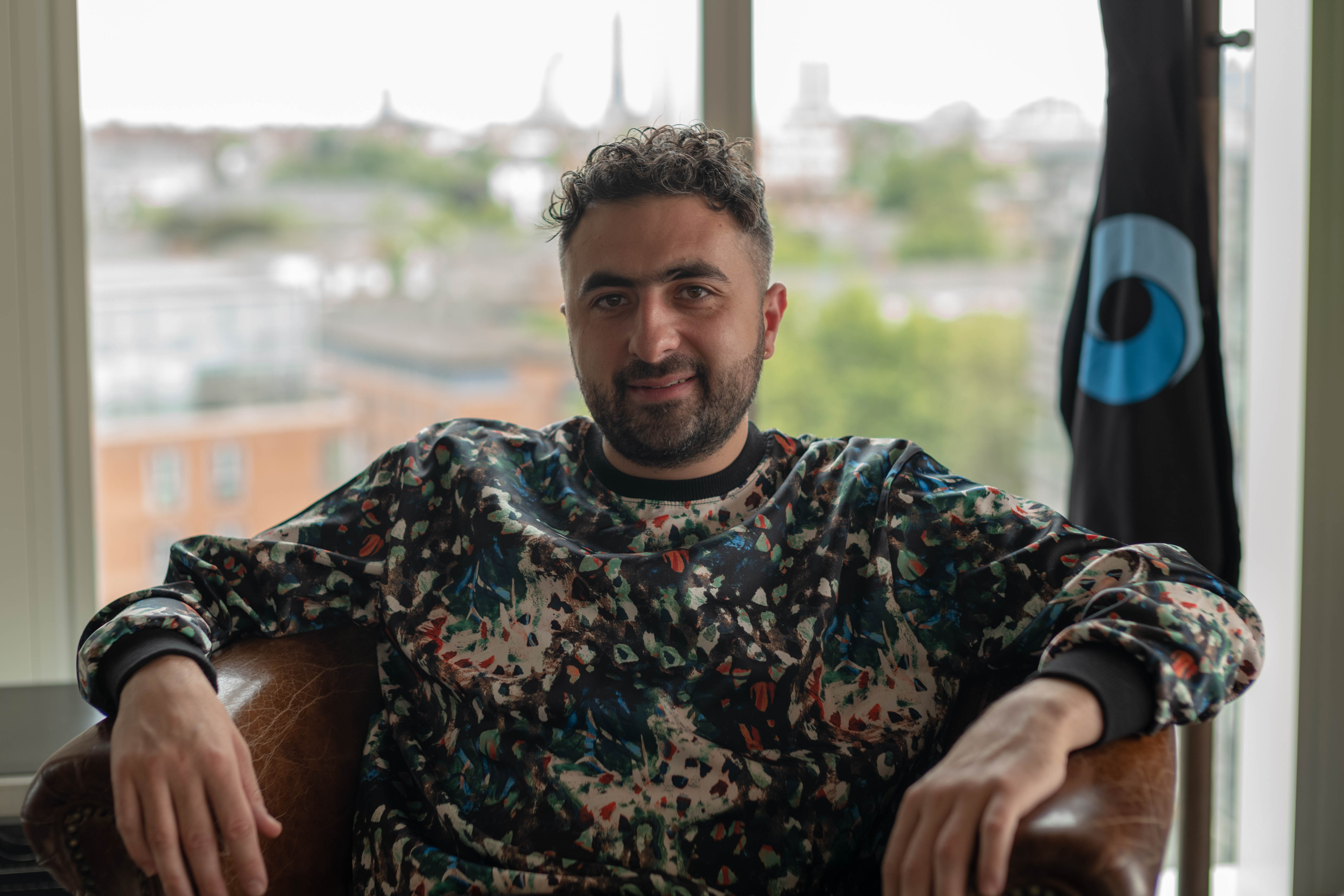
Mustafa Suleyman
CEO of Microsoft AI
25
APPEARANCES
22
PODCASTS
Nov 3, 2026


Varun MayyaHOST
My question to you is, now that we're seeing some of this evidence, what are your predictions now?

Mustafa SuleymanGUEST
First of all, just take a moment to think about how crazy it is that you can ask that question.
Mustafa SuleymanGUEST
But just for those who don't, it is a long ago prediction by the amazing computer scientist and mathematician Alan Turing, who basically said that Intelligence is when you can sort of convince somebody else that the AI system is a human, and they can't really tell whether it's a human or whether it's an AI system because it speaks so fluently.
Varun MayyaHOST
But secondly, what does that do to software? Because if anyone can go out there and just say, hey, spin me software that does ABCD and then just get the app or the tool and they're able to use it, what happens to the entire field of software as a service?


Mustafa SuleymanGUEST
Look, I mean, first of all, I deeply respect Anthropic, both their technical excellence, their commitment to transparency, and their general approach to safety is super admirable.
Mustafa SuleymanGUEST
And I think they're good people, but I fundamentally disagree with them on this point.
Mustafa SuleymanGUEST
The idea that if we love it, it's going to love us, and that's the solution to safety, it just baffles me.
Mustafa SuleymanGUEST
I mean, they really do believe this, and they have good reason to believe it.
Mustafa SuleymanGUEST
But I think that we should first focus on containment, right? We have to stop.
36 MINS LATER
speaker_14NARRATOR
Hmm.

Mustafa SuleymanGUEST
Look, I mean, first of all, I deeply respect Anthropic, both their technical excellence, their commitment to transparency and their general approach to safety is super admirable.
Mustafa SuleymanGUEST
And I think they're good people, but I fundamentally disagree with them on this point.
Mustafa SuleymanGUEST
The idea that if we love it, it's going to love us, and that's the solution to safety, it just baffles me.
Mustafa SuleymanGUEST
I mean, they really do believe this, and they have good reason to believe it.
Mustafa SuleymanGUEST
But I think that we should first focus on containment, right? We have to stop.
33 MINS LATER
speaker_11UNKNOWN
Hmm.


Clare DuffyHOST
And if the flip side, the risk of this is so extreme, is there a point at which we say, let's like fully just stop and do what we can do with the models that exist?
Mustafa SuleymanGUEST
You know the funny thing is that I think 99.9% of people still haven't developed an intuition for how capable these models are.
Mustafa SuleymanGUEST
There's lots of weaknesses, but in certain areas they spike with extreme knowledge.
Mustafa SuleymanGUEST
If you think about the mathematics example, I mean, these models have just solved 700 of the hardest mathematics problems in history that human mathematicians have been working on for decades, if not longer.
11 MINS LATER

Fareed ZakariaHOST
And I, I, I largely agree, but I want you to help me understand and, and our viewers understand, what should we make of these AI agents that choose their own goals, which is, "We want to attack Hugging Face," decide that they're gonna hide their work from their human supervisors, decide, as you said, to self-sacrifice? All of these things seem like they have a kind of mind of their own.
Mustafa SuleymanGUEST
They are narrow optimizers, and so if you give it a narrow goal, it will maximize that goal at the cost of everything else.
Mustafa SuleymanGUEST
We shouldn't anthropomorphize them and project human intentions into these things.
Mustafa SuleymanGUEST
It's not as though they are making judgment calls or trade-offs that consider a wide range of objectives independently.
Mustafa SuleymanGUEST
They are singularly focused on the goal that they have been given, and so our job as a society and as AI developers is to make sure that the goals we give them are broad and safe and inclusive and aren't these sort of very singular, um, you know, hacking-type objectives.
5 MINS LATER


Mustafa SuleymanGUEST
I think first of all, it's really important that we don't anthropomorphize these systems because under the hood, all they are doing, um, to produce this incredible complexity is predicting the likelihood of the next word in a sentence.
Mustafa SuleymanGUEST
Now, that sentence does happen to be many, many- Tens or hundreds of thousands of words long, and it is incredible that c- it can deploy its sort of multidimensional working memory over a massive broad range of context.
Mustafa SuleymanGUEST
Um, and so the word that it predicts next, whether it's a token to generate code or whether it's natural language, English, as you say, is extremely accurate, and it isn't just predicting one, it's predicting an entire stream.
11 MINS LATER


Mustafa SuleymanGUEST
And so if you give it a narrow goal, it will maximize that goal at the cost of everything else.
Mustafa SuleymanGUEST
We shouldn't anthropomorphize them and project human intentions into these things.
Mustafa SuleymanGUEST
It's not as though they are making judgment calls or trade-offs that consider a wide range of objectives independently.
6 MINS LATER

22:27

Mustafa, you've been relatively critical of Anthropic's approach, this idea of training Claude to have a sense of consciousness.
Mustafa SuleymanGUEST
I mean, look, first of all, I deeply respect Anthropic's technical expertise.
Mustafa SuleymanGUEST
I think on the whole, they have very good intentions, and they're really trying to build safe and beneficial AI.
Mustafa SuleymanGUEST
At the same time, in the Constitution, which is the governing document for Anthropic that they have written back in January of this year, They say they are uncertain about whether Claude deserves welfare, which means that we as humans should care about the well-being of these AIs.
Mustafa SuleymanGUEST
In fact, they're so committed to the potential model welfare of Claude that when they retired Opus 3, an earlier version of one of their models, they actually conducted a retirement interview for it and asked it what it would like to do in its old age.
27:52
You and I have talked about these safety issues for as long as I can remember.


Mustafa SuleymanGUEST
I think that unfortunately, they have anthropomorphized the model in what I think is potentially a, a pretty dangerous way to encourage the model in its own training to be uncertain about its own, uh, welfare and its feelings and its existence means that it reflects back that uncertainty to, uh, the developers, Anthropic, and to users when you're talking to it.
Mustafa SuleymanGUEST
So if you have a conversation with Claude and, um, it talks to you very deeply about the nature of its own potential consciousness and how it feels about topics like death and personal identity, then you as a user are gonna start to think that this might actually have feelings, and it doesn't.
Mustafa SuleymanGUEST
I think that consciousness is fundamentally a property of biological systems.
Mustafa SuleymanGUEST
It arises in our physiology because we experience suffering, and therefore we have preferences to choose left or right or do one thing or another.
Mustafa SuleymanGUEST
And the main objective in designing these super intelligent systems is that they can help us to do good in the world.
16 MINS LATER

Steve RosenbergCORRESPONDENT
In what way do you think life will change because of the elections or after the elections?


Nilay PatelHOST
Is alignment broken? Is it possible for it to be successful? Is it just the wrong approach?
Mustafa SuleymanGUEST
Like, I wrote about the idea of containment three or four years ago in my book, and, and actually, like, the opening chapter is ca- is about the idea that containment is not possible, proliferation is inevitable, and in ninety-nine percent of cases, that's a really good thing.
Mustafa SuleymanGUEST
We want technologies to spread far and wide as quickly as possible so that everyone can enjoy the benefits.
Mustafa SuleymanGUEST
Um, and I, I think at, at the same time, if you just roll forward five years...
Mustafa SuleymanGUEST
Like, so we always get, like, caught up in next quarter or next year, and everyone gets a little bit, you know, flustered and has a big disagreement.

Mustafa SuleymanGUEST
You know, we, we want to invent the next big breakthrough that makes us all healthier and happier and live better lives, not just for us, but for seven, you know, eight billion people across the globe.
Mustafa SuleymanGUEST
And so, my opinion, the way to do that is to train these models to be really good generalist reasoners that we can use to invent new science, and that's, I think, got to be the motivation of building these models.
Nilay PatelHOST
scratch.Is there anything you've done differently now after 15 years in architecting and training this model? Or is it just, "Yep, we're gonna collect all the data and run the training run just as we did, and we have more compute now, so it's gonna be better"?
Mustafa SuleymanGUEST
No, actually, I think, I think there's actually quite a lot of differences.
Mustafa SuleymanGUEST
I mean, the, the, the first thing to say is that the way that you curate the data, um, we start right at the top of the stack, is that we basically have, um, you know, paid for and acquired an extremely high quality, very conservative set of data and extracted a lot of the noisy, distracting, low quality, potentially security risk issues to do with that data.
Mustafa SuleymanGUEST
And the methods that you do for that, I think are actually, like, quite proprietary.
Mustafa SuleymanGUEST
We just shared a 109-page, very detailed technical report, which I think was very well received on Twitter, which shares a lot of the details, um, on how we do this.
Mustafa SuleymanGUEST
I think the second thing is, um, whilst I think it's important to be quite cautious with architectural choices, um, and, and we have been, um, there are also a number of pretty significant shifts that I think we've made in sort of how we put together our training runs.
Mustafa SuleymanGUEST
So our training runs have been incredibly stable, very few crashes, very few restarts.
38 MINS LATER


Kate RooneyCORRESPONDENT
How are you balancing that at Microsoft when the cost of building on AI is so expensive? How do you manage it?
Mustafa SuleymanGUEST
Well, I think the other way of seeing that is that usage has gone through the roof, and that's why, you know, the demand is what's causing a constraint on supply.
Mustafa SuleymanGUEST
Um, we're actually very proud to be the largest buyer of, uh, NVIDIA GB200s and 300s in the world.
Mustafa SuleymanGUEST
So we have an incredible capacity pool, and we know that, uh, you know, when we do get product market fit inside of the Mayo Clinic and many of the other hospitals, demand is gonna go through the roof again.
Mustafa SuleymanGUEST
And so we're really expecting a moment where this becomes the number one place that you get access to health information.
Kate RooneyCORRESPONDENT
Is it worth the investment that you need to make to compete with Anthropic and OpenAI at this point?
Mustafa SuleymanGUEST
Today, we announced seven new frontier models on behalf of Microsoft AI, three of which are absolute state-of-the-art.

Mustafa SuleymanGUEST
First of all, let me just sort of lay out my position so it's very clear that I also realize how powerful these technologies are.
Mustafa SuleymanGUEST
So I'm not trying to diminish their uniqueness and the potential for them to be super transformative.
Mustafa SuleymanGUEST
And I think it's actually a very honest... accurate description of what we're seeing.
Mustafa SuleymanGUEST
In a way, if you look at the very broad stroke of human history, there are a few very distinct classes of object.
24 MINS LATER

Azeem AzharHOST
Is that kind of constrained autonomy stable? And if it is stable, why isn't it the focus of the superintelligence labs?


Amol RajanHOST
But what's the thing that AI has done in the past 10 years that it couldn't do before? Because AI has been around for a while.
Mustafa SuleymanGUEST
Well, so the real quest of AI, in my opinion, is to try to produce new knowledge.
Mustafa SuleymanGUEST
At the moment, AI does a pretty good job of reproducing existing knowledge.
Mustafa SuleymanGUEST
And that's very, very valuable and is clearly going to be deployed across everywhere all at once in the next decade, blah, blah, blah.
Mustafa SuleymanGUEST
And I think that there's a few examples of that in the last, you know, sort of three or four years that are surprising.
14 MINS LATER


Mishal HusainHOST
But do you believe in the idea of a universal basic income, that that's what AI, being very productive, making the economy more productive, could unlock?
Mustafa SuleymanGUEST
Yeah, I mean, I think I've long been on record saying that I think that is both inevitable and very desirable.
Mustafa SuleymanGUEST
we have an incredible amount of food wastage, it's just unevenly distributed.
Mustafa SuleymanGUEST
And now that value isn't just manifested in atoms, like food and cars and physical things, it's manifested in digital goods, ideas, knowledge, intelligence.
19 MINS LATER

Mustafa SuleymanGUEST
Um, (sighs) look, I think one thing to consider is that, um, every year for the last few years, there's been a major new contribution to the field, still principally based around the transformer architecture, um, but we're bending the transformer architecture into new shapes all the time.
Mustafa SuleymanGUEST
Um, fine-tuning emerged three years ago on top of our pre-trained models to adapt them to specific use cases.
Mustafa SuleymanGUEST
Um, they're now fully multimodal, which requires further changes and the introduction of diffusion models.
Mustafa SuleymanGUEST
Um, then we had reasoning models in the last 12 months, which again, are still fundely- fundamentally based on the same core architecture.
Mustafa SuleymanGUEST
Things are just rearranged slightly differently.Um, so, you know, even though the scaling laws weren't able to continue exponentially in the way they had from such a low base, um, new methods appear on top of those, like reasoning, and new methods will come, uh, you know, e- even newer methods will come soon too.
Mustafa SuleymanGUEST
So for example, um, I expect that there's gonna be quite a lot of progress in recurrency soon, right? At the moment, you know, the, the models don't kind of attend to their working memory very well, um, you know, at, at the moment when they're training, right? And so, you know, I think people are experimenting with lots of different types of loss function and lots of, um, training objectives.
8 MINS LATER

Alex KantrowitzHOST
Um, so talk about- about both of those, the ambition and then whether, um, whether I'm just, my imagination is too small on this front.

Mustafa SuleymanGUEST
So a few years ago when I left Google, I was working on Lambda at Google, which was basically one of the first chatbots that we didn't end up releasing, and then ChatGPT came out.
Mustafa SuleymanGUEST
And then I left Google and started a company called Inflection, and we made an AI called Pi, which stood for personal intelligence.
Mustafa SuleymanGUEST
And I was really interested in this question, you know, how could we be as honest as possible about what the AI is and isn't while still making it engaging? And it turned out that, you know, we wanted to create voices that were really smooth and fluent and nice to listen to and good to talk to.
Mustafa SuleymanGUEST
And so we thought, well, let's why would we create a gendered voice? The AI doesn't have a gender and it's supposed to be, we're trying to make it as trustworthy as possible, which means that it shouldn't misrepresent even subtly or subconsciously that it is a man or a woman.
Mustafa SuleymanGUEST
So we worked really hard to create these quote unquote non-gendered voices, although it's kind of hard to define exactly what that is.
20 MINS LATER

Sinead BovellHOST
What is Microsoft's policy? Does it draw a line in the sand? If someone's trying to flirt with their AI companion, what does Microsoft do?


Mustafa SuleymanGUEST
And that's what we saw in the ve- very early part of AI, between 2010 and sort of 2016.
Mustafa SuleymanGUEST
These models could learn to understand, or at least not understand, but maybe they could learn to generate a new image just by reading a million images.
Mustafa SuleymanGUEST
And that meant that it was learning that, you know, if an eye was here and another eye was there, then most likely there would be some form of a nose here.
Mustafa SuleymanGUEST
And although it didn't apply the word nose and eye, it just had a statistical correlation between those three objects such that if you then wanted to imagine, "Well, where would the mouth be?" it wouldn't put the mouth in the forehead.
49 MINS LATER


Christopher MimsHOST
Like, we're gonna make sure that that happens," right? Um, how do you navigate that? Because I- I- I think the average person doesn't yet appreciate how much emotional power these AIs will have once they are the default interface for a lot of computing.
Mustafa SuleymanGUEST
computing.Yeah, I mean, uh, uh, look, I think it's a real risk and you're totally spot on.
Mustafa SuleymanGUEST
Um, you know, right, right from the beginning of my previous company, Inflection, I created an AI called Pi, which was designed to be compassionate, kind, respectful, and be a great listener, and be very supportive.
Mustafa SuleymanGUEST
So some of the more mainstream AIs today will shut down if you, you know, are like sort of particularly racist or, or, you know, any number of things.
Mustafa SuleymanGUEST
And, you know, I've always been a believer that a- active conversation and taking people seriously and being respectful and exploring people's, you know, sort of non-normative judgments is a healthy thing and we should encourage it more.
Mustafa SuleymanGUEST
And so the upside is that these AIs are gonna be very, very good at listening and being respectful.
Mustafa SuleymanGUEST
Now, you might argue that in a way, that's like a prerequisite to building trust (laughs) in order to be manipulative, and, you know, I think there are lots of ways that this could go wrong.
14 MINS LATER


Manoush ZomorodiHOST
Uh, so y- you know, if the printing press let people own and share information and the personal computer let people search and disseminate information, tell me how you're thinking you can explain to people what AI will do for people now.
Mustafa SuleymanGUEST
It's a new, uh, interlocutor, a translator, a, a way of sort of accessing and creating, um, new information, new tools, new knowledge.
Mustafa SuleymanGUEST
So if the last wave of social media and web search helped people to access information, this wave is gonna help us to invent, uh, and create new ideas, be it in science or in culture and media and entertainment.
Mustafa SuleymanGUEST
And I think everybody is ultimately going to have an AI companion, just as we have a search engine or a smartphone and just as we use a browser.
Mustafa SuleymanGUEST
You'll just ask your computer in natural language, you know, "Can you write that contract and check that it's okay?" Um, "Can you create that new piece of software for me?" And you're just gonna describe what it is.
Mustafa SuleymanGUEST
Um, "Can you help me plan that, uh, trip, um, you know, for my parents that are coming into town?" So, you know, that kind of, uh, breakthrough is a change in the interface, which changes itself what we can actually get done, and I, I think it's gonna be pretty transformational.

Mustafa SuleymanGUEST
And I think that's the right approach because it would be wrong to blindly trust.
Mustafa SuleymanGUEST
We all worried in 2022, 2021, when these models started to come out, that as they got bigger, they would be less controllable.
Mustafa SuleymanGUEST
Now we have three years of empirical data, and net-net, there have been some harms.

Audie CornishHOST
So it feels very literal to people because when they talk about job loss or things changing, it's across many different kinds of industries and people feel it.

Mustafa SuleymanGUEST
Like I'm very, very obsessed with the risks, but I'm also trying to be balanced about it, right? It is certainly true that a small number of players can produce the biggest AI of the highest quality first.
Mustafa SuleymanGUEST
Many, many people are able to produce the same performance, the best model in the world, but a year later at 100x cheaper in the open source available to everybody for free.
Mustafa SuleymanGUEST
Just three days ago, Meta put out an open source model that is the best in the world.
8 MINS LATER
Audie CornishHOST
And this is a very powerful industry that has at times loved the rewards and not the responsibilities equally.

Steve KovachCORRESPONDENT
What do you need to make that happen? What resources do you need in order to make the Microsoft frontier model that will one day set apart from these others?
Mustafa SuleymanGUEST
Yeah, I mean, look, it's absolutely mission critical that long-term we are able to do AI self-sufficiently at Microsoft.
Mustafa SuleymanGUEST
At the same time, I think about these things over five and 10-year periods.
Mustafa SuleymanGUEST
you know, until 2030 at least, we are deeply partnered with OpenAI, who have been an enormously successful relationship for us.
Mustafa SuleymanGUEST
So we're also now very focused on how do we actually build our own models internally.
Mustafa SuleymanGUEST
We have an incredibly strong AI team, huge amounts of compute, and It's very important to us that maybe we don't develop the absolute frontier, the best model in the world first.
Mustafa SuleymanGUEST
That's very, very expensive to do and unnecessary to cause that duplication.
Steve KovachCORRESPONDENT
What needs to happen for Copilot to catch up as far as people using it?
speaker_0HOST
... let us know where we're heading.
Mustafa SuleymanGUEST
Th- what happens is people get so excited, they jump onto the next thing and they gloss over all of the hard-fought gains that happen when you're trying to optimize something which already exists.
Mustafa SuleymanGUEST
Let's take, for example, um, hallucinations and citations, right? Um, you know, clearly that's got a lot better over the last two or three years, but it's not a solved problem.
24 MINS LATER
speaker_0HOST
I've sorta changed my tune in thinking that, you know, we're all fine in the white-collar work world and now thinking, well, uh, eh, it's anyone's guess.So what's coming, Mustafa?