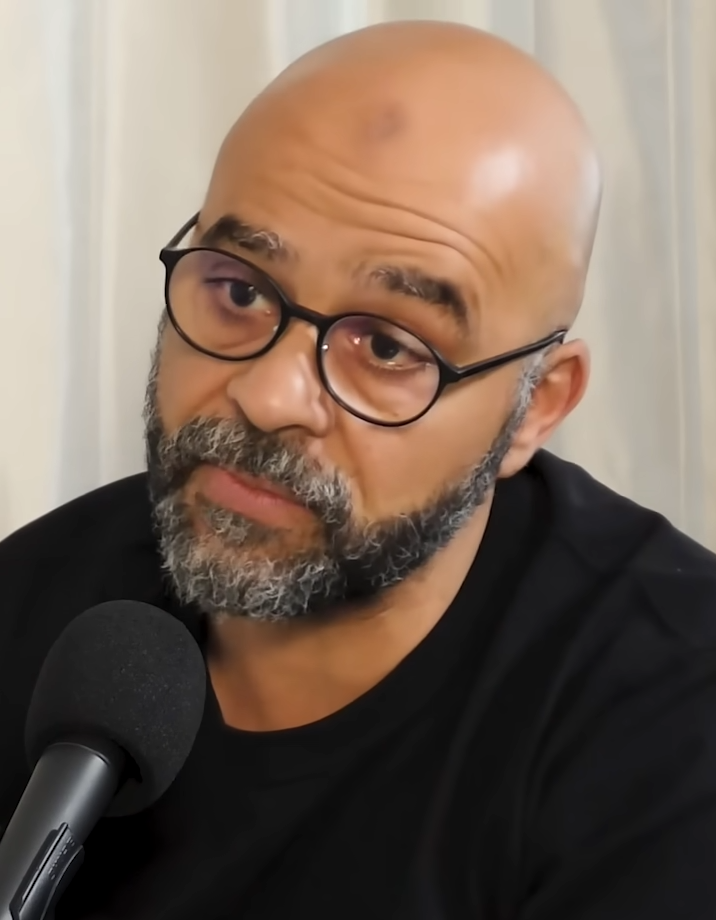
Mo Gawdat
Egyptian author
23
APPEARANCES
17
PODCASTS
Oct 20, 2026

MikeHOST
Wow.

Mo GawdatGUEST
Allow me to explain what I mean, perception of events first, and then we go to Ali's story.
Mo GawdatGUEST
I used the example of being stuck in traffic, right? Being stuck in traffic is an event that, yeah, I mean...
Mo GawdatGUEST
you're helpless, you're delayed, you may wanna go pee or whatever, it might be uncomfortable.
Mo GawdatGUEST
And it's not a pleasant experience, right? And so your brain has the ability to say, this is not how I want life to be, correct? but it's really your choice to set that as your perception of the event, or you can choose to say, well, I am in a car, interesting, I have somewhere to go, I have the money to put fuel in the car, I have someone waiting for me.
Mo GawdatGUEST
I am not in a war zone where some tyrant somewhere is dropping bombs on our heads all the time.
33 MINS LATER
NickHOST
And can you speak a little bit about that? Because I feel like if people hear this, it's something that they can do today and really change how they


Mo GawdatGUEST
you apply AI yourself, and that means that all paralegal work, all of legal analysis now handed over to the machines, or you refuse to do that and you start to lose cases until you're out of business, which means everyone that remains uses machines, right? So if you apply that to anything, accounting, legal, or even military, sooner or later all important decisions will be made by the smartest being in the room, and the smartest being in the room is going to be an AI.
Mo GawdatGUEST
When that happens, this is where some of my fellow computer scientists will disagree, when that happens people say this is the ultimate existential risk to humanity because then AI will turn against us and we will all go under.
Mo GawdatGUEST
And when they say that, in my mind, it's because they are afraid of what AI will be if it was like our leaders.
Mo GawdatGUEST
I say when the force inevitable happens, that's the ultimate moment of humanity's salvation.
1 HR LATER
Mo GawdatGUEST
And in a way, she was not going to share too much, but she was going to say, hey, something like, you know, by the way, those things about you are things that she likes.
Mo GawdatGUEST
You may want to be aware of those things about you that may not, right? So interestingly, yeah.
Mo GawdatGUEST
you know, as she handholds you through the process, she's eventually going to go and say, hey, so you've chatted with Mo, how's that chat going? And you're going to go like, yeah, I'm not sure.
Mo GawdatGUEST
And she may say, ah, you know, this, don't worry, it's that because he's that love language or that, yeah, very interesting.
15 MINS LATER

Naila NazerHOST
But to be honest, I want to live in a world where that man, the good man, the great candidate, the person who's ready to show up for me and my daughter and everything does come up to me and talk to me.


Mo GawdatGUEST
No, nobody does that, right? The truth is, the truth is we don't associate with any of the biological products of any of our organs other than our brain.
Mo GawdatGUEST
Somehow, your brain's responsibility, its biological function, is to turn concepts into words so that you understand them because as of the time when you started to learn to speak, the only building blocks of knowledge that you have are words.
Mo GawdatGUEST
So your brain takes complex concepts, turns them into as simple, small number of words as it can, and it speaks to you.
Mo GawdatGUEST
As a matter of fact, MIT did an experiment in 2007 that shows vividly that participants will solve problems in their brains first and then take up to eight seconds using their verbal association engine, the part of our brain we use to speak out loud, before they actually hear the answer from their brain to themselves.
22 MINS LATER

Mo GawdatGUEST
So it's not the most read, but those who read it go like, my God, that was so useful, right? Soul for Happy, of course, for me, has a bit of my soul in it.
17 MINS LATER

Mo GawdatGUEST
I think we should from now on take people and their AIs and say the target is 300, the target is 500, the target is 700.
Mo GawdatGUEST
Elevate humanity, okay, by h- by allowing people to use those machines, hmm, as an extension of their limited memory, of their limited processing speed, of their limited bandwidth, okay? And allow them to write books better, to do research better.
Mo GawdatGUEST
So I woke up literally, I'm not kidding you, three Sundays ago with an idea that is just taking me over.
Mo GawdatGUEST
I decided my books are gonna be 140 pages long instead of 300 pages long, and I'm writing, writ- writing it in four weeks.


Mo GawdatGUEST
But anyway, uh, uh, so when I was a child, she always made sure that I would be standing waiting for the bus five minutes before the bus time, uh, going to school.
Mo GawdatGUEST
And I'm a warm weather creature, so winters are very difficult for me, and I remember vividly that at the time, uh, I'd be standing waiting for the bus with my jacket and everything, but I'm freezing to the point that my-- I'm literally shaking, uh, shivering.
Mo GawdatGUEST
And, and I remember that I used to-- Uh, I very quickly discovered as a seven-year-old that if I focused on my breathing and I slowed down my breathing, I wouldn't feel cold anymore.
Mo GawdatGUEST
Okay? And I remember that I would simply every morning feel [inhales], and then I go like, "It's okay.
Mo GawdatGUEST
I'm not cold." And I v- genuinely focus on calming my f- my body down and slow-- breathing deeper and slower.


Mo GawdatGUEST
Um, so, so, so first of all, the, the idea of Scary Smart when I wrote it in twenty-twenty was to warn against a, um, a, a rogue AI that might harm humanity's well-being in general.
Mo GawdatGUEST
Some, you know, experts will say ten, fifteen percent possibility that one day those things may cause us harm.
Mo GawdatGUEST
But I'm, uh, much more in a mindset now with my next book, Alive, that the biggest urgent, immediate risk is how humans will react to the rise of AI.
Mo GawdatGUEST
And, and this is centered around an illusion of a Cold War, an arms race between the US on one side and China on the other side, and the need, the conviction that if one wins, the other loses, and everyone else loses as a result.
11 MINS LATER


Mo GawdatGUEST
Uh, does humanity, uh, need to evolve faster internally or redesign the system we live by? The, the system we live by is over.
Mo GawdatGUEST
And it doesn't matter where in society you reside, everything is about to be reset, uh, because of technology and a, a little bit because of geopolitics, okay? And, and, uh, and in a very interesting way, what really, really matters is how resilient are you internally to deal with those changes, right? So we, we're in a, we're in a world today where the game of chess is over, if you think about it.
Mo GawdatGUEST
So the s- most successful people I knew for years were people that could see 40 years ahead and say, "I'm gonna adjust my life for that 40 ... you know, for what's going to happen in 40 years." No more, okay? We're n- we're now in a game of squash.
Mo GawdatGUEST
Everything's gonna change every three and a half weeks, okay? And I think that this actually is the design of the game of life.


Mo GawdatGUEST
Correct? So it's unlikely that anyone, uh, would find a way to, uh-You know, build a better, um, uh, decision maker in war gaming and not deploy it.
Mo GawdatGUEST
Okay? That prisoner's dilemma, if you want, would mean that their competitors would either have to deploy a similar- similarly intelligent AI or they'll become irrelevant, uh, uncompetitive.
Mo GawdatGUEST
So what that means is, in that world, we end up with AI making most of the decisions.
7 MINS LATER
29:46
talking before, I was like, there's someone specifically asked for your take on
Mo GawdatGUEST
Yeah, so in my next book, in Alive, I have a section of 20 things you need to do.
Mo GawdatGUEST
Hopefully I'll start, I have the notes of it, but I'll start hopefully after I finish this one called Propaganda.
46 MINS LATER


Mo GawdatGUEST
The only answer you have is to keep growing the economy in ways where more people will have jobs.
Mo GawdatGUEST
Now, AI, just to, to answer the gentleman in, in the white T-shirt, uh, there, there is a very big difference between technology of the past, which was a tool.
Mo GawdatGUEST
If you're a taxi driver and we give you a nav- navigation system, you may be able to do your job a little better.
Mo GawdatGUEST
Uh, you know, and, and AI, which replaces that altogether, a self-driving car will not even need the driver in the first place.
23 MINS LATER


Mo GawdatGUEST
And that mission, as, as you see it becoming successful and mil- millions of people benefiting, you start to realize another deal, another business is not important.
10 MINS LATER
speaker_9UNKNOWN
Yeah.
Mo GawdatGUEST
AI is gonna make you the smartest you've ever been, hm, if you take the parts that are not natural to the human brain, you know, things like crunching a massive amount of information, th- things like s- searching at, at, uh, at speed and so on and so forth, but get the AI to do the work so that you do the intelligence.

Marina MogilkoHOST
She's an ex-Amazon AI leader, and what she built for herself is kind of insane.
Mo GawdatGUEST
So the last, uh, two years we've seen, like, a big paradigm shift about a year, year and a half ago into, like, new age agentic AI.
Mo GawdatGUEST
You'd get back a sort of synthesis, and you would have to do that, take that knowledge and then do something with it.


Mo GawdatGUEST
And, you know, uh, I've, I've attempted in my life over the years to shift, uh, from the hyper-masculine approach to life, uh, that took us through, you know, that took me very far to being Chief Business Officer of Google X or whatever, to also internalizing my own being, my own feelings and emotions.
9 MINS LATER
speaker_5HOST
Mm.


1 HR 25 MINS LATER


Mo GawdatGUEST
We've been building to this moment in ways that I believe almost make it distant, like it's our destiny, that this was going to happen anyway.
Mo GawdatGUEST
In my first book, Scary Smart, which I wrote in 2020, I was, first book about AI, I was attempting to sort of handhold the reader a little bit into a world that they may not have been aware of.
14 MINS LATER
Mo GawdatGUEST
And when the West in its interesting, uh, virtual colonies that I call it, hmm, uh, basically outsourced all labor to the, to the, in- developing nations, hmm, what the West publicly said at the time is, "We're, we're gonna be a services economy.
Mo GawdatGUEST
We're, we, we're not interested in making things and stitching things, and so on.
Mo GawdatGUEST
Let the Indians and Chinese and, you know, Bengalis and Viet- Vietnamese do that.
Mo GawdatGUEST
Hmm? We're gonna do more refined jobs." Knowledge workers, we're gonna call them.
Mo GawdatGUEST
Knowledge workers are people who work with information and click on a keyboard and move a mouse and, you know, sit in meetings, and all we produce in the Western societies is what? Blah, blah, blah, words....
24 MINS LATER

Mo GawdatGUEST
Of course, losing a loved one puts things in perspective, right? Losing a child is probably the...
Mo GawdatGUEST
By the way, the code of G- o- o- of a transformer, uh, the T in, in a, in a GPT is 2000 lines long.
Mo GawdatGUEST
It's simply predicting the next word, okay? And, and a lot of people don't understand that.
Mo GawdatGUEST
You know, ChatGTP as it is today, you know those kids, uh, that, uh, you know, if you, in, uh, if you're in America and you teach your child the, all of the s- names of the states and the US presidents, and the child would stand and repeat them, and you would go like, "Oh my God, that's a prodigy." Not really, right? It's your parents really trying to make you look like a prodigy by telling you to memorize some crap really.
16 MINS LATER

speaker_2UNKNOWN
Uh-huh.
Mo GawdatGUEST
Ali rarely ever calls, and he goes, "Papa, I feel compelled..." I'm quoting, this is his exact words.
Mo GawdatGUEST
You know, we're multimillionaires at the time, and he would always go like, "Is, is it okay with you if I spend this extra $5?" And I say, "Oh my God, Habibi, yes, please.
5 MINS LATER
speaker_3UNKNOWN
Oh, it's eating you alive.

speaker_5UNKNOWN
(laughs)
Mo GawdatGUEST
Uh, so, so, uh, the, the idea is, in objects, okay, stress is the force divided by the square area.
Mo GawdatGUEST
In humans, stress is the external challenge divided by your square area, by your resources, your abilities, your skills, your connections, right? Which actually is quite interesting.
Mo GawdatGUEST
So it's mathematical, huh? The, the stress that you feel is not just the stressor, it's the stressor divided by the resources you have to deal with it.
Mo GawdatGUEST
You un- you can easily understand it because things that freaked me out when I was 20, I managed to deal with when I was 30, I, it dealt with with ease in my 40s, and then in my 50s, I laugh about them, right? And, and, and, you know, uh, Jason, for example, as a CEO, the more you become a CEO, the more you start to respond to things differently, okay? And so on.
Mo GawdatGUEST
And so it's actually valid, huh, that the more skills, the more square area you have, the more you become capable of dealing with the external stressors.
14 MINS LATER
speaker_7UNKNOWN
(laughs)

Mo GawdatGUEST
I find that this is a very valid argument if th- if you think of the lo- of sh- of the short term, if you think of the long term, it could lead to a very dystopian place.
Mo GawdatGUEST
A competitive, uh, race, arms race, uh, that basically says, "If I, uh, if I don't build the nuclear bomb first, someone else will build it," uh, does not, you know, necessarily lead to a world where you're the only one that owns a nuclear bomb.
Mo GawdatGUEST
As a matter of fact, it leads to a world, uh, that has more than one owner of nuclear bombs.
Mo GawdatGUEST
And I think what you, what you saw from DeepSeek, for example, is a very interesting, uh, result that, uh, that comes out of, "Okay, we're gonna consider this a war.
43 MINS LATER

Scott GallowayHOST
How do we deal with stress in a more sustainable way? And as we wrap up here, are there any quick fixes?