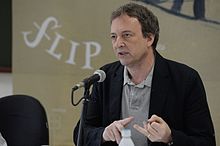
Misha Glenny
Journalist
9
APPEARANCES
8
PODCASTS
Sep 3, 2026


Misha GlennyGUEST
Or what you'll see is you'll see one camera angle and then two days later you'll see another camera angle which tells a very different story or which adds a factor which changes the substance of the story combined, of course, with the absurdity of senior politicians denying what we can all see.
Misha GlennyGUEST
Well, obviously the question... goes straight to the heart of what has happened with internet technologies in terms of reporting the news.
Misha GlennyGUEST
It's not so much that there is fake news around, because there's always been fake news.
Misha GlennyGUEST
You've always had people who have said, well, you can take the protocols of the elders of Zion, for example, in the early 20th century, essentially anti-Semitic Tract, which was written by a mischievous Russian, but which to this day is used by anti-Semitic forces of this type and that to justify their prejudice, even though it's completely fake news.
13 MINS LATER

speaker_0UNKNOWN
[laughing]
Misha GlennyGUEST
I mean, three companies providing cybersecurity services to the FBI have been hacked.
Misha GlennyGUEST
I mean, is nothing sacred anymore, for heaven's sake? Anyway, this mysterious group, Anonymous, and they would say this themselves, they are providing a service by demonstrating how useless companies are at protecting our data.
Misha GlennyGUEST
They say that governments are trying to take over the internet and control it, and that they, Anonymous, are the authentic voice of resistance, be it against Middle Eastern dictatorships, against global media corporations, or against intelligence agencies, or whoever it is.
11 MINS LATER
speaker_3UNKNOWN
[laughs]


Misha GlennyGUEST
The last four years I've been in Vienna running an advanced studies institute and dealing with academics and research all the time.
Misha GlennyGUEST
I've taught as a visiting professor at University College London at the LSE and at Columbia University in New York.
Misha GlennyGUEST
public outreach with broadcasting to try and make difficult but important subjects comprehensible.
6 MINS LATER
13:49
I wonder if we're going to see more subjects like that, perhaps delving into tech a little bit more?

PaulHOST
Can you tell us something about it?
Misha GlennyGUEST
Well, it was part of the Ottoman Empire for a long time, but the Ottomans found it difficult to keep Montenegro entirely under control.
Misha GlennyGUEST
It's very mountainous, and then it drops down steeply onto the coast, which, with some glorious beaches... on the Adriatic, just opposite Italy and just north of Albania, south of Croatia.
Misha GlennyGUEST
A lot of Serbs claim Montenegrin roots and they speak the same language with a dialectical variation in Montenegro.
Misha GlennyGUEST
But during the war in the 1990s, it was first of all allied with Serbia, but during the war it broke with Serbia and became an important country trying to drive a wedge between various factions of the Serbs and Montenegrins.
PaulHOST
Why does it find the allure of the European Union so hot? I saw a Eurobarometer poll last year suggesting that 83% of citizens of Montenegro tend to trust the EU.


Misha GlennyGUEST
Well, it's actually slightly different from Berlin because Berlin aft- in 1945 was divided into four zones.
Misha GlennyGUEST
Vienna was divided into four zones, but in the middle, there was the international zone where all four powers held jurisdiction, and that's where most of the, the action takes place.
Misha GlennyGUEST
There was also an interesting thing is, is that the British zone, outside of the international zone, dissected two Russian zones, which was not the case in, in Berlin.
Misha GlennyGUEST
The other thing about Vienna, two things which one needs to, to know about it historically, is that, first of all, the Allies were trying to split Germany from Austria after the Second World War.
Misha GlennyGUEST
And so they had done a deal in 1944 whereby they agreed that Austria would be determined as the first victim of Nazism, and Berlin and Germany was the responsible power.
Misha GlennyGUEST
And this meant that they had a different approach to Austria than they had to Germany.
37 MINS LATER

Misha GlennyGUEST
Um, I was a BBC foreign correspondent for many years, covering the collapse of communism in Eastern Europe and then the fall of, uh, Yugoslavia.
Misha GlennyGUEST
And after that, I wrote a variety of books, including, uh, a, a big history of the modern Balkans.
Misha GlennyGUEST
I wrote a book about the favelas of Brazil, and more recently, I've been looking a lot at technology and science.

Justin WebbMODERATOR
So, Misha, how does it change now?
Misha GlennyGUEST
I am hugely honored to be taking this role on, but I don't want to go in and smash up the china, as it were.
Justin WebbMODERATOR
Tell us about the way in which you've gone from there to here.
Justin WebbMODERATOR
So, Misha, how does it change now?
Misha GlennyGUEST
Well, [clears throat] first of all, I want to say, try stepping into these boots.
Misha GlennyGUEST
I am hugely honored to be taking this role on, but I don't want to go in and smash up the china, as it were.
Misha GlennyGUEST
I want to do what Melvin has been doing very well, I mean, brilliantly, for so many years, and I need to get my feet under the table.
Justin WebbMODERATOR
Tell us about the way in which you've gone from there to here.

Misha GlennyGUEST
Well, first of all, the past week has demonstrated that diplomatically, neither the United States nor the European Union are really quite aware of what they're doing.
Misha GlennyGUEST
So these talks overnight in Geneva between the representatives of the Ukrainian government and the US are very important in as much that not only has the US come out and said that it understands the changes that Ukraine requires, but the European Union understands.
Misha GlennyGUEST
and the United Kingdom were represented there by national security advisors, in particular Jonathan Powell, who has a track record of being able to persuade the Americans to come down.
Misha GlennyGUEST
Trump will not follow through on his ultimatum of the Ukrainians have to accept a deal or just deal with the Russian war machine by Thanksgiving, i.e. this coming Thursday.